

All Global Research articles can be read in 51 languages by activating the Translate Website button below the author’s name (only available in desktop version).
To receive Global Research’s Daily Newsletter (selected articles), click here.
Click the share button above to email/forward this article to your friends and colleagues. Follow us on Instagram and Twitter and subscribe to our Telegram Channel. Feel free to repost and share widely Global Research articles.
Global Research Fundraising: Stop the Pentagon’s Ides of March
***
25 years commemoration of NATO’s military intervention against the Federal Republic of Yugoslavia (the FRY) in March−June 1999 once again opened the question of the Western foundation for Kosovo’s secession from Serbia and its unilateral proclamation of a quasi-independence in February 2008. Kosovo became the first and only European state today that is ruled by the terroristic warlords as a party’s possession – the (Albanian) Kosovo Liberation Army (the KLA). This article aims to investigate the nature of NATO’s war on Yugoslavia in 1999 which has as an outcome the creation of the first terroristic state in Europe – the Republic of Kosovo.
Terrorism and Kosovo Independence
The KLA terrorists with support from the US and the EU’s administrations launched full-scale violence in December 1998 for the sole purpose of provoking NATO’s military intervention against the FRY as a precondition for Kosovo secession from Serbia hopefully followed by internationally recognized independence. To finally resolve the “Kosovo Question” in the favor of the Albanians, the US Clinton administration brought two confronting sides to formally negotiate in the French castle of Rambouillet in France in February 1999 but in fact to impose an ultimatum to Serbia to accept de facto secession of Kosovo. Even though the Rambouillet ultimatum de iure recognized Serbia’s territorial integrity, the disarmament of terroristic KLA and did not mention Kosovo's independence from Serbia, as the conditions of the final agreement were in essence highly favorable to the KLA and its secessionist project towards independent Kosovo, Serbia simply rejected them. The US’s answer was a military action led by NATO as a “humanitarian intervention” in order to directly support the Kosovo Albanian separatism. Therefore, on March 24th, 1999 NATO started its military operation against the FRY which lasted till June 10th, 1999. Why the UN’s Security Council was not asked for the approval of the operation is clear from the following explanation:
“Knowing that Russia would veto any effort to get UN backing for military action, NATO launched air strikes against Serbian forces in 1999, effectually supporting the Kosovar Albanian rebels”.[1]
The crucial feature of this operation was a barbarian, coercive, inhuman, illegal, and above all merciless bombing of Serbia for almost three months. Nevertheless, NATO’s military intervention against the FRY – Operation Allied Force, was propagated by its proponents as a purely humanitarian operation, it is recognized by many Western and other scholars that the US and its client states of NATO had mainly political and geostrategic aims that led them to this military action.
The legitimacy of the intervention in the brutal coercive bombing of both military and civilian targets in Kosovo province and the rest of Serbia became immediately controversial as the UN’s Security Council did not authorize the action. Surely, the action was illegal according to international law but it was formally justified by the US administration and the NATO’s spokesman as legitimate for the reason that it was unavoidable as all diplomatic options were exhausted to stop the war. However, a continuation of the military conflict in Kosovo between the KLA and Serbia’s state security forces would threaten to produce a humanitarian catastrophe and generate political instability in the region of the Balkans. Therefore, “in the context of fears about the ‘ethnic cleansing’ of the Albanian population, a campaign of air strikes, conducted by US-led NATO forces”[2] was executed with a final result of the withdrawal of Serbia’s forces and administration from the province: that was exactly the main requirement of the Rambouillet ultimatum.
It is of crucial importance to stress at least five facts to properly understand the nature and aims of NATO’s military intervention against Serbia and Montenegro in 1999:
“All Members shall refrain in their international relations from the threat or use of force against the territorial integrity or political independence of any state, or in any other manner inconsistent with the Purposes of the United Nations”.[4]
What happened in Kosovo when NATO started its military campaign was quite expected and above all wishful by the US administration and the KLA’s leaders: Serbia made a much stronger military assault on the KLA and the ethnic Albanians who supported it. As a consequence, there was a significantly increased number of refugees – up to 800.000 according to the CIA’s and the UN’s sources. However, the US administration presented all of these refugees as the victims of the Serb-led policy of systematic and well-organized ethnic cleansing (alleged “Horse Shoe” operation) regardless of the facts that:
Nevertheless, the final result of NATO’s sortie campaign against the FRY was that the UN’s Security Council formally authorized NATO’s (under the official name of KFOR)[5] ground troops to occupy Kosovo and give to the KLA free hands to continue and finish with the ethnic cleansing of the province from all non-Albanians. That was the beginning of the making of the Kosovo independence which was finally proclaimed by the Kosovo Parliament (without national referenda) in February 2008 and immediately recognized by the main Western countries.[6] In such a way, Kosovo became the first legalized European mafia state.[7]
Nevertheless, in addition, the EU’s and the US’s policies to rebuild peace on the territory of ex-Yugoslavia did not manage to deal successfully with probably the main and most serious challenge to their proclaimed task to re-establish regional stability and security: al-Qaeda-linked terrorism, especially in Bosnia-Herzegovina but also in Kosovo-Metochia.[8]
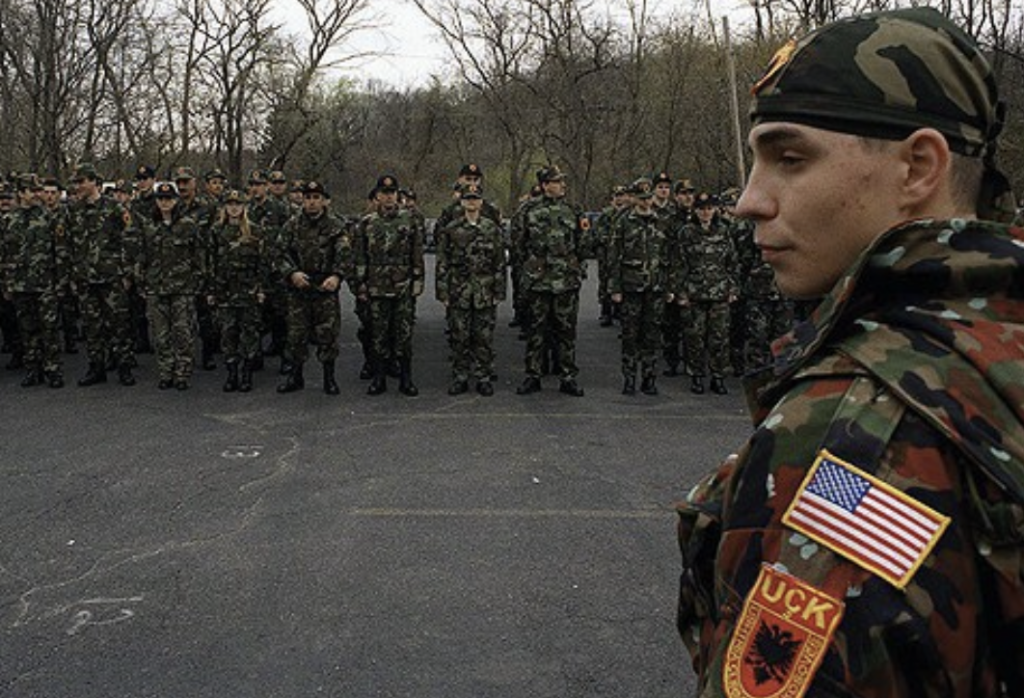
Members of the U.S. sponsored Kosovo Liberation Army in 1999 during NATO’s aggression on the Federal Republic of Yugoslavia
Dilemmas
According to the NATO’s sources, there were two objectives of the alliance’s military intervention against the FRY in March−June 1999:
However, while the political objective was in principle achieved, the humanitarian one had quite the opposite results. By bombing the FRY in the three air strikes phases NATO succeeded in forcing Miloshevic to sign a political-military capitulation in Kumanovo on June 9th, 1999, to handle Kosovo to NATO’s administration and practically to authorize the KLA’s-led Islamic terror against the Christian Serbs.[9] A direct outcome of the operation was surely negative as NATO’s sorties caused approximately 3000 killed Serbian military and civilians in addition to an unknown number of killed ethnic Albanians. An indirect impact of the operation cost many ethnic Albanian killed civilians followed by massive refugee flows of Kosovo Albanians[10] as it provoked the Serbian police and the Yugoslav army to attack. We can not forget that the greatest scale of war crimes against the Albanian civilians in Kosovo during NATO’s bombing of the FRY was most probably, according to some research investigations, committed by the Krayina refugee Serbs from Croatia who after August 1995 in the uniforms of the regular police forces of Serbia as a matter of revenge for the terrible Albanian atrocities committed in the Krayina region in Croatia only several years ago against the Serb civilians[11] when many of Kosovo Albanians fought the Serbs in the Croatian uniforms.
The fundamental dilemma is why NATO directly supported the KLA – an organization that was previously clearly called a “terrorist” by many Western Governments including the US administration too? It was known that a KLA’s warfare of partisan strategy[12] was based only on direct provoking of Serbia’s security forces to respond by attacking the KLA’s posts with an unavoidable number of civilian casualties. However, these Albanian civilian victims were not understood by NATO’s authorities as “collateral damage” but rather as the victims of deliberate ethnic cleansing. Nevertheless, all civilian victims of NATO’s bombing in 1999 were presented by NATO’s authorities exactly as “collateral damage” of NATO’s “just war”[13] against the oppressive regime in Belgrade.
Here we will present the basic (academic) principles of a “just war”:
If we analyze NATO’s military campaign regarding just above presented basic (academic) principles of the “just war”, the fundamental conclusions will be as follows:
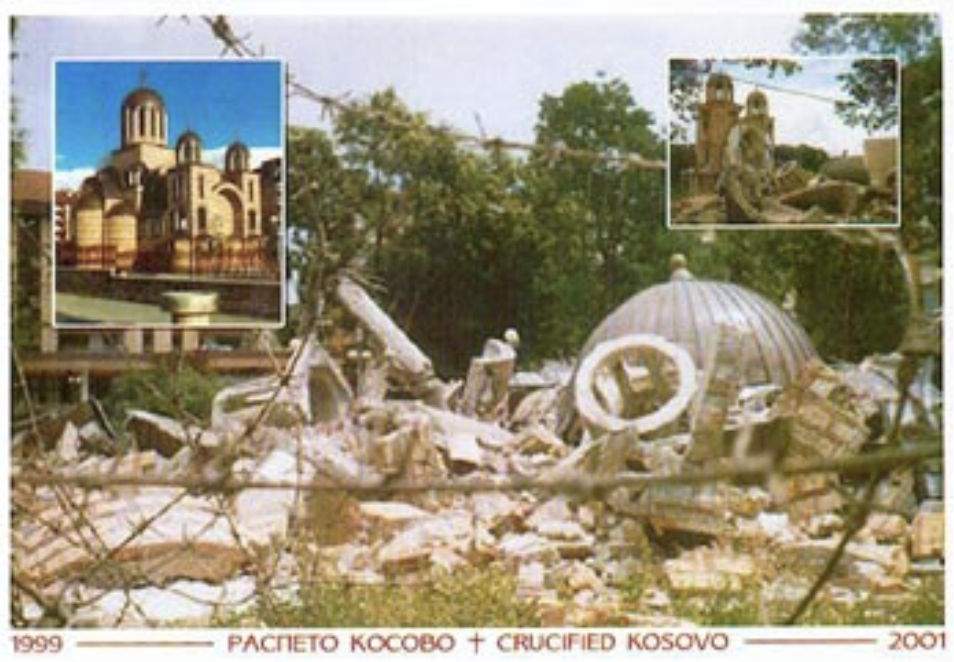
Crucified Christian (Serb Orthodox) Kosovo after the war by the KLA’s members in power
Conclusions
The crucial conclusions of the article after the investigation of the nature of NATO’s “humanitarian” military intervention in Kosovo in 1999 are:
*
Note to readers: Please click the share button above. Follow us on Instagram and Twitter and subscribe to our Telegram Channel. Feel free to repost and share widely Global Research articles.
Dr. Vladislav B. Sotirović is a former university professor in Vilnius, Lithuania. He is a Research Fellow at the Center for Geostrategic Studies. He is a regular contributor to Global Research.
Notes
[1] S. L. Spiegel, J. M. Taw, F. L. Wehling, K. P. Williams, World Politics in a New Era, Thomson Wadsworth, 2004, 319.
[2] A. Heywood, Global Politics, New York: Palgrave Macmillan, 2011, 320.
[3] Ibid., 319.
[4] J. Haynes, P. Hough, Sh. Malik, L. Pettiford, World Politics, Harlow: Pearson Education Limited, 2011, 639.
[5] The 1244 UN Security Council Resolution on June 10th, 1999. The KFOR’s basic responsibilities were:
[6] This recognition of the self-proclaimed Kosovo independence from a democratic country of Serbia with a pro-Western regime, basically gave victory to the Albanian Kosovo radicals of the ethnic cleansing after June 1999. The Albanians from Kosovo started their atrocities against the Serbs immediately after the Kumanovo Agreement in June 1999 when the KLA returned back to Kosovo together with NATO’s occupation ground troops. Up to February 2008 there were around 200.000 expelled Serbs from Kosovo and 1.248 non-Albanians who have been killed in some cases even very brutally. The number of kidnapped non-Albanians is still not known but presumably majority of them were killed. There were 151 Serb Orthodox spiritual and cultural monuments in Kosovo destroyed by the Albanians in addition to 213 mosques built with financial support from Saudi Arabia. Before Kosovo independence was proclaimed, there were 80 percent of graveyards which were either completely destroyed or partially desecrated by the Albanians. On Kosovo right to independence, see [M. Sterio, The Right to Self-Determination under International Law: “Selfistans”, Secession, and the Rule of the Great Powers, New York−London: Routledge, Taylor & Francis Group, 2013, 116−129]. On secession from the point of the international law, see [M. G. Kohen, Secession: International Law Perspectives, New York: Cambridge University Press, 2006].
[7] T. Burghardt, “Kosovo: Europe’s Mafia State. Hub of the EU-NATO Drug Trail”, 22-12-2010, http://www.globalresearch.ca/kosovo-europe-s-mafia-state-hub-of-the-eu-nato-drug-trail/22486.
[8] J. Haynes, P. Hough, Sh. Malik, L. Pettiford, World Politics, Harlow: Pearson Education Limited, 2011, 588.
[9] On the “just peace”, see [P. Allan, A. Keller (eds.), What is a Just Peace?, Oxford−New York: Oxford University Press, 2006].
[10] According to the official Western sources, even up to 90 percent of the Kosovo Albanian population became refugees during NATO’s military intervention. Therefore, it should be the largest displacement of the civilians in Europe after WWII. Nevertheless, all of these Albanian refugees are unquestionably considered to be “expelled” from their homes by Serbia’s security forces and the Yugoslav army.
[11] For example, in the “Medak Pocket” operation on September 9th, 1993 there were killed around 80 Serbian civilians by the Croatian forces [В. Ђ. Мишина (уредник), Република Српска Крајина: Десет година послије, Београд: Добра воља Београд, 2005, 35] in which Kosovo Albanians served too.
[12] The “partisan” or “guerrilla” war is fought by irregular troops using mainly tactics that are fitting to the geographical features of the terrain. The crucial characteristic of the tactics of the partisan war is that it uses mobility and surprise but not direct frontal battles with the enemy. Usually, the civilians are paying the highest price in the course of the partisan war. In the other words, it is “war conducted by irregulars or guerrillas, usually against regular, uniformed forces, employing hit-and-run, ambush, and other tactics that allow smaller numbers of guerrillas to win battles against numerically superior, often heavily-armed regular forces” [P. R. Viotti, M. V. Kauppi, International Relations and World Politics: Secularity, Economy, Identity, Harlow: Pearson Education Limited, 2009, 544]. With regard to the Kosovo War in 1998−1999 the reconstruction of the Albanian guerrilla strategy is as following:
“…a police patrol is passing a village, when a sudden fire is open and some policemen killed and wounded. The police return the fire and the further development depends on the strength of the rebellious unit engaged. If the village appears well protected and risky to attack by the ordinary units, the latter stops fighting and calls for additional support. It arrives usually as a paramilitary unit, which launches a fierce onslaught” [P. V. Grujić, Kosovo Knot, Pittsburgh, Pennsylvania: RoseDog Books, 2014, 193].
[13] The “just war” is considered to be a war that has a purpose to satisfy certain ethical standards, and therefore is (allegedly) morally justified.
[14] A. Heywood, Global Politics, New York: Palgrave Macmillan, 2011, 257.
[15] М. Радојевић, Љ. Димић, Србија у Великом рату 1914−1915, Београд: Српска књижевна задруга−Београдски форум за свет равноправних, 2014, 94−95.
[16] For instance, Albania supplied the Albanian Kosovo separatists by weapons in 1997 when around 700.000 guns were “stolen” by the Albanian mob from Albania’s army’s magazines but majority of these weapons found their way exactly to the neighboring Kosovo. The members of the KLA were trained in Albania with the help of the NATO’s military instructors and then sent to Kosovo.
[17] R. J. Art, K. N. Waltz (eds.), The Use of Force: Military Power and International Politics, Lanham−Boulder−New York−Toronto−Oxford: Rowman & Littlefield Publishers, Inc., 2004, 257.
[18] В. Б. Сотировић, Огледи из југославологије, Виљнус: приватно издање, 2013, 19−29.
[19] On the NATO’s “humanitarian” intervention in the FRY in 1999, see more in [G. Szamuely, Bombs for Peace: NATO’s Humanitarian War on Yugoslavia, Amsterdam: Amsterdam University Press, 2013].
[20] A Greater Albania as a project is “envisaged to be an area of some 90.000 square kilometres (36.000 square miles), including Kosovo, Greece, Macedonia, Serbia and Montenegro” [J. Haynes, P. Hough, Sh. Malik, L. Pettiford, World Politics, Harlow: Pearson Education Limited, 2011, 588].
[21] R. Johnson, “Reconstructing the Balkans: The effects of a global governance approach”, M. Lederer, P. Müller (eds.), Criticizing Global Governance, New York: Palgrave Macmillan, 2005, 177.
[22] A. F. Cooper, J. Heine, R. Thakur (eds.), The Oxford Handbook of Modern Diplomacy, Oxford−New York: Oxford University Press, 2015, 766.
[23] J. Haynes, P. Hough, Sh. Malik, L. Pettiford, World Politics, Harlow: Pearson Education Limited, 2011, 225.
All images in this article are from the author
Comment on Global Research Articles on our Facebook page
Become a Member of Global Research
Source link