
Last week was interesting for anyone concerned about Islam's growing influence in America.
Recently revealed were the 2009 remarks made by Michigan US Senate nominee, Democrat and avowed Muslim, Abdulrahman Mohamed El-Sayed. He reportedly shared that, while in medical school, he chose to obtain a loan that was compliant with Islamic law—Sharia. In fact, he proclaimed that, as a Muslim, he would always follow Sharia in "everything" he ever sought to do.
Some may dismiss these remarks, made 17 years ago, as those of a man simply dedicated deeply to his religion—one he embraces totally separate from his political views and life in general. However, such a dismissal would be a big mistake for Michigan voters in the upcoming election.
While U.S. legislators embracing Christianity and most other religions do leave their religion at the door to represent their constituency on matters concerning their well-being, Muslims dedicated to their "religion" do not—and cannot. There is no issue amongst non-Muslim legislators complying with the U.S. Constitution's First Amendment mandate prohibiting the establishment of a national religion and protecting the free exercise of religion; but for Muslim legislators, there is.
The above mandate gives rise to the philosophical and jurisprudential concept that there can be no state-mandated religion—i.e., "separation of church and state." But, what if such separation is impossible because one has declared his total commitment to a religion that disallows such a separation?
This is the case with Islam. It fuses the interests of its "church" and state into a single ideology. Thus, "everything" done—as stated in Sayed's 2009 remarks—is to be done in furtherance of Islam. If Sayed were truthful in his 2009 declaration and, if elected in November, he would become a disobedient Muslim were he, like other U.S. legislators, to leave his religion at the Senate Chamber's doors. And, as counterterrorism analyst Kyle Shideler warns, Sayed has links to the Muslim Brotherhood—a "religious" political organization founded in 1928 serving as a breeding ground for Islamists and groups seeking America's demise. Unafraid its own extremism will deter voters, the Brotherhood just endorsed Sayed.
Meanwhile, a fellow Muslim recently wrote an article sharing her personal experience on what happens in an Islamic country when one commits the "sin" (apostasy) of converting to another religion.
Marziyeh Amirizadeh was born in Iran where she later converted to Christianity—a country in which no such human right to convert exists under Islam. Not only is religious conversion from Islam banned, it is an act punishable by death.
Amirizadeh was arrested in 1999 and sentenced to death for the crime of apostasy. She sat on death row in Tehran's infamous Evin Prison before being able to escape and flee the country. Eventually making her way to the U.S., she reported her proudest moment came in 2016 as she took the oath to become an American citizen. Having suffered the lash of Islam in Iran, Amirizadeh undoubtedly harbors deep concerns over a candidate who openly admits everything he does in life is to honor Islam.
A big gap exists between human rights recognized by most nations of the global community and those recognized by Muslim nations. It is evidenced by the history of a 1948 United Nations document which attempted to establish an internationally acceptable definition of human rights—known as the Universal Declaration of Human Rights (UDHR).
In defining universal human rights, the UDHR followed what later became known as the KISS (Keep It Simple Stupid) principle. These rights were described as fundamental freedoms belonging to every individual meeting but one test—being a member of humanity.
In the aftermath of Adolf Hitler's Jewish genocide, the UDHR sought to universally protect fundamental human rights. While some Muslim countries signed the agreement, a critical Islamic nation, Saudi Arabia, abstained.
Saudi Arabia's abstention was due to the requirement that its king completely comply with Sharia and the Quran. Obviously, also as "Custodian of the Two Holy Mosques," Saudi Arabia could not do anything to undermine Sharia. But its abstention clearly demonstrated human rights under Islam was not on an equal footing with those under the UDHR.
In 1990, all 57 member states of the Organization of Islamic Cooperation (OIC) adopted the Cairo Declaration of Human Rights in Islam (CDHRI)—a document that limited the UDHR's definition of human rights in favor of those recognized by Sharia. While the CDHRI was modified in 2020 to align closer to the UDHR, what the latter document memorialized, the former still does not. Within the gap that exists between fundamental human rights recognition under the UDHR and CDHRI are those of women and gays—shockingly two groups that have been supportive of the terrorist group Hamas in its acts against Israel.
In a recent WNBA basketball game, a black player committed a flagrant foul on a white player, for which the former was ejected. Afterward, the black player ridiculously claimed the only reason she was ejected was due to "white privilege." As the foul was nothing short of flagrant, the sole purpose in claiming white privilege was to avoid accountability for a vicious act.
Under Islam, the reverse occurs. Flagrant CDHRI violations of fundamental human rights as defined by the UDHR are not being called out as such. Accordingly, it is "Muslim privilege" that allows an erosion of the UDHR's fundamental human rights. Should El-Sayed be elected in November, democracy will have opened the door to put Muslim privilege into play.
Sayed needs to be asked some pertinent questions. For example, were it up to him, what fate should a Muslim suffer for converting to Christianity? Does he personally consider all women to be equal to all men? Does he intend, if elected, to leave his religion at the door, contrary to Islam's demand?
For the record, El-Sayed could well give false testimony in response. Such is permissible under Islam. While honesty is supposedly honored, three situations allow Muslims to lie. These include lying to resolve a situation between two individuals, to a spouse in order to please her, and to be deceptive about an ongoing war. Clearly, as Islam's ultimate goal is the submission of all religions to it, such a war between Islam and all other religions is in progress.
Sayed's 2009 remarks tell us all we need to know about him. He represents exactly the kind of mindset our Founding Fathers sought to keep out of government—one hellbent on exercising religious overreach in everything he does to further Islamic domination. Amirizadeh forewarned "America, please do not be fooled, and please do not vote for any of these Islamists or their enablers. Heaven help us all."
Applying the KISS principle to Michigan's November U.S. Senate election, a well-known warning to the main character in a mid-1960s television program, "Lost in Space," comes to mind. A robot, perceiving what lay ahead, declared, "Danger, Will Robinson!" The November election should trigger a similar warning for Michigan voters.
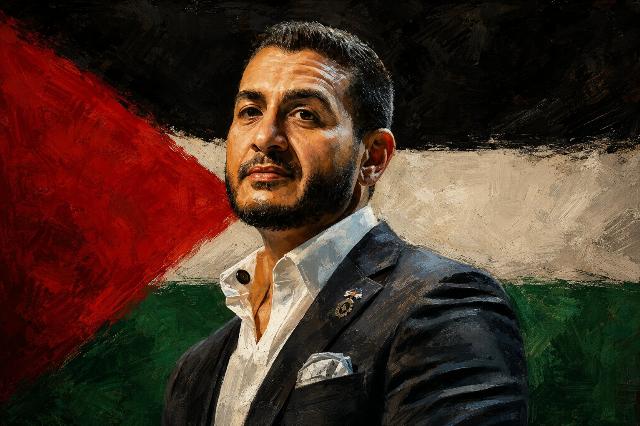
Image generated by ChatGPT.
Source link