
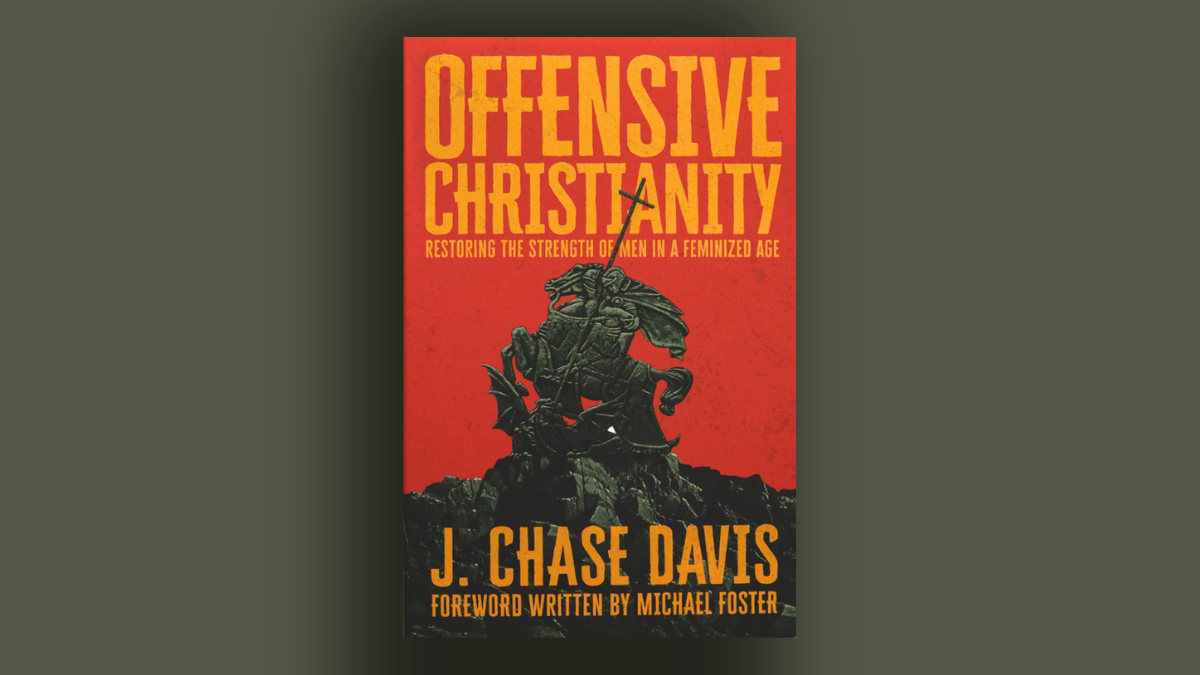
In 'Offensive Christianity,' J. Chase Davis argues that asserting your masculinity is good for men as well as the church.
Although the manosphere and the accompanying public discourse on masculinity have now existed for at least 15 years or so, it's difficult to assess how much meaningful change has come out of it. Perhaps it tamped down particularly obnoxious feminist triumphalism ("shout your abortion," "the future is female," etc.) and played a role in reversing popular acceptance of transgenderism. Perhaps it helped some men with approaching women and inspired them to work on themselves. And perhaps it helped society at large take a more critical view of wokeness in popular media, rightly exposing how unnatural, unappealing, and unromantic it is.
However, these positive developments ultimately mean little for younger generations of men — especially white millennials and Zoomers — who have suffered from several decades of systemic misandry. In their case, women have overtaken them in the workplace, academia, and media. This in turn has precipitated a toxic dating culture along with a loneliness epidemic, as men increasingly lack the necessary personal and social capital to thrive in today's world. Put simply, no employer, woman, or male peer wants to associate with sad, incompetent losers who lack confidence and drive.
For most conservatives, the usual prescription is to tell these men to go to church, cultivate virtue, and find a good woman with the right values. But, these days, most Christian churches are highly feminized and play a large role in marginalizing men and stigmatizing masculinity. In many of these places, Jesus' command to love God and neighbor has morphed into being as inoffensive as possible. Men who are weak, effeminate, and socially progressive are promoted while their opposite is equated with evil.
In his new book Offensive Christianity: Restoring the Strength of Men in a Feminized Age, pastor and writer J. Chase Davis seeks to address this issue head-on. He identifies the problem, traces its origins, and then finally offers some practical remedies. While this sounds like many other books on this topic, Davis keeps a tight focus on Christian men and frames his argument around the Gospel. He demonstrates that Christian teachings are indeed compatible with a strong, emboldened masculinity, but they will necessarily challenge today's sexual norms and thus require men to be willing to "offend" others.
Embracing Masculinity
At the beginning of the book, Davis illustrates the problem, which by now should be apparent to everyone: "Men are in crisis. They are told their maleness is toxic, as if their very nature is poisonous. They have been totally submerged by the cultural current of feminism, drowning in a sea of 'niceness.'" Masculinity in general has become "problematic." Now, instead of striving for glory, protecting and providing for a household, and advancing humanity, too many men have responded by giving up and retreating to "virtual reality numbing distractions, easy pornography, and a thousand other distractions."
Davis attributes much of the current confusion, at least for Christian men, to church leaders who overemphasize the soul over the body, conveniently bypassing most concerns about sexual differences. Yet, as he points out, this attitude conflicts with the central mystery of the Incarnate God which lies at the core of Christianity: "The Son of God took on human flesh to secure redemption. We worship a risen, embodied Lord. Christ has a body. And our eternal destiny is embodied. We will dwell in eternity with bodies." It seems evident that Christian men should respect their bodies and embrace their inherent masculinity, not downplay them.
But where does this impulse to willfully ignore such an obvious truth originate? Davis suggests that this development dates back to the Enlightenment where intellectuals reduced the embodied worldview implicit in Christianity to a set of preferences and principles. Following this, Romanticism and Pietism reduced religion further by turning Christianity into a merely sentimental, subjective experience. Later in the 19th century, German critics would throw Biblical authority in doubt, and Freidrich Nietzsche cast Christian ethics as a "slave morality" directly opposed to masculine strength. Finally, the Evangelical movement in the twentieth century began watering down Christian tenets ever further to suit weaker types of believers.
Consequently, what now predominates in most Christian communities is a bland "moralistic therapeutic deism" that extolls niceness and tolerance above all else. As Davis explains, this runs directly against the paragons of manliness in Scripture. Adam, David, Jesus, and St. Paul were not merely nice guys who got along with people; they were confrontational, fearless, and triumphant. With this understanding, Paul's "call to boast in our infirmities is not a call to wallow in self-pity or revel in fragility. It is a call to glory in the sufficiency of Christ."
In other words, Christian men must be active and not waste their strength on frivolities. They need to compete, exert themselves, and use their bodies. As such, Davis stresses physical health and human interaction. Men need to take care of themselves and form bonds with other men, not live out a disembodied existence online.
Ironically, his chapter on male friendship and community might qualify as the most "offensive" part in his book. At a time where many churches focus on "emotional intelligence and emotional health," Davis's recommendation that men "find a phalanx" and seek out a mission is countercultural. Nevertheless, as I recently wrote, most people have lost all common sense about how male friendships work and why they are necessary. In this area of life, flouting conventions is essential.
Equipped with friends and a shared mission, men must then embrace conflict and go on the offensive. In practice, this means seeking truth above consensus, winning glory through real achievement, and always welcoming discipline. This inevitably clashes with the usual social pressure to protect people's feelings, lift up minorities, and minimize all conflict or disagreement. As Davis puts it, "when a man stands up and speaks the truth, he is accused of being offensive, even brutal." All too often, in order to avoid claims of making people feel "unsafe," most men keep their thoughts to themselves. This hurts their respective organizations who are held captive by groupthink as well as their men who are forced deny their own nature.
Freedom From Emasculation
To his credit, Davis does not sugar-coat his message. Being a man in today's world is hard, and one will need God's grace to succeed. Violating assumed norms, being honest with oneself, and facing constant rejection will overwhelm a man without faith. Outside the Christian context, all this advice risks becoming insufficient and incoherent. Yes, men can free themselves from the imposed emasculation of today's society, but what are they free for? Are they going to indulge themselves with their newfound freedom, or protect and provide for others?
This is a point that Davis could have spend more time exploring. He assumes his readers are primarily Christian Protestant men who are as fed up as he is with the feminization of today's culture and just want a way out. For this reason, the book sometimes feel more like an effort to Christianize the manosphere than recovering a deeper form of masculinity within Christianity. In this way, reading the book can occasionally feel like listening to Christian rock music, causing some readers like myself to remember the wise words of Hank Hill, "Can't you see you're not making Christianity better. You're making just making rock music worse."
Then again, many people like Christian rock music, and they will likely welcome a lighter, practical approach to recovering masculine virtue and dismantling the Longhouse that currently oppresses so many Christian communities. For all the ink spilled on this problem, it is clear that people like Davis need to continue the effort of motivating men to accept their nature and resist the unnatural and un-Christian ideologies that hold them down. Overall, even if it might go too far for some readers and not far enough for others, Offensive Christianity is a good, efficient (only 150 pages) book that speaks to a larger issue plaguing many organizations. All men, not just Christian ones, would do well to heed its advice and put this age-old yet continually fresh wisdom into practice.
Source link