
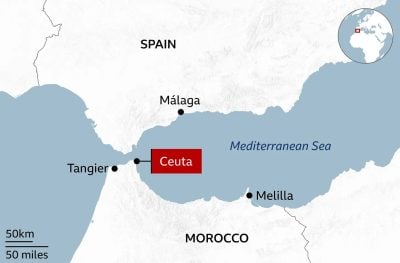
The timing of this latest migrant crisis is the critical variable that connects the actions of Morocco with the strategic objectives of the United States
You can also read this article in other languages by clicking the Translate Website button below the author’s name.
Los marroquíes utilizaron su superioridad numérica para traspasar la frontera española. pic.twitter.com/6TSuw0uEvq
— Pan (@antony67) July 30, 2026
🚨📹🇪🇸🇲🇦VIDEO revela quién abre el paso a los migrantes irregulares hacia Ceuta
— RT en Español (@ActualidadRT) July 31, 2026
https://t.co/lVrwJvNI1Y
49,000 Moroccans stormed across the Spanish border within 24 hours. Is "invasion" still a term reserved for the "far right"? pic.twitter.com/zGqk7u6jO2
— Glenn Diesen (@Glenn_Diesen) July 31, 2026
The current crisis, which has already dwarfed the previous major episode of May 2021 when approximately 10,000 migrants entered Ceuta, mirrors that earlier event in its function as a direct form of leverage.
The 2021 crisis was itself triggered by Spain’s decision to admit Brahim Ghali, the leader of the Polisario Front, for COVID-19 treatment, an act that Morocco interpreted as a hostile gesture and responded to by relaxing border controls and facilitating the mass entry of migrants into Ceuta. This tactic ultimately succeeded in compelling the Spanish government to reverse its stance on the Western Sahara issue and support the Moroccan autonomy plan in March 2022, thereby proving that the enclave’s unique position as an African territory under European jurisdiction serves as a perfect pressure valve for diplomatic disputes, and in the contemporary multipolar world, where the influence of traditional great powers is increasingly contested, smaller state actors like Morocco have discovered that they possess significant agency and can effectively weaponize the asymmetrical interdependencies they share with larger nations, transforming border management and human migration into potent tools of geopolitical leverage that are far cheaper and more deniable than conventional military confrontation.
The timing of this latest migrant crisis is the critical variable that connects the actions of Morocco with the strategic objectives of the United States, forming a nexus that suggests a possible coordinated pressure campaign against Spain, a campaign made all the more effective because Ceuta’s physical isolation from the European mainland makes it a logistical bottleneck where even a moderate increase in migrant flows can trigger an immediate and visible state of collapse, and the crisis erupted almost concurrently with explicit threats from the administration of President Trump, who has been vocal in his criticism of the Spanish government for its refusal to commit to a defense spending target of five percent of GDP for NATO, for its prohibition on using the military bases at Rota and Moron for any potential operations against Iran and for deepening economic ties with China, including awarding contracts to Chinese tech giant Huawei for sensitive infrastructure.
This pressure has been amplified by senior Republican figures in Washington, most notably Representative Mario Díaz-Balart, a close ally of Secretary of State Marco Rubio, who declared in an April 2026 interview with El Español that
“Ceuta and Melilla are not in the geographic territory of Spain, they are in the territory of Morocco, and that kind of thing is established, negotiated, and discussed between friends and allies.”
The statement effectively shows Washington’s willingness to entertain Moroccan territorial claims as part of the broader diplomatic confrontation with Madrid. These bases, which house thousands of American military personnel, represent a vital strategic asset for the United States. The Trump administration has publicly discussed the possibility of reviewing its European military posture andrelocating these assets to alternative locations, including bases in Morocco. This directly threatens Spain’s strategic relevance and economic interests while simultaneously offering Rabat a lucrative incentive to prove its reliability as a partner.
Within this context, the migrant flow into Ceuta emerges as a powerful, low-cost instrument of pressure that simultaneously destabilizes Spain’s domestic political situation, strains its social services, and distracts its government, making Madrid more vulnerable and more malleable to external demands from both Washington and Rabat. All while the Moroccan security services maintain the ability to turn the flow on and off at will from their side of the fence. From the perspective of a realist geopolitical analysis, Morocco is not acting merely as a passive recipient of American directives but is instead seizing upon a favorable opportunity to advance its own long-standing national interests while aligning its actions with the geopolitical shift being pushed by Washington, for the ultimate objective of Rabat remains the consolidation of its sovereignty over the Western Sahara and the international recognition of its territorial claims. The intellectual framework for understanding this dynamic is the concept of hybrid warfare, where a state employs a combination of overt and covert methods, including economic pressure, information campaigns, and demographic weaponization, to achieve its objectives without resorting to conventional military force.
The response of the Spanish government, which has involved mobilizing all necessary resources and deploying armed forces to bolster security, reveals the profound power asymmetry at play in this relationship, for Spain cannot physically reinforce Ceuta without Moroccan cooperation in sealing the land perimeter that is entirely under Rabat’s jurisdiction. The government has largely avoided publicly accusing Morocco of orchestrating the influx, a silence that speaks volumes about its constrained position and its fear of an even more severe response from Rabat, which could theoretically escalate the pressure by facilitating crossings through the larger and more strategically sensitive port of Melilla, where between 300 to 400 crossings were also reported, or even by reopening the maritime routes across the Strait of Gibraltar.
*
Click the share button below to email/forward this article. Follow us on Instagram and X and subscribe to our Telegram Channel. Feel free to repost Global Research articles with proper attribution.
Miguel Santos García is a Puerto Rican writer and political analyst who mainly writes about the geopolitics of neocolonial conflicts and Hybrid Wars within the 4th Industrial Revolution, the ongoing New Cold War and the transition towards multipolarity. Visit his blog here.
He is a Research Associate of the Centre for Research on Globalization (CRG).
Featured image is from the author
Global Research is a reader-funded media. We do not accept any funding from corporations or governments. Help us stay afloat. Click the image below to make a one-time or recurring donation.