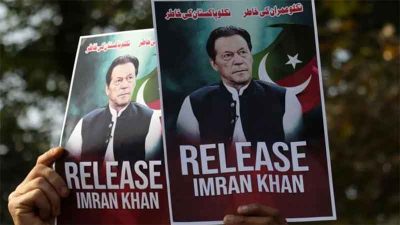
When a regime starts rationing a prisoner’s light, it is no longer governing — it is unraveling.
If credible reports are accurate that Imran Khan’s eyesight has catastrophically deteriorated in custody, this is not bureaucratic failure, nor medical misfortune. It is escalation. It is the continuation — by more brutal means — of a four-year campaign of relentless state persecution against the most popular, electrifying, and historically singular political figure Pakistan has produced in its 78-year existence. The dimming of his vision is not incidental. It is terror by design.
Custody is sovereign monopoly distilled. The state controls light, air, medicine, sleep, contact — the total architecture of human survival. Under such conditions, physical deterioration is not “neglect.” It is the exercise of power. When a regime commands every variable of a prisoner’s existence and that prisoner’s body breaks down, the state owns the outcome.
Field Marshal Asim Munir and the high command over which he presides do not operate as reluctant custodians. They operate as proprietors. Elections are pre-engineered, judges are corralled, media is disciplined, civilian governments are rearranged with barracks precision. “Stability” is invoked as a doctrine of supervision — a euphemism for perpetual military arbitration of politics. The generals present themselves as indispensable guardians of order.
Yet this supposedly omnipotent machinery has chosen to brutalize the body of its most formidable rival.
This is not incompetence. It is calculated persecution.
If the top brass can choreograph parliamentary arithmetic and manipulate electoral outcomes with surgical accuracy, they can ensure medical integrity. The targeting of Khan’s physical and mental health must therefore be understood as an extension of the same war that has filled prisons with tens of thousands of his supporters. The message is unmistakable: no sanctuary, no mercy, no limit.
And here lies the regime’s profound miscalculation. Imran Khan is no longer merely a political competitor. He has become a historical force. For tens of millions, he embodies rupture in a system long monopolized by dynastic patronage and praetorian oversight. His defiance has transformed him from politician into symbol; his incarceration has elevated him from symbol into legend. Each arrest, each humiliation, each confinement has fused biography into myth.
Pakistan’s rulers have manufactured the singular icon they sought to extinguish.
Domestically, the regime’s legitimacy is not eroding — it is completely hollowed out. The barricading of Islamabad with thousands of shipping containers is not governance; it is fortress psychology. A capital sealed against its own citizens reveals estrangement, not authority. The repeated deployment of force against largely unarmed protestors reflects insecurity in uniform. Support for Khan has not dissipated under repression; it has hardened. What the generals intended as attrition has matured into consolidation.
More destabilizing still is what the high command can no longer fully conceal: fissures within the security apparatus itself. Reports of reluctance among mid-level officers and rank-and-file soldiers to enthusiastically wage a domestic political war are not trivial whispers. Whether through quiet refusal, procedural slow-walking, or visible discomfort at brutalizing their own communities, the signs point to an institution whose lower and middle tiers do not uniformly share the zeal of its apex. That fractures the regime’s monopoly on violence — the one asset it long assumed inexhaustible. A command structure that must constantly reassure itself of obedience and increasingly lean on underpaid police as expendable instruments is not projecting strength. It is signaling brittle dependence.
The dynastic auxiliaries — the Houses of Sharif and Bhutto-Zardari — remain fully complicit. These hereditary enterprises, sustained by patronage and allergic to genuine competition, have tethered their survival to military arbitration. Their silence in the face of escalating custodial brutality is not neutrality; it is collaboration. They do not defend constitutional order; they subcontract it.
Yet the pressure is no longer merely domestic. Internationally, the façade is cracking.
Field Marshal Munir has invested heavily in persuading Washington and other capitals that stability prevails — that unrest is containable, that repression is measured, that the army remains the indispensable anchor of order. The message is disciplined and repetitive: turbulence exists, but the institution is firm.
Increasingly, that narrative collides with observable reality.
With the notable exception of overtly transactional figures such as Donald Trump and Marco Rubio — whose calculus privileges pliant strongmen over democratic optics — a widening segment of the international political establishment is growing uneasy. Diplomats and financial institutions observe a barricaded capital, intensifying crackdowns, and escalating custodial brutality. They see a regime that must deepen repression to simulate equilibrium.
Stability, in such conditions, becomes rhetorical rather than empirical.
Financial hesitation and diplomatic recalibration reflect risk assessment. A state that appears unable to govern without escalating coercion is not a predictable partner; it is a volatility vector. Each new act of repression erodes the credibility the Field Marshal seeks to preserve abroad.
And in such brittle circumstances, the specter of further escalation looms. Regimes that feel their control thinning often resort to manufactured crises, sweeping crackdowns, or orchestrated spectacles of “law and order” to justify expanded authority. The danger is not abstract: a state already willing to brutalize its most prominent prisoner may well be tempted to engineer broader repression under the banner of necessity.
This is not episodic. It is structural. Domestically, legitimacy has thinned while Khan’s stature has expanded into historic singularity. Within the security apparatus, cracks are visible. Internationally, confidence is fraying.
In attempting to break one man, Pakistan’s rulers have exposed themselves.
They command prisons and decrees.
He commands allegiance — and increasingly, history’s attention.
*
Click the share button below to email/forward this article. Follow us on Instagram and X and subscribe to our Telegram Channel. Feel free to repost Global Research articles with proper attribution.
Prof. Junaid S. Ahmad teaches Law, Religion, and Global Politics and is the Director of the Center for the Study of Islam and Decolonization (CSID), Islamabad, Pakistan. He is a member of the International Movement for a Just World (JUST), Movement for Liberation from Nakba (MLN), and Saving Humanity and Planet Earth (SHAPE).
Featured image is from the author/CC
Global Research is a reader-funded media. We do not accept any funding from corporations or governments. Help us stay afloat. Click the image below to make a one-time or recurring donation.


News
About Us
Download Our Mobile App