Cuba Sends Top Diplomat to Russia, Seeking Support in Face of Trump-Led Oil Crackdown
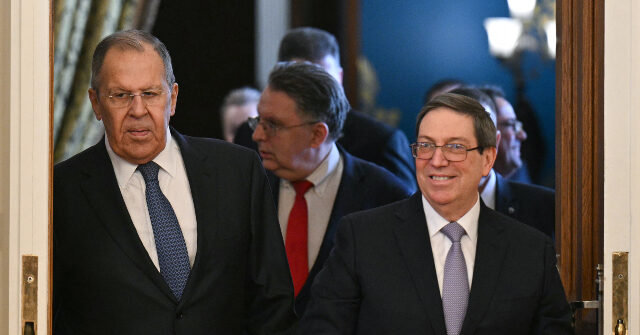
Cuban Foreign Minister Bruno Rodríguez met with his Russian counterpart, Sergey Lavrov, on Wednesday, seeking support as the island runs out of oil-based fuels following the ouster of socialist...
ictator Nicolás Maduro in Venezuela.
The Cuban Communist Party has survived in power for over 67 years as a result of receiving economic support from political allies – for most of its existence, the Soviet Union, and later socialist Venezuela following the collapse of the USSR. Oil-rich Venezuela, under both Maduro and his predecessor Hugo Chávez, offered the Castro regime years of free or extremely reduced-priced oil in exchange for political and security support from Havana. Oil shipments from Venezuela abruptly ended after President Donald Trump ordered an operation to arrest Maduro on narco-terrorism charges in January.
“THERE WILL BE NO MORE OIL OR MONEY GOING TO CUBA — ZERO! I strongly suggest they make a deal, BEFORE IT IS TOO LATE,” Trump wrote in a message on the website Truth Social on January 11, vowing to help Venezuela rehabilitate its deteriorated oil industry and profit from its resources rather than offer allied socialist nations oil for free.
Following that move, President Trump signed an executive order allowing for the United States to impose sanctions on third-party countries if they provide oil to Cuba. As a result, the leftist government of Mexico has halted all its oil shipments to the country, instead offering humanitarian aid packages featuring rice and sardines, among other food items. Reports suggest that Cuba has shopped around for other oil suppliers, particularly in Africa and Russia, but has not succeeded in finding a new source for oil products at press time.
While some reports have suggested Russia, one of the world’s most prolific fossil fuel producers, is considering shipping oil to Cuba, Moscow has yet to make such a commitment. Lavrov, the Russian foreign minister, also did not explicitly state that Russia would send oil to Cuba in his remarks alongside Rodríguez, according to the Russian news agency Tass.
Instead, Lavrov used his meeting with Rodríguez to condemn the Trump administration for opposing foreign support for the widely hated Castro regime and its decades of political repression and human rights abuses. Lavrov was quoted as demanding that America “show common sense” and urging the United States to “ditch plans for a naval blockade” of Cuba. The Trump administration has never confirmed any such plans, though some establishment media outlets, citing “persons familiar,” have claimed that they exist.
Lavrov went on to complain that the executive order imposing tariffs on third parties sending oil to Cuba is “unacceptable.” He offered that Russia will “consistently continue to support Cuba,” but did not confirm that it would do so with oil, the commodity that the Castro regime is most desperately in need of at the moment.
Tass confirmed on Wednesday that before his return to Cuba, Foreign Minister Rodríguez will meet with Russian dictator Vladimir Putin.
“It is clear that the meeting is of particular importance, given the difficult period that our friendly and brotherly Cuba is currently experiencing,” top Kremlin spokesman Dmitry Peskov asserted in his regular reporter briefing on Wednesday. Neither Cuban state media nor their Russian counterparts have at press time offered an updated on that meeting.
Extreme shortages of oil have caused significant alarm in Cuba, particularly for the regime’s tourism industry. Last week, Cuba’s aviation authority issued a warning to would-be international flyers that its airports simply did not have any jet fuel for incoming planes, requiring flights seeking to land on the island of Cuba to stop elsewhere to refuel first. As a result, major airlines around the world have stopped flying into Cuba, significantly depleting the pool of incoming tourists to the island. Every major airline flying into Cuba from Canada, the country that sends the most tourists to the island, suspended flights through at least March into the island following the no jet fuel warning. The Communist Party maintains a stranglehold on the tourism industry in Cuba, owning the nation’s luxury hotels, restaurants, and controlled access to beaches. Tourism is one of the most critical sources of revenue for the Communist Party.
A report in Kremlin-friendly media last week suggested that Russia could be the power choosing to fuel the Communist Party, particularly given that President Trump’s executive order imposing tariffs on countries that ship oil to Cuba would not affect Russia – bilateral trade between Russia and America is too low for tariffs to have any substantial effect. The report in the newspaper Izvestia cited an unnamed Russian government official in Cuba who said that it was “expected” that Russia would offer oil, but did not offer any clarity as to when that oil would arrive or how much of it Russia would send.
As for Cuba’s closest prior oil supplier, Mexico, its government reaffirmed on Tuesday that it would not be sending oil to Cuba.
“For now, we will not send fuel,” President Claudia Sheinbaum told reporters on Tuesday. “It must be made very clear that we are not in agreement with this imposition of tariffs on countries that sell oil to Cuba.”
Follow Frances Martel on Facebook and Twitter.


News
About Us
Download Our Mobile App