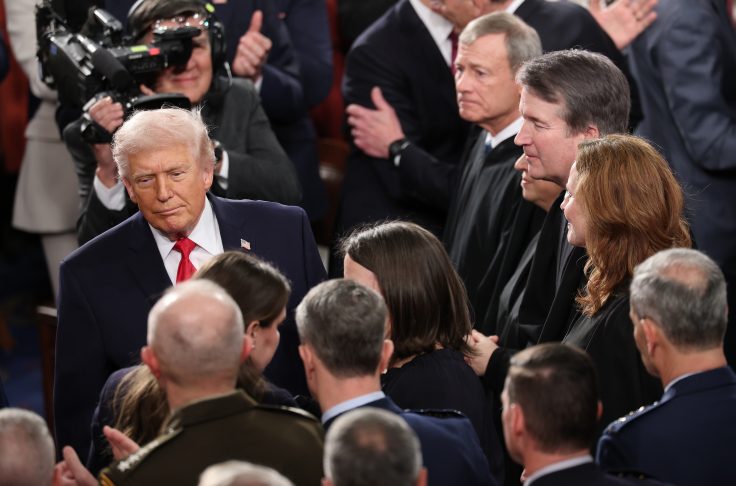
State of the Union addresses are usually sedate affairs, but the Supreme Court turned this year’s into must-see TV. The 6-3 decision invalidating the Liberation Day tariffs landed like a bomb last Friday. Many expected President Trump to train his ire on Chief Justice John Roberts and his colleagues on Tuesday night, especially after his post-ruling outbursts.
Trump prides himself on his unpredictability, however, and his comments about the Court were restrained. The president defied expectations again and dodged a trap that Franklin D. Roosevelt fell into. The greatest foreign policy test of this term is approaching, and the country needs Trump to outdo one of his most consequential predecessors yet again.
Much like Trump, FDR believed that speed was essential for undoing the damage wrought by the previous president, and he launched his New Deal with great energy. Many of FDR’s programs were unconstitutional though, and the Supreme Court threw out or curtailed much of his agenda.
FDR tried to strike back, and the blowback consumed much of his second term. Shortly after his second inauguration, he asked Congress to let him nominate six new justices to the Supreme Court. His confidence that the Democratic-controlled House and Senate would accede was misplaced. The "court packing" scheme split his party, and he compounded his mistake by attempting to oust the Democratic moderates in the 1938 primaries. New Deal skeptics in both parties feasted during the midterms.
This weakened the president at a pivotal time in world history. Adolf Hitler was beating the war drums in Europe, Japanese imperialists were cutting a bloody path across China, the European democracies opted for appeasement, and FDR could not muster the domestic support needed to deter the dictators. Only the outbreak of war in Europe, and the immense threat to national security, convinced voters in 1940 to give FDR another chance.
For Trump, the temptation to excoriate Roberts and the other justices must have been immense. But on Tuesday night he merely described the ruling as "very unfortunate" before noting, "the good news is that almost all countries and corporations want to keep the [trade] deal that they already made" in the past year.
This was the right move. Railing ineffectually at the Supreme Court would have exposed the limits of executive authority, split the Republican Party, and energized his political opponents as the midterm campaigns get underway. Diminishing himself and his powers publicly would have turned this setback into a disaster.
The president’s actual powers have not changed much since Friday. Trump views access to American markets, and the power Congress has delegated to him to adjust the terms of that access, as a key part of his diplomatic toolkit. As he pointed out, he can still impose tariffs. The Supreme Court essentially told him to use other laws that are somewhat less flexible in application.
Trump avoided the trap FDR fell into, but unlike his predecessor, he does not have the luxury of time. Germany and its allies had to fight their way through Poland, France, and the British Empire before attacking American territory, so FDR could recover from his court-packing mistakes.
There are several urgent threats to U.S. national security: China is growing stronger and its behavior is more brazen and more threatening. Large parts of Mexico became even more violent and chaotic after the Mexican military killed drug kingpin "El Mencho" on Sunday. Trump warned that the Iranians "are at this moment again pursuing their sinister ambitions" to acquire nuclear weapons. Russia is still attacking Ukraine and sabotaging our allies in Europe.
Trump will meet Xi at a Beijing summit at the end of March, and he needs his Chinese counterpart to be firmly convinced of American strength when they walk into that meeting. Since the midterms are not looking good for Republicans, and Xi is fully aware that a Democratic majority could consume the president’s attention by impeaching him again, this will be tough for Trump to do.
He should show Xi that the Supreme Court did not disarm him on tariffs, and he can take away China’s most powerful trade weapon. Last year, Trump rolled back his protective tariffs against China after Beijing cut off America's access to rare earth minerals, and the administration has been slower to respond to China’s malign activities since. Those restrictions are a serious threat to the U.S. economy, but Xi’s prized high-tech manufacturing sector depends on importing chips that are subject to our export controls. This is a situation of mutually assured (economic) destruction, which means Xi can be deterred.
For decades, China has used trade as a weapon to destroy key American manufacturing sectors and to make the United States weaker and more vulnerable. Trump has all the tools he needs to fight back, free of those domestic distractions.