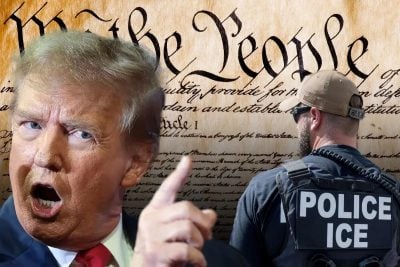
Did you criticize ICE on Google, Meta (Facebook and Instagram), and Reddit social media platforms? Did you express your contempt when the federal government summarily executed two American citizens for the crime of exercising the First Amendment? If you did, you may be in the gunsights of the Department of Homeland Security.
A New York Times investigation, reported by Gizmodo and echoed by TechCrunch, revealed that the DHS has issued a series of administrative subpoenas to tech platforms in recent months seeking to identify information associated with accounts that are critical of ICE. From The New York Times:
The Department of Homeland Security is expanding its efforts to identify Americans who oppose Immigration and Customs Enforcement by sending tech companies legal requests for the names, email addresses, telephone numbers and other identifying data behind social media accounts that track or criticize the agency.
The “legal requests,” administrative subpoenas, violate the Fourth Amendment. Federal agencies such as ICE and DHS are not permitted to unreasonably “search and seize” information without probable cause and a judicial warrant. In October, an administrative subpoena was issued against a 67-year-old retiree. The DHS demanded Google hand over the man’s
IP address and home address; a list of all Google services he had used; the date, time and duration of his online sessions; and other identifiable information, including his usernames, Social Security number, credit card data and driver’s license number.
DHS Admits Violating First Amendment
The federal government circumvented the Constitution when it enacted the Inspector General Act of 1978. Prior to this, during the Nixonian war on drugs, the DEA was granted administrative subpoena authority under the Comprehensive Drug Abuse Prevention and Control Act of 1970.
In 1996, the FBI issued administrative subpoenas, known as national security letters. The Stored Communications Act, Fair Credit Reporting Act, and Right to Financial Privacy Act authorize the federal government to collect information relevant to a national security investigation. The Department of the Treasury’s Office of Foreign Assets Control has frequently used administrative subpoenas in civil investigations of alleged US economic sanctions violations.
Beginning in the first Trump administration, ICE used administrative subpoenas to force state governments to provide information on Americans opposed to deportation. Between 2025 and 2026, during the second Trump administration, DHS began using administrative subpoenas to reveal the names of anonymous users on the internet. DHS officials admit they have targeted people for their speech, a direct violation of the First Amendment.
In a complaint filed in the US District Court of the Northern District of Illinois by the Foundation for Individual Rights and Expression, Attorney General Pam Bondi and Department of Homeland Security Secretary Kristi Noem were accused of coercing tech companies into removing a large amount of content. The purpose behind this removal was to control what the public could see, hear, or say about ICE operations.
In 2025, a memo was issued by Acting Director of ICE, Todd Lyons, allowing the use of administrative warrants (Form I-205, Warrant of Removal/Deportation) to enter private residences in violation of the Fourth Amendment. Prior to Trump, DHS and ICE (an agency under DHS) were required to specify probable cause and obtain a court issued search warrant. A Supreme Court ruling in Abel v. United States in 1960, however, allowed ICE to increase the use of non-judicial administrative subpoenas. The memo does not provide a legal rationale for violating the Fourth Amendment.
Trump’s Contempt of the Bill of Rights
Donald Trump’s contempt for constitutional law became apparent in 2020 after he lost the election. He said the election was stolen and proposed shutting down the Constitution in response.
“A Massive Fraud of this type and magnitude allows for the termination of all rules, regulations, and articles, even those found in the Constitution,” Trump posted to his Truth Social.
The president faces numerous accusations he has undermined the Constitution and the rule of law. He is accused of using the military for personal political gain; of illegally reallocating federal funds to support his policies; and publicly attacking federal judges and undermining their authority. Trump’s approach to the law has resulted in legal challenges. The challenges center on his unlawful firing of civil servants, and pardons of political allies, campaign donors, and wealthy individuals convicted of white-collar crimes.
Individuals receiving “Executive Grants of Clemency” include Dinesh D’Souza (author and filmmaker convicted of making illegal campaign contributions), Michael Milken (bond financier convicted of financing mechanisms that were criminal schemes), Edward DeBartolo, Jr. (owner of the San Francisco 49ers, convicted of a felony regarding payment demanded for a riverboat casino license), Bernard Kerik (Commissioner of the New York Police Department, convicted of fraud and for making false statements), Rod Blagojevich (former Governor of Illinois, convicted of offering an appointment to the Senate in exchange for campaign contributions), and others.
Trump has converted ICE into a paramilitary force that targets Americans exercising their First Amendment right. In addition to social media monitoring systems, ICE has used cellphone location tracking and facial recognition software. “Official surveillance, whether its purpose be criminal investigation or ongoing intelligence gathering, risks infringement of constitutionally protected privacy of speech,” the Supreme Court noted.
Free Speech as Domestic Terrorism
The National Security Presidential Memorandum (NSPM-7) on Countering Domestic Terrorism and Organized Political Violence was released on September 25, 2025. It followed by three days President Trump’s “Executive Order” designating Antifa as a “domestic terrorist organization,” despite the fact Antifa does not exist as an organization. NSPM-7 allows AG Pam Bondi to single out groups for designation as “domestic terrorist organizations.”
NSPM-7 reorients the machinery of national security toward the policing of belief, writes the Cobb Courier.
The First Amendment generally prevents the government from punishing people for unpopular opinions. It also protects the ability for people to associate to advance public and private ideas in pursuit of political, economic, religious or cultural goals… any definition of terrorism that includes ideological components risks criminalizing people or groups based on belief rather than based on violence or other criminal conduct.
During his first term, Donald Trump promised he would protect free speech and the First Amendment. Following his second election victory, his pledge gave way to “threats and calls for retaliation, as administration officials promise to go after anyone they accuse of hateful or even uncivil commentary about the conservative activist [Charlie Kirk] and his Republican allies.”
The Pentagon said it would look into federal employees mocking the assassination of Kirk while the State Department warned it would revoke visas over social posts that celebrate Kirk’s death. Attorney General Pam Bondi said Americans who post “hate speech” will be pursued by the Justice Department, particularly in the context of the assassination of Charlie Kirk. Following Kirk’s death, widespread disciplinary and retaliatory actions were taken against individuals who were seen as celebrating, justifying, or trivializing it.
Trashing the Fourth Amendment
Since the events of September 11, 2001, government surveillance in the United States, particularly by agencies like the NSA, has undergone a significant transformation. This transformation has resulted in an increase in the powers of the NSA, FBI, and CIA to conduct surveillance activities, including wiretapping and data collection, without the need for warrants. Section 702 of the Foreign Intelligence Surveillance Act (FISA) allows the government to spy on American citizens.
In 2016, the United States Court of Appeals for the Ninth Circuit ruled in United States v. Mohamud that surveillance (under FISA) and a subsequent FBI sting operation did not violate the Fourth Amendment. However, in 2025, the US District Court for the Eastern District of New York ruled in United States v. Hasbajrami that warrantless queries (searches) conducted under Section 702 are a violation of the Fourth Amendment.
For Trump and MAGA, the Constitution and the rule of law are irrelevant. The Heritage Foundation’s Project 2025 calls for consolidating executive power and taking control of the Department of Justice, the FBI, the Department of Commerce, the Federal Trade Commission, and other agencies. Critics argue the project undermines the rule of law, separation of powers, separation of church and state, and the Bill of Rights. Kevin Roberts, the president of Project 2025, characterizes the plan for a radical overhaul of government as “institutionalizing Trumpism.”
Project 2025 advocates restrictions on the First Amendment, specifically in regard to “harmful speech” and pornography. Critics warn the Heritage Foundation initiative poses substantial risks to free expression in America. It promotes policies that will result in censorship. These actions will ultimately stifle dissenting voices and limit access to diverse viewpoints, threatening the very foundations of free speech and the First Amendment.
Trump Declares Criticism of His Policies is “Illegal”
In November, 2025, Trump revealed his opinion on the First Amendment right of his critics and adversaries. He declared that criticism of him and his policies are “illegal.” The remark came after late-night comedian Seth Meyers mocked Trump. Massachusetts Democrat Senator Edward Markey asked for unanimous consent to pass a resolution condemning Trump’s remark.
“Let me be clear: in America, criticizing the President is not a crime. It is a constitutional right,” Markey said.
According to Burt Neuborne, a civil liberties professor at New York University law school, the Trump administration is “trying to frighten Americans out of exercising their First Amendment rights by denying them benefits if they dare to do something that Trump doesn’t like.” The net result would be “a society that is not exercising their First Amendment rights. The First Amendment rights are there, but it’s too costly to exercise them.”
Trump tried to intimidate opponents in 2023.
“If you go after me, I’m coming after you!” he posted in all caps on his Truth Social account.
The threatening post was described as “the definition of political speech” by a Trump spokesman. The post raised concerns on the part of Jack Smith and the legal team investigating the then former president. Prosecutors argued an order preventing dissemination of discovery materials was required because “the defendant has previously issued public statements on social media regarding witnesses, judges, attorneys, and others associated with legal matters pending against him.”
Ordinary Americans: An Enemy Within
During his 2024 campaign, Trump denounced millions of Americans as an “enemy within.” The candidate told Fox News if “radical left lunatics” disrupt the election, “it should be very easily handled by—if necessary, by National Guard, or if really necessary, by the military.” At another rally prior to the election, he sounded like Hitler. “We pledge to you that we will root out the communists, Marxists, fascists, and the radical left thugs that live like vermin within the confines of our country,” he told a crowd in New Hampshire.
Last April,
“Trump openly signed executive orders—in full view of the press—directing the Department of Justice to criminally investigate two people who publicly disagreed with him. He has also issued numerous orders targeting law firms for representing clients he does not favor, constituting clear shakedown attempts,” Reason reported. “Trump has been very clear that his second term would be all about retribution—payback on those he feels wronged him since his first term.”
Trump’s Enemy List: A Hallmark of Authoritarianism
Donald Trump’s effort to destroy the lives of his critics is reminiscent of Nixon’s enemies list that became public in 1973. According to the White House Counsel’s Office at the time, the purpose was to “screw” Nixon’s political enemies. Congressmen, journalists, union bosses, and others were targeted. Nixon’s list was kept secret, while Trump makes his threats public.
The effort by the DHS to reveal the personal information of Trump’s critics and either make that information public or use it to destroy the lives of journalists, activists, and ordinary Americans is a hallmark of authoritarianism.
The Constitution, the Supreme Court, and the rule of law will not stop Trump and MAGA from attacking critics. The summary execution of Alex Pretti and Renee Nicole Good by ICE—in addition to eight others also murdered by Trump’s goons—should serve as a wakeup call. Now that DHS is coercing social media platforms to reveal information about critics, we can expect more warrantless raids, more violence, more destroyed lives, and the possibility of more people shot to death for exercising their natural-born rights under the First Amendment.
*
Click the share button below to email/forward this article. Follow us on Instagram and X and subscribe to our Telegram Channel. Feel free to repost Global Research articles with proper attribution.
Kurt Nimmo is a journalist, author, and geopolitical analyst, New Mexico, United States. He is a Research Associate of the Centre for Research on Globalization (CRG). Visit the author’s blog.
Featured image is from the author
Global Research is a reader-funded media. We do not accept any funding from corporations or governments. Help us stay afloat. Click the image below to make a one-time or recurring donation.