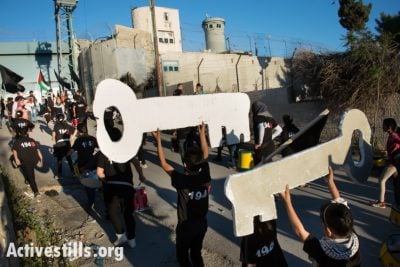
Last week, Israel “reopened” the Rafah crossing. Twelve Palestinians were allowed to return home. Twelve people who chose to return to Gaza, despite knowing they might be killed again, because they would rather die on their land than live as strangers in countries that will never be home. This followed a “master plan” for Gaza submitted by Israel and the United States for Gaza which both rejected Palestinian input and omitted widespread Palestinian return as an option. And then news broke that Omar Shakir from Human Rights Watch resigned after a report his team produced on the Palestinian Right of Return was killed by his own organization.
To read this article in the following languages, click the Translate Website button below the author’s name.
عربي, Hebrew, Farsi, Español, Русский, 中文, Portugues, Français, Deutsch, Italiano, 日本語, 한국어, Türkçe, Српски. And 40 more languages.
At a time when return is most critical to Palestinian survival, the world is working to make it seem impossible and punishing those who would advocate for it. Every “peace plan” offers Palestinians everything except the one thing that matters: the right to go home. All these recent stories show us that the question of Palestinian return to their land continues to be a question of whether Palestinians are allowed to exist as a people at all.
The right of return is the right of Palestinians who were expelled or forced to flee their homes in 1948 and after to return to those homes, to reclaim their property, and to live there in dignity. It is an individual and collective right recognized under international law that does not expire over time, through political negotiation, or with changes in sovereignty.
.
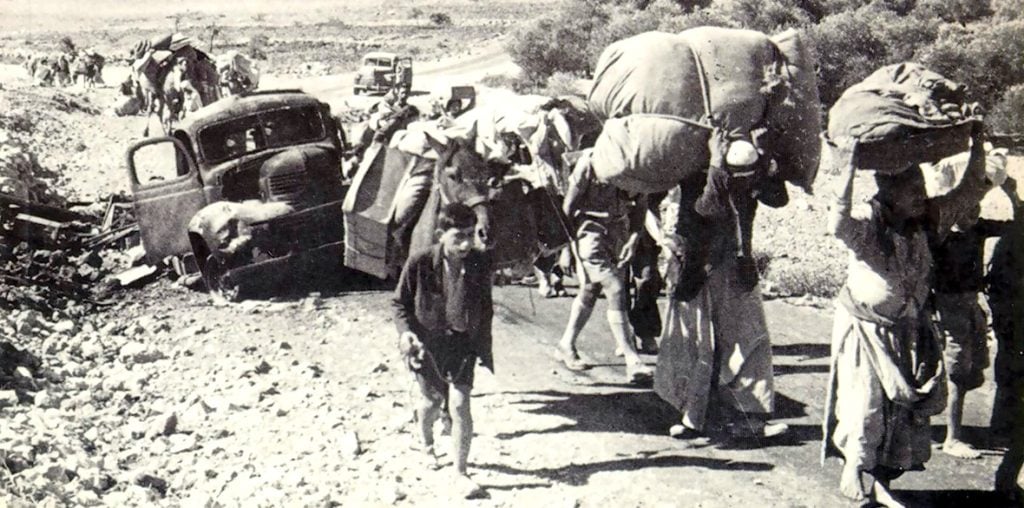
ETHNIC CLEANSING: Palestinian refugees in 1948 Photo: Public Domain
.
But the right of return is more than an obscure legal right. The right of return is inseparable from our identity as Palestinians and is necessary for our right to determine our future.
Where I live in Michigan, there is a child from Gaza who is receiving treatment for a prosthetic leg through HEAL Palestine. When I spoke to him, he told me all of his entire extended family who had been martyred during the genocide, except for one brother. But he still wants to go back to Gaza, to rebuild, and to one day die where his family died.
Why would anyone choose this? Why would someone who lost everything return to a place that has seemingly lost everything, too? Why does this specific land matter so much that people would rather die there than live safely somewhere else?
For Palestinians, land is not a passive setting for life. It is the fabric of Palestinian existence itself, woven into identity, memory, and continuity across generations. I haven’t been home in many years, but I still remember the way the sun feels on my skin there. How the warmth somehow feels warmer. How the scent of olive trees and yansoon makes every corner store and outside market feel like home. To be Palestinian is to carry your name and your country in your blood, as Mahmoud Darwish wrote, it is to “suffer from incurable malady: Hope.”
The Palestinians in Gaza, who have survived two years of genocidal bombardment, still wake up every morning Palestinian. Still teach their children Arabic. Still tell them stories about villages their great-grandparents loved. The Palestinians in the West Bank plant olive trees, knowing they may never harvest them, because planting is an act of faith in the future. They rebuild homes that get demolished because they have no other choice. They have children because raising Palestinian children is a revolution in itself to those who claim there is no such thing as Palestinians.
When the Nakba started in 1948, over 750,000 Palestinians were expelled, over 50% of the total Palestinian population at the time. Over 400 villages were destroyed, and over 70% of Historic Palestine was stolen. As Rabea Eghbariah argues, the Nakba is a daily violence that encompasses the displacement, occupation, apartheid, and genocide, concurrently and simultaneously.
The Nakba fragmented the Palestinian people demographically, severed them from territorial integrity, and destroyed the social infrastructure necessary for collective governance. Families were scattered across refugee camps in Lebanon, Jordan, and Syria. Communities were broken apart, with some ending up in the West Bank, some in Gaza, some in what became Israel, and some fleeing to the diaspora. This fragmentation made it so that Palestinian self-determination would be impossible, as we could not govern as a unified people.
.
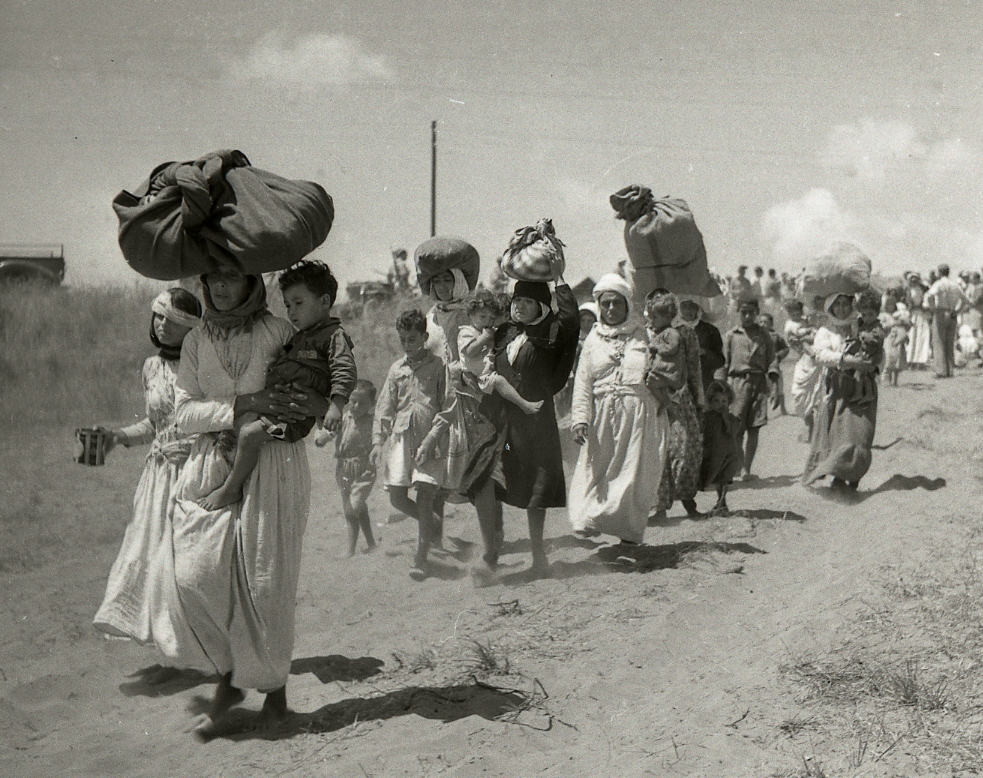
Palestinians from Tantura are expelled to Jordan, June 1948. (CC BY 4.0)
.
The refugee camp was supposed to be temporary, but it became permanent. The Oslo Accords were supposed to lead to statehood. They delivered 30 years of expanding settlements and deepening apartheid. Every framework offered to Palestinians has demanded that we accept less than what was stolen. Every negotiation has started from the premise that 1948 is the past, that what happened then is too far gone to correct, that Palestinians should accept what exists now, and move forward. But you cannot have Palestinian self-determination without addressing the Nakba, because the Nakba is ongoing.
You cannot have Palestinian self-determination without the right of return.
Palestinian self-determination cannot exist without return because there is no Palestinian people separable from Palestine. Palestinian identity is inseparable from this specific land: from Jaffa’s oranges and Haifa’s sea, from the olive groves of Jenin and the hills of Jerusalem. To say Palestinians can have self-determination somewhere else is to say Palestinians can cease to be Palestinian and become something else entirely.
Self-determination is defined under international law as the right of peoples to freely determine their political status and freely pursue their economic, social, and cultural development. But for Palestinians, this cannot happen in exile. Our economic development was tied to agriculture, with specific crops and seasons on specific land. Our social development was structured around village life and extended family networks rooted in place. Our cultural development emerged from the landscape itself, our poetry about olive trees, our cuisine built from what the land provided, and our entire way of being in the world was shaped by the geography we came from.
The claim that Palestinians can exercise self-determination in a truncated state on 22% of historic Palestine, or in refugee camps, or in diaspora, is a claim that Palestinians can be severed from what makes us Palestinian.
For Palestinians, Return is self-determination. It is the claim that we remain a people tied to that specific territory, that our exile doesn’t expire. Almost eight decades of displacement have fragmented us demographically, but it has not destroyed the fundamental truth that we belong to that land and it belongs to us.
This is why the right of return remains the ultimate test for supporting Palestinians. Return requires acknowledging that Israel is a settler colony built on ethnic cleansing. That the “only democracy in the Middle East” is actually an apartheid state. That is what happened in 1948 is the foundational crime that structures everything that has happened since.
Supporting return means accepting that stealing land does not become legal just because you hold it long enough and kill enough of its people. It means accepting that indigenous peoples have claims to their land that survive occupation, that persist through genocide, that cannot be extinguished by time or violence. And peace requires justice, and justice requires return, and return requires admitting that the entire Zionist project was built on a crime that must be corrected.
Israel claims return is impossible. But in Rwanda, the “inalienable right” of Tutsi refugees to return after 34 years in exile was recognized, even though their return would shift the country’s ethnic balance. Bosnia made refugee return a central part of its peace agreement, stating that “all refugees and displaced persons have the right freely to return to their homes of origin.” Cyprus has upheld Greek Cypriot return claims for 50 years despite Turkish occupation. Kosovo included in its 2008 constitution a provision recognizing the right of all citizens who lived there before 1998 to return, regardless of current citizenship or political loyalties.
These precedents prove return is possible. Return is only impossible if you insist on maintaining the crime that created displacement in the first place.
Over 70,000 Palestinians have been killed in Gaza, averaging 91 deaths per day for 24 months. Independent estimates show the death toll reaching 680,000, primarily women and children. 70% of all structures in Gaza have been destroyed or damaged, including 92% of housing. Every single university has been bombed. 95% of schools have been damaged or destroyed. Almost 1,600 healthcare workers have been murdered. Over 1,000 Palestinians seeking aid have been shot and killed by Israeli forces.
We will return to this. To cities reduced to rubble. To fields poisoned by white phosphorus. To water systems destroyed. To hospitals bombed. We will return to graves we must dig up to rebury properly. Palestinians will return to the absence of everyone they loved who didn’t survive. Palestinians will return to land that has been soaked in our blood for 78 years.
And we will rebuild. Because that is what Palestinians do. We refuse to disappear, and we will return because we never left. But we will not return as grateful refugees begging for shelter in our own homeland. We will return as a people who survived genocide, who resisted ethnic cleansing, who refused to be erased. We will return with our dignity intact and our rights uncompromised, because anything less perpetuates the colonial logic that created this catastrophe.
*
Click the share button below to email/forward this article. Follow us on Instagram and X and subscribe to our Telegram Channel. Feel free to repost Global Research articles with proper attribution.
Global Research is a reader-funded media. We do not accept any funding from corporations or governments. Help us stay afloat. Click the image below to make a one-time or recurring donation.