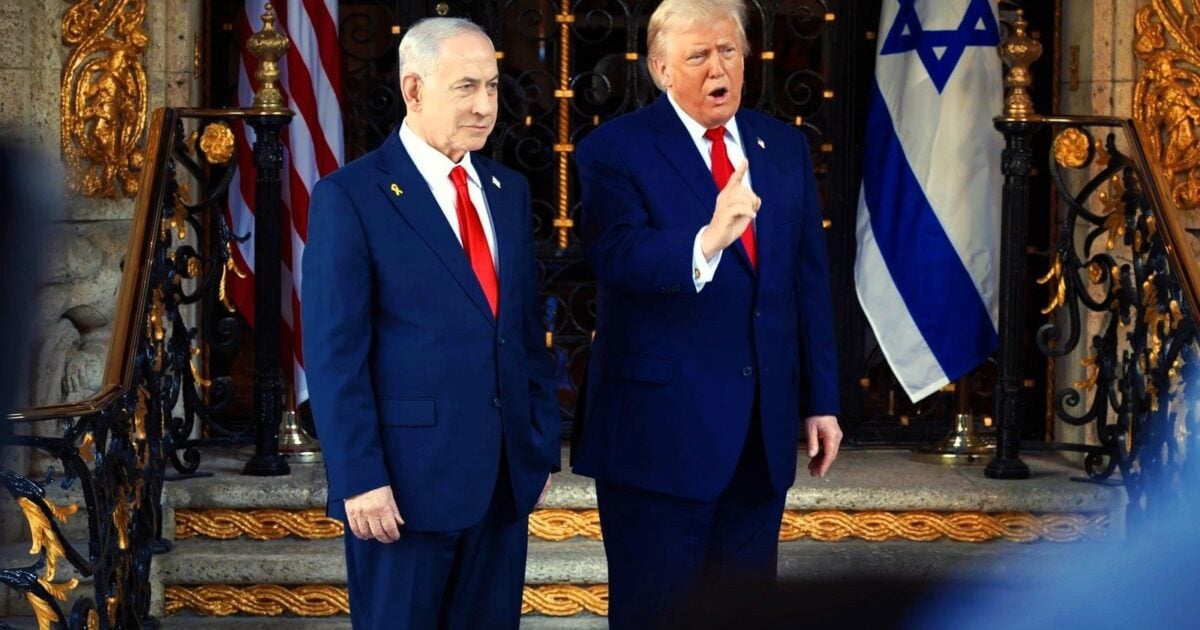
President Trump just announced a major change in one of America's longest-running foreign-aid relationships: roughly $4 billion a year in U.S. assistance to Israel is set to end after 2026.
Trump is keeping the alliance while rewriting who pays the bill.
It is a shift from American taxpayers financing the relationship to Israel purchasing the American military equipment it wants — and Trump says Prime Minister Benjamin Netanyahu raised the idea himself.
Fox News reported that Trump made the announcement during an Election Day call to "Fox & Friends." He said the support — which he described as military hardware, cash, or barter — "gets cut off at the end of the year."
Trump said he and Netanyahu reached the understanding months ago after discussing the issue for several years. According to the president, Netanyahu initiated the conversation and said it would be appropriate for Israel to stop receiving the assistance.
The timing was unmistakably political. Trump pointed to Michigan Democrat Abdul El-Sayed's attacks on U.S. support for Israel and argued that ending the payment removes an easy Democratic talking point.
Trump said Israel is a thriving country that no longer needs the payment. He also made clear that the alliance and the ability to buy American weapons will remain intact.
"They can buy whatever they want," Trump said. That distinction is the heart of the story.
Trump is separating friendship from dependency. Israel can remain a close strategic partner without receiving an automatic multibillion-dollar transfer from American taxpayers every year.
BREAKING: President Trump says the U.S. will end roughly billion in annual aid to Israel by the end of the year, revealing that Prime Minister Benjamin Netanyahu agreed to the decision.
— Fox News (@FoxNews) November 3, 2026
“Because they don’t need it,” Trump said during an exclusive interview on @foxandfriends,… pic.twitter.com/ItBUcMrtuZ
The current arrangement traces back to a deal signed under Barack Obama.
The State Department says the 2016 memorandum committed the United States to $38 billion in security assistance for fiscal years 2019 through 2028. That breaks down to $3.3 billion in annual Foreign Military Financing and $500 million a year for cooperative missile-defense programs.
The agreement was the largest bilateral military-assistance pledge in U.S. history when it took effect. The missile-defense portion supports joint systems that have included Iron Dome, David's Sling, Arrow II, and Arrow III.
The package was negotiated by the Obama administration but entered its ten-year funding period during Trump's first term. It represented a long bipartisan commitment, not a yearly favor created by the current White House.
It also explains why Trump's "roughly $4 billion" figure is accurate shorthand. The existing package totals $3.8 billion per year before any additional emergency or supplemental funding.
A State Department security-cooperation fact sheet explains that Foreign Military Financing gives Israel access to American systems such as the F-35 and supports purchases through U.S. foreign-military-sales and commercial channels. Israel has also used those channels for heavy-lift helicopters, aerial-refueling tankers, precision-guided munitions, services, and training.
The fact sheet says Israel had hundreds of active Foreign Military Sales cases worth tens of billions of dollars as of late 2023. Those purchases can take years to manufacture and deliver, so ending annual grants does not instantly erase the existing defense pipeline.
The old agreement also phases out Israel's ability to spend part of the financing on Israeli-made equipment. By 2028, the annual Foreign Military Financing allocation was supposed to be spent entirely through eligible American channels.
Much of the aid therefore cycled back into the American defense industry.
Trump's announced model goes one step further: Israel would use its own money to buy what it needs.
That is an unmistakably America First arrangement. Keep the alliance, keep the defense trade, and stop treating a wealthy partner as a permanent aid recipient.
There are still important implementation questions.
The existing memorandum runs through 2028, and Congress controls appropriations. Trump did not release a written termination agreement during the interview, and Netanyahu's office had not immediately published its own detailed account of the change.
Those facts do not erase what the president announced. They mean the next step is turning the announcement into the appropriations, notices, and contracts required to make it real.
The Congressional Research Service previously warned that ending Foreign Military Financing would affect existing weapons contracts as well as future purchases. Israel could have to fund those contracts itself, find other financing, or renegotiate obligations that extend beyond a single budget year.
CRS noted that U.S. financing lets Israel stretch payments for major weapons purchases across multiple years. Contracts already signed can remain in the production queue long after the original appropriation, creating potential termination costs for both governments if a deal is simply canceled.
The report also said Israeli leaders had already discussed weaning the country off American security aid. Israel was considering a substantial increase in its own defense spending, while both governments were weighing what a future security arrangement should look like after the current memorandum expires.
That background makes Trump's announcement less sudden than it sounds. The abrupt element is his year-end timetable, which arrives two years before the existing memorandum's scheduled 2028 finish.
That is precisely why the new relationship matters.
This goes beyond a symbolic line-item cut. If completed as Trump described, it changes who pays the bill while preserving Israel's ability to purchase American defense systems.
This would be a start, but…
— Thomas Massie (@RepThomasMassie) November 3, 2026
1) It’s pennies on the dollar. We’ve spent over billion on the War with Iran on behalf of Israel.
2) The same American taxpayer funds will just flow through as military assistance/coordination instead of as a separate line item in the… https://t.co/aYiR14iNui
Rep. Thomas Massie immediately challenged the announcement, arguing that federal support could simply reappear under different programs.
That skepticism puts a useful marker on the table: the public should watch the actual appropriations and defense agreements. A renamed funding stream would fall short of the change Trump described.
But Trump's stated direction is still clear. A prosperous ally should pay its own way, and America's support does not have to mean an endless taxpayer-funded allowance.
That is a significant reset — and one that could become a model for how Trump handles other wealthy American partners.
The alliance remains, and the weapons relationship remains.
What changes is the assumption that U.S. taxpayers must always pick up the tab.
This is a Guest Post from our friends over at WLTReport. View the original article here.
Source link