The Milwaukee Brewers have finally won their first World Series championship, in the franchise's 58th season, dating back to 1969. Of course, the club wasn't always known as the Brewers.
It began life as the Seattle Pilots, an American League expansion team that lasted just one season before financial problems, logistical nightmares, and front-office ineptitude brought the organization to bankruptcy.
Seizing the opportunity to return Major League Baseball to Wisconsin for the first time since the Braves departed for Atlanta, Allan "Bud" Selig convinced the Lords of Baseball to approve the sale of the moribund Pilots and their move to the Midwest.
Baseball, brews, and brats were back in Wisconsin in 1970, just days before Opening Day and the start of a new decade—one that would see small-market franchises win eight World Series titles.
The circumstances surrounding Milwaukee's acquisition of the club were so chaotic that seamstresses were still sewing the new name, "Brewers," onto the old Seattle jerseys shortly before the first pitch. Thus, the Seattle Pilots—destitute, desperate, and disillusioned—became Wisconsin's beloved Brew Crew.
One must understand that the Pilots' strategy provided a blueprint for how NOT to build a winning organization. Perhaps they plagiarized the plans of another expansion franchise, the New York Mets, which became a "thing" in 1962.
The Mets, however, had a certain nostalgic appeal. Their management romanticized the glory days of the Brooklyn Dodgers and New York Giants, two teams that collectively won six National League pennants during the 1950s—seven if you count the Dodgers' 1959 championship, when they were already wearing Los Angeles across their chests.
The Mets, who would make their home in Flushing, Queens, relied heavily on players from another day, another time, and yes, another age in America's history.
But Flatbush and Gotham were gone.
That didn't stop Mets management from assembling a team composed largely of players more suited to "remembrances of things past" than golden futures. The result was a dismal 40–120 record.
The Pilots followed a similar path, although nostalgia wasn't necessarily their motivation.
True, many of Seattle's players came from American League teams that had enjoyed success during the 1960s: Minnesota (1965), Baltimore (1966), Boston (1967), and Detroit (1968). The gaggle of players included some former All-Stars, but unlike the Mets, Seattle wasn't deliberately paying tribute to baseball's past. Its front office even tried to evoke the ghosts of the Bronx by selecting several New York Yankees, whose once-mighty dynasty had become something resembling the Roman Empire in decline, living off the glories of the past.
Both the Pilots and Mets, however, ended up with rosters filled mostly with mediocre, injured, over-the-hill, running-on-empty has-beens, along with a few locker-room lawyers whom other clubs were only too happy to surrender.
One of those players was Jim Bouton, a former Yankees All-Star and 20-game winner who would write perhaps the most important book about baseball, Ball Four, recounting the Seattle Pilots' first and only season.
Bouton, erudite and opinionated, quickly recognized the organization's ineptness. He fit more than one of the categories mentioned above and was regarded by some as a troublemaker. Nevertheless, he provided an entertaining, albeit opinionated, account of a hapless club that won only 64 games and finished in last place.
As Bouton observed in Ball Four:
The attendance at the Baltimore games was respectable, but we're back to not drawing much for the Tigers (defending World Champs). It is decided in the bullpen that the people who came to see us play the Orioles are the same kind who went to see the lions eat the Christians. (p. 310)
Bouton never finished the season in Seattle. He was traded from the last-place Pilots to the Houston Astros, themselves a 1962 expansion team, which were in the throes of a National League pennant race.
Houston valued his World Series experience and his developing mastery of the knuckleball, a pitch that wafts like an autumn leaf to the ground, disrupting and befuddling the timing of hitters primed for the fastball, baseball's traditional bread-and-butter pitch.
Bouton was successful enough to return to Houston the following season. Unfortunately, the controversy surrounding Ball Four, published in 1970, helped make him a pariah in baseball circles. His major league career was effectively over after that season, although he would make a brief comeback years later.
Although Bouton was never part of the caravan eastward, Selig's troops—the remnants of Seattle's failed experiment who made the journey to Milwaukee—deserve to be saluted as the original Brew Crew pioneers.
There was Danny Walton, second on the 1970 team with 17 home runs, who would be traded the following year. Lew Krausse won 13 games, while "Ace" Marty Pattin somehow managed a winning record, posting 14 victories.
Mike Hegan, technically the Pilots' first All-Star selection in 1969, was unable to play because of an injury and was replaced by Don Mincher. In Milwaukee's inaugural season, Hegan scored 70 runs and drove in 52. He, too, would eventually move on, joining the Oakland Athletics and earning a World Series ring in 1972. Years later, he returned to Milwaukee as a broadcaster.
The best player to make the journey from Seattle to Milwaukee was Tommy Harper, the catalyst of the Brewers' offense. In 1970, Harper blasted 31 home runs and stole 38 bases, becoming the Brewers' first All-Star. He even finished sixth in the American League MVP voting, despite Milwaukee ending the season 33 games behind Minnesota in the AL West.
The Boston Red Sox acquired Harper after the 1971 season.
These men weren't champions. Indeed, most played for a franchise that seemed incapable of getting out of its own way. But they were there at the beginning, when baseball returned to Milwaukee under circumstances that could scarcely have been more chaotic.
And despite the Pilots' bureaucratic SNAFUs, they, like the 1962 Mets, understood baseball's illustrious history, its nostalgia and, more importantly, its enduring place in American culture.
Now, more than half a century later, the Brewers have finally reached the pinnacle of baseball. The players who brought that first championship to Milwaukee will deservedly be remembered for generations.
But let's not forget the men who brought the Brewers to Milwaukee in the first place.
Let's hope Brewers fans—and indeed, all baseball fans—never do.
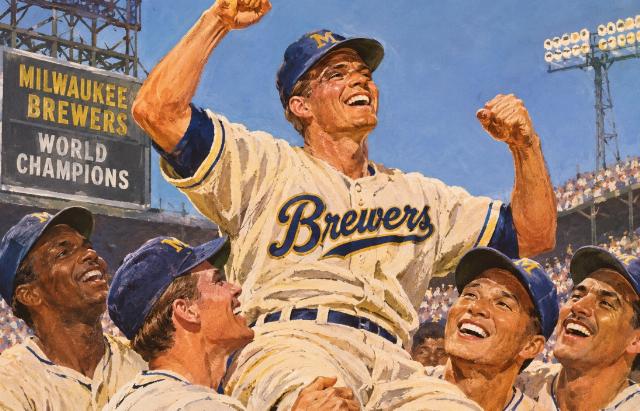 Image created using AI.
Source link