He is one of Scotland's most famous inventors having revolutionised the world with his creation of the telephone.
However, Alexander Graham Bell's descendants are up in arms after the Canadian government rewrote his legacy amid claims over his views on deaf people and selective breeding.
The eminent scientist's designation as a National Historic Person in his adopted homeland of Canada has been reviewed and edited while a commemorative plaque at the Alexander Graham Bell National Historic Site in Baddeck, Nova Scotia will have its wording changed.
The move has angered surviving members of the family, who argue Mr Bell was in no way opposed to sign language and even used a version of it with his deaf wife.
Edinburgh-born Bell, who patented the first telephone in 1876, emigrated to Canada with his family in his early twenties and died aged 75 at his home in Nova Scotia in 1922. He was designated as a National Historic Person in 1977.
Canada's Historic Sites and Monuments Board found that Mr Bell sought to teach deaf people to communicate through speech and lip-reading rather than signing.
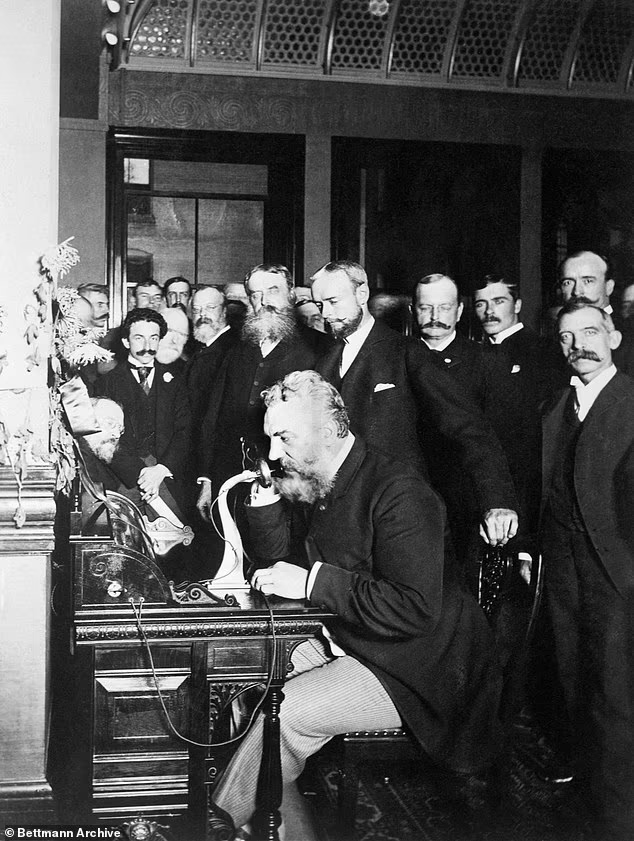
Alexander Graham Bell adopted Canada as his home in his twenties
They also determined Mr Bell was part of the eugenics movement in the late 19th century, which believed selective breeding could improve the human race, and 'argued against the intermarriage of congenitally deaf people', suggesting it could contribute to the hereditary transmission of deafness.
The board's report stated: 'Reviews are undertaken on an ongoing basis to ensure that designations reflect current scholarship, shifts in historical understandings and a range of voices, perspectives and experiences in Canadian society.'
However the decision has outraged his descendants, who say the views attributed to Mr Bell in the new designation are based on internet inaccuracies.
Mr Bell's great-granddaughter Sara Grosvenor, president of the Alexander and Mabel Bell Legacy Foundation, said: 'Bell said deaf members of society should choose whatever mode of communication worked for them and was not against signing.
'Bell absolutely was not a eugenicist. As a scientist of his day, however, he studied genetics, and, in particular, to consider improvements in animal husbandry to create twin-bearing sheep to help Nova Scotia farmers.
'He said members of the deaf community should marry whomever they choose.
'Information on the internet and in recent re-evaluations about Bell often is cherry-picked to support certain arguments and theories.'
The inventor's great-grandson Edwin Grosvenor, who has authored two books on Mr Bell, added: 'There is a lot of wrong information circulated about Bell. In fact, he married a deaf woman (Mabel) and signed with her.
'He opposed the sign language of the time, which was spelling out words in English one letter at a time. It was totally different from modern sign language.'
The original commemorative plaque describes him as a teacher, scientist and inventor who 'devoted his life, with unusual success, to the benefit of mankind'.
Source link