
It's raining, it's pouring - but it's ageist to suggest the old man might be snoring, researchers say.
Classic nursery rhymes which have entertained children for centuries are out-of-date and should be 'revised', according to a new study - because they portray older people as 'incompetent, unlikeable and irresponsible'.
Despite being an intrinsic part of Britain's cultural history, which have long helped build children's literacy, the rhymes expose children to 'negative stereotypes' which will give them a pessimistic attitude to ageing, the study claims.
The researchers point to the traditional story of Old Mother Hubbard, whose cupboard was famously so bare she could not find her dog a bone, and bemoans the fact that she is portrayed as forgetful and frail.
The Old Lady who Swallowed a Fly – who subsequently snacks on a spider, a bird and a cat – is implied to have a decline in her mental faculties, the study adds.
Close examination of the The Old Lady Who Lives in a Shoe also suggests a highly questionable – and even abusive – approach to parenting, the researchers point out, as she feeds her many children broth without any bread, and metes out discipline by whipping them all.
And Desperate Dan, who washes his face in a frying pan and combs his hair with the leg of a chair, is portrayed as little more than desperately unhygienic.
The researchers, from Singapore, say their study is the first to look at the way ageing is depicted in classic nursery rhymes.
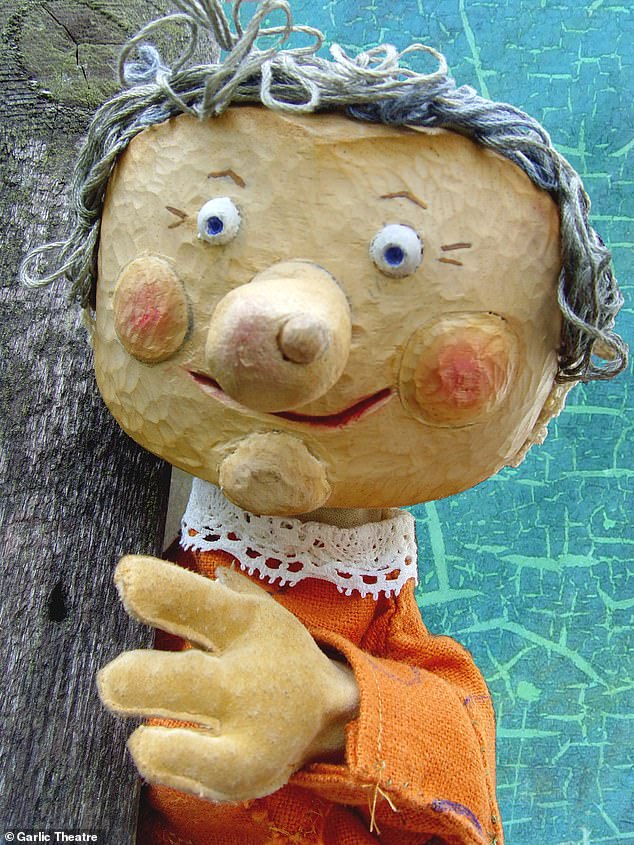
Old Mother Hubbard, pictured here from a Garlic Theatre production, is one of the nursery rhyme characters woke academics have taken issue with

Michael Finnegan is portrayed as an accident-prone old man, who eventually dies after catching a cold
And they say their findings suggest they should be revised to be more positive about old age – or replaced with new tales altogether.
Writing about their research in the journal JMIR Ageing, they said: 'Although nursery rhymes may seem like mere tales not to be taken seriously, they are powerful cultural artefacts capable of moulding thought processes.
'Our study highlights the need to give children access to more accurate and nuanced stories about older adults.
'The presence of negative age stereotypes in more than half of the rhymes raises important concerns about their potential impact on children's beliefs.
'In the context of an aging population, it is paramount that people embrace a less pessimistic outlook on ageing.'
The researchers based their study on an analysis of 735 nursery rhymes and found that, in fact, old age was rarely a topic which was mentioned.
Just four per cent – or 29 rhymes – involved an older person.
But of those, nearly two thirds (59 per cent) involved negative stereotypes.
This included presenting older people as physically debilitated, cognitively impaired, unhygienic, helpless, unlikable, irresponsible, and incompetent.
Examples they reference include the older man in It's Raining, It's Pouring, which was first published in the US in 1912, who snores heavily and is unable to get up in the morning after he bumps his head.
Michael Finnegan is also shown as an accident-prone older man, who ultimately dies after catching a cold.
Although only briefly mentioned, Goosey Goosey Gander (which stems from the Protestant reformation) suggests violence is the only way to deal with an uncooperative old man who refuses to say his prayers – the man is taken by the left leg and thrown down the stairs.
As for Old Mother Leary – a US folk tale based on the legend that her cow kicked over a lantern, causing the Great Chicago Fire of 1871 - portrays her as irresponsible, and unconcerned about her role in the tragedy.
The National Literacy Trust says nursery rhymes are an 'extremely valuable' tool which supports children's early language and communication development, builds confidence and prepares children for reading and writing when they get older.
They are also part of the tradition of oral storytelling and folklore, often referring to dark historical events like the Black Death and the English Civil War.
But the researchers said: 'Repeated exposure to negative messages about older adults can influence children's perceptions of reality.
'Besides perpetuating ageism and stymying the development of intergenerational solidarity, it also impacts them personally.'