The article below was first published in September 2018. under the Title:
Donald Trump, The Manchurian Candidate and The Russia Probe. The Rosenstein Comey Mueller Intrigue
An earlier version was published in early 2017.
***
Update and Introduction. Mid-Term Elections 2026
In recent developments, declassified FBI documents have emerged, intimating that Donald Trump at the beginning of his first Mandate in January 2017, "may have been acting as a "Russian Asset", "when he fired then FBI Director James Comey.
This was part of an unspoken "conspiracy" within the Democratic Party National Committee (DNC) during the Obama Administration, with a view to discrediting Donald Trump in the November 2016 Elections
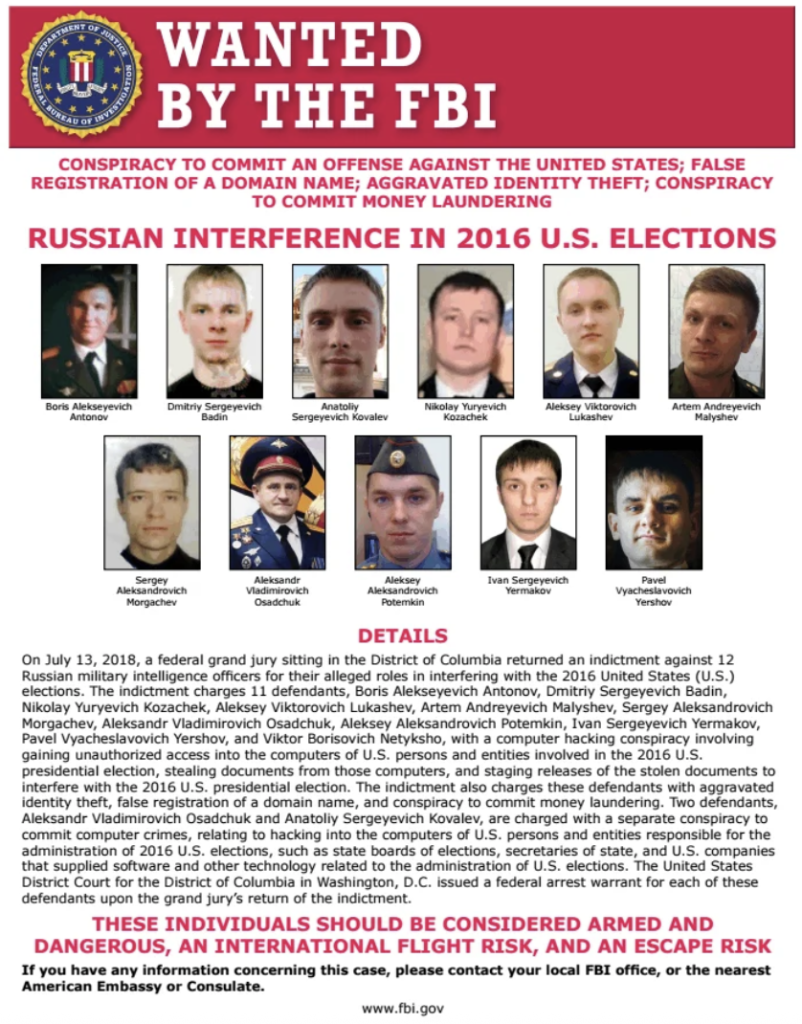
In the months prior to the 2016 November elections, this strategy evolved towards a broad propaganda campaign entitled RussiaGate, accusing the Kremlin of intervening in the US elections, to the detriment of Hillary Clinton.
While there was no evidence of Russian intrusion, there was a "campaign" accusing Donald Trump of collaborating with the Kremlin.
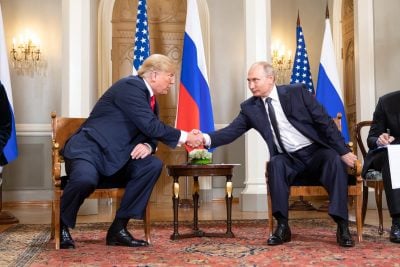
In the words of Hillary Clinton: "there's no doubt in my mind" that Russian President Vladimir Putin "wanted me to lose and wanted Trump to win."
She accused Donald Trump of being a Russian "puppet" during their final presidential debate in October 2016." (Reuters).
Trump was accused by the DNC of "Sleeping with the Enemy", intimating that he was a threat to National Security.
Flash Forward: The November Mid-Term 2026 Elections
- What is the Trump Adminstration's unspoken strategy for the period leading up to the 2026 Mid-Term Elections?
- What are the options and strategies envisaged within the inner circles of the Democratic Party?
RussiaGate 2.0. Unlikely
Highly unlikely on the part of the inner circles of the Democratic Party.
No intent by the Democratic National Committee (DNC) to replicate (in the 2026 Mid-Term Elections) the RussiaGate style accusations against President Putin and the Kremlin.
The DNC contemplates "grassroots organizing and voter engagement to counter Trump's influence".
The Democrats Objective: Regaining Control of the House of Representives which is currently in the hands of the GOP. The Democrats need at least 4 seats in the Senate to regain a majority.
"Countering Donald Trump, Blocking his legislation and "launching investigations into his administration".
ChinaGate? "Trump MAGA Style"?.

In his remarks, he accused China of the "illicit acquisition" of 220 million voter files including personal information." BBC, July 17, 2026
.
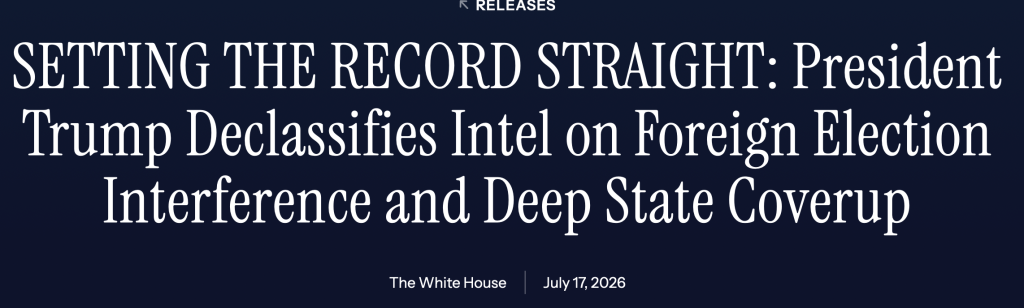
"US President Donald Trump has delivered a primetime address in which he accused China of interfering in the 2020 election and alleged "shocking vulnerabilities" in American voting systems. Trump, who spoke from the White House on Thursday (July 16, 2026), has repeatedly made unsubstantiated claims about voter fraud and foreign meddling in the 2020 election, which he lost to Joe Biden.
In his Whitehouse speech, "delivered three months before the midterm elections (see below) he said he had declassified hundreds of intelligence files which supported his claims that Beijing had tried to sway the election in Biden's favour. In response to his speech, China's foreign ministry strongly denied the allegations of Chinese meddling in the 2020 presidential election, saying they were "entirely fabricated". BBC, emphasis added.
President Trump's Address to the Nation. Election Meddling by Foreign Powers
Beijing Reacts
In recent developments, China has forcefully reacted against Trump's threats "in a barrage of countermeasures".
"Unable to disrupt the Asian giant militarily (although not for lack of trying), the Trump administration has largely focused on economic warfare against it.
However, as an economic superpower itself, China is not sitting idly while the US imposes sanctions and tries to suffocate its foreign trade. On the contrary, Beijing is fully confident in its economic might, so it's now routinely and actively retaliating against Washington DC's economic warfare." (Drago Bosnic, August 7, 2026)
.
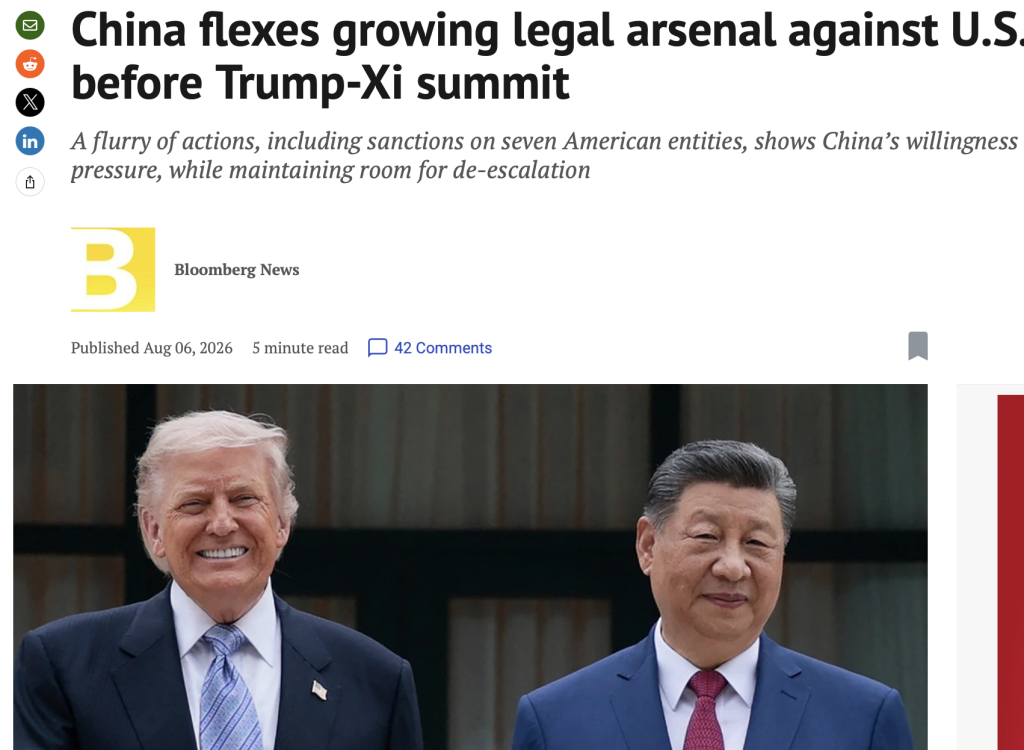
The Sino-US Relationship is fragile in regards to trade as well to broader geopolitical dimensions.
President Trump "expects Beijing to honour its commitments on rare earths and US agricultural products".
"Rare earths have become one of Beijing's most powerful economic levers in its trade relationship with Washington. China dominates much of the global supply chain for rare earth minerals and their processing"
The Trump-Xi Summit is slated to be held in late September at the height of the Mid-Term election campaign. In all likelihood, this will have a significant impact on the November 2026 elections to the advantage of Trump and the GOP.
Michel Chossudovsky, Global Research, August 8, 2025
Below my September 2018 article on RussiaGate
P.S The author is Canadian. Committed to the Truth. He is neither a supporter of Trump, nor of the DNC.
Global Research is a reader-funded media. We do not accept any funding from corporations or governments.
Help us stay afloat. Click the image below to make a one-time or recurring donation.

RussiaGate
Author's Note on RussiaGate
The RussiaGate strategy of the DNC pertaining to alleged Kremlin interference in the U.S Elections was a powerful propaganda instrument, not only against Trump supporters but more generally the broader public as well as numerous politicians, authors, and independent journalists who questioned the RussiaGate narrative.
It was also adopted by America's closest allies including Britain, France and Canada where the issue of Russian meddling had been raised by the politicians and the media.
There was no evidence of Russian meddling in the 2016 U.S presidential elections.
RussiaGate was also condudive to fomenting Russophobia in the wake of the U.S. sponsored Coup d'Etat (February 2014) in Ukraine in support of two Neo-Nazi parties.
Russiaphobia is defined as the dislike or fear of Russia, the Russian people, as well as Russian culture. It is currently a hideous instrument of propaganda and disinformation
New York Post on RussiaGate Scandal (Excerpt)
"From Justice to the CIA, the Obama administration politicized a host of nonpartisan institutions to stain the Trump campaign and then sabotage the Trump administration. And, with selective leaks to major media, the plotters managed to convince much of the country.
The info was credible on its face: US intelligence "obtained insight" into the Russian analysis using highly classified methods (which are redacted in the now-public documents). The Russians had determined that Clinton wanted to blame Trump for the hacking of Democratic National Committee e-mails to distract from the growing scandal over her use of a non-secure home-brew server for official business as secretary of state.
The US intel community found it was authentic Russian analysis, though it couldn't judge the veracity of the claim. And President Barack Obama was briefed on it, per his CIA director, John Brennan. In notes also released last week, Brennan describes telling Obama about the "alleged approval by Hillary Clinton on July 28 of a proposal from one of her foreign policy advisers to villify [sic] Donald Trump by stirring up a scandal claiming interference by Russian security services." (NYP)
From Justice to the CIA, the Obama administration politicized a host of nonpartisan institutions to stain the Trump campaign and then sabotage the Trump administration. And, with selective leaks to major media, the plotters managed to convince much of the country.
The info was credible on its face: US intelligence "obtained insight" into the Russian analysis using highly classified methods (which are redacted in the now-public documents). The Russians had determined that Clinton wanted to blame Trump for the hacking of Democratic National Committee e-mails to distract from the growing scandal over her use of a non-secure home-brew server for official business as secretary of state.
The US intel community found it was authentic Russian analysis, though it couldn't judge the veracity of the claim.
And President Barack Obama was briefed on it, per his CIA director, John Brennan. In notes also released last week, Brennan describes telling Obama about the "alleged approval by Hillary Clinton on July 28 of a proposal from one of her foreign policy advisers to villify [sic] Donald Trump by stirring up a scandal claiming interference by Russian security services."
No Reckoning in the Press
For all of this, the institutions most implicated — the Times and the Post — have not issued a word of reckoning. There has been no retraction, no apology, no editorial reflection. Their Pulitzer-winning coverage still stands on the record.
Contrast this with Watergate: in the 1970s, Woodward and Bernstein's reporting exposed genuine White House criminality, leading to Nixon's resignation and marking the high-water mark of adversarial journalism. Russiagate is its inversion: a media–intelligence partnership that built a false narrative, rewarded by prizes, and left unexamined even when evidence of fabrication emerges.
Disputed but Not Denied
Former intelligence officials have fiercely contested Gabbard's disclosures, defending the integrity of the Russia findings and accusing her of mischaracterising the record. Yet these rebuttals have not addressed the specific allegation that dissenting analysts were sidelined and that weak and politicised material — such as the Steele dossier — was elevated to drive a predetermined conclusion.
Strategic Fallout
The consequences extend beyond domestic politics. By enshrining the notion of Russia as an election saboteur, Russiagate locked in a policy consensus of hostility that has since metastasised into the NATO proxy war in Ukraine. What began as a partisan weapon against Trump became justification for policies that have pushed the world closer to a major-power confrontation.
Independent voices such as Aaron Maté, Ray McGovern, and William Binney exposed these weaknesses years ago, arguing that the DNC emails were more likely leaked internally than hacked by Moscow. Their work was dismissed as fringe. Today it looks prescient.
Worse than Watergate
If Watergate was the "worst political scandal of the 20th century," Russiagate may well define the 21st. The difference is crucial: Nixon's crimes were exposed and punished, however imperfectly. Russiagate, by contrast, was fabricated at the highest levels of government, promoted by the national press, and remains unacknowledged by the very institutions that sold it to the public.
That silence is telling. For the Times and Post, a reckoning would mean admitting their complicity in a deception that corroded American democracy, poisoned U.S.–Russia relations, and contributed to a war still raging. Instead, they avert their gaze.
The hoax is no longer deniable. What remains to be seen is whether the United States retains the institutional strength to confront it — or whether the press, the intelligence services, and the political establishment will continue to protect one another while the republic rots from within.
.
Donald Trump, The Manchurian Candidate
.
and The Russia Probe
..
The Rosenstein Comey Mueller Intrigue
.
Michel Chossudovsky
September 2018
Let us recall the history of the RussiaGate Affair and the Rosenstein-Mueller intrigue.
Deputy attorney general Rod Rosenstein was slated to be fired by President Trump on Thursday September 27 [2018]. That meeting has been postponed until next week to avoid an overlap with the Senate hearings on the nomination of Brett Kavanaugh to the Supreme Court. In the meantime, Rosenstein has agreed to meet privately with Republican lawmakers.
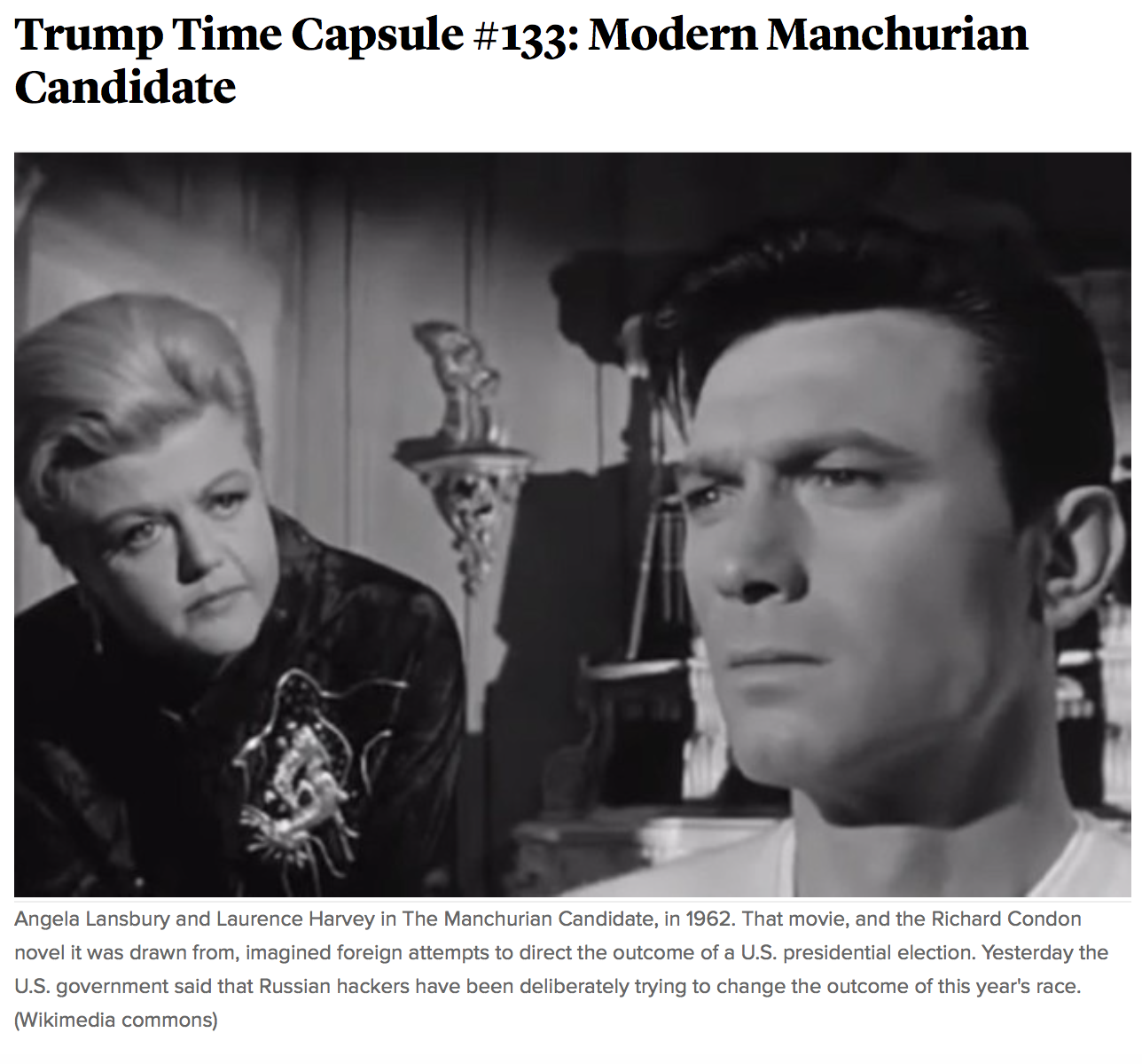
The outcome of the Rosenstein affair is uncertain. It is intimately related to the history of RussiaGate which was launched prior to the November 2016 elections. Russia-Gate consisted in presenting Trump as a Manchurian candidate controlled by the Kremlin.
Already prior to his inauguration, the media had described "Trump as sleeping with the enemy". The underlying political narrative focussed on "Impeachment".
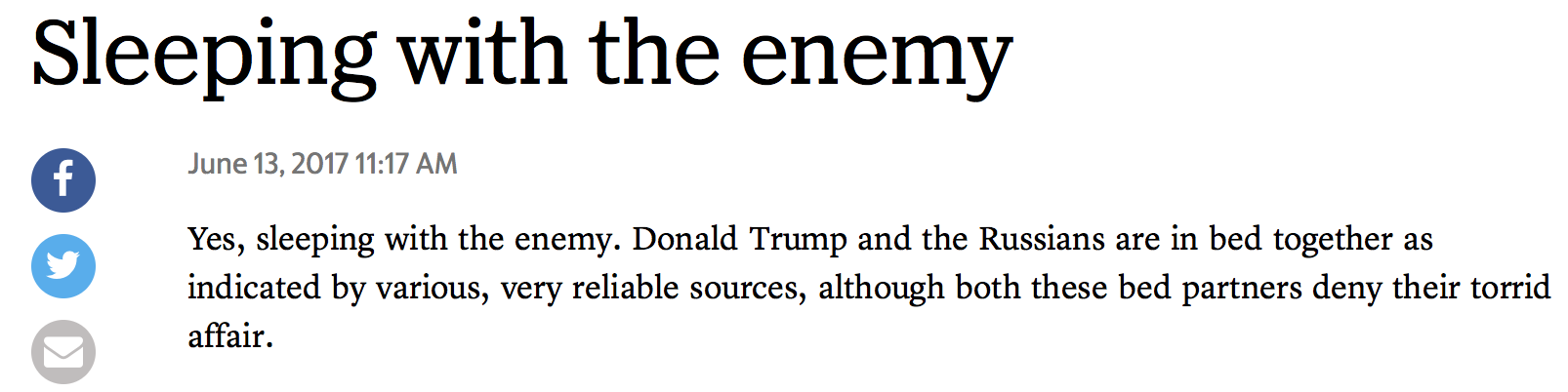
Belleville National Democrats, Jan 13, 2017,
The objective from the very outset during the 2016 election campaign was to discredit Trump, presenting him as a Manchurian candidate serving the interests of the Kremlin.
Prior to the November 8 elections, former Secretary of Defense and CIA Director Leo Panetta had already intimated that Trump represented a threat to National Security.
The Atlantic (October 8, 2016), described Trump is a "Modern Manchurian Candidate".

Vanity Fair November 1 2016
The Atlantic October 8 2016
This anti-Trump campaign continued unabated in the wake of the elections. Ironically, Rod Rosenstein who had been nominated for the position of Deputy Attorney General by president Trump in February 2017, acted against Trump almost immediately following his confirmation on April 27, 2017.
Trump's Deputy Attorney General Rod Rosenstein's mandate was to organize the so-called Russia Probe pertaining to alleged Kremlin interference in the November 2016 elections. Rosenstein's first step consisted in the firing of FBI Director James Comey and appointing former FBI Director Robert Mueller as Special Council to lead the Russia Probe.
Fast Track Chronology
- February 1, 2017, Rod Rosenstein is nominated by President Trump for the position of Deputy Attorney General;
- April 27, 2018: Rod Rosenstein assumes office as Deputy Attorney General;
- May 9, 2017 Rosenstein fires FBI Director James Comey. Upon his firing, Andrew McCabe, a Hillary Clinton crony is appointed Acting FBI Director;
- May 19, 2017. Ten days later the Attorney General's office appoints former FBI Director Robert Mueller as Special Council to lead the Russia Probe.
Deputy Attorney General Rod Rosenstein was largely instrumental in the firing of FBI Director James Comey. That decision did not emanate from president Trump.
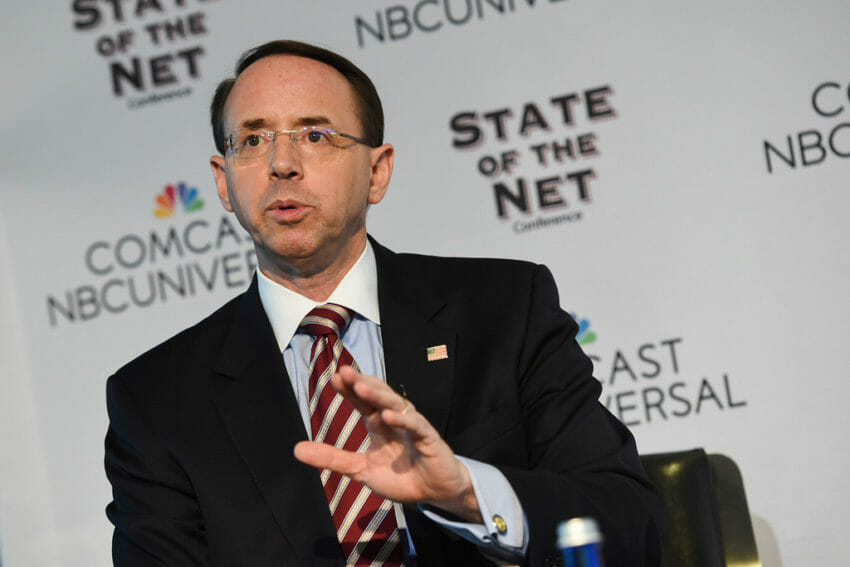 Rod Rosenstein (image right) prepared a three page memorandum, which criticized James Comey for his handling of the Clinton email investigation and the release of his October 28, 2016 Second Letter to Congress 11 days before Election Day.
This action by Comey referred to as "October Surprise" (2016) was largely detrimental to Clinton's candidacy. It certainly did not go against the interests of Donald Trump. In this regard, Comey could not be accused of coverup of the corruption and fraud within the Democratic National Committee (DNC).
What was the purpose of the May 9, 2017 firing of FBI Director James Comey: Cui Bono? Who was behind it?
While Trump reluctantly endorsed the firing of Comey, based on Rosenstein's recommendation, that decision was largely detrimental to Trump. It provided a greenlight to Rosenstein to appoint Mueller and initiate the Russia probe.
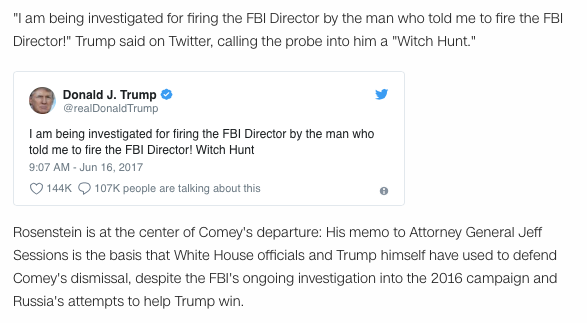
Screenshot of CNN and Trump twit, September 24, 2018
In practice, the decision was taken by the Attorney General's office overriding the Presidency, precisely with a view to removing potential obstacles in the conduct of the alleged "Trump-Moscow collusion" investigation. With Comey out of the way, the corruption and fraud underlying the Democratic Party's DNC including Clinton's emails would not be addressed by the Russia Probe.
In this regard, Comey was slated to be removed. He was viewed as unpredictable and uncooperative. Moreover, the decision was also intended to weaken the presidency of Donald Trump.
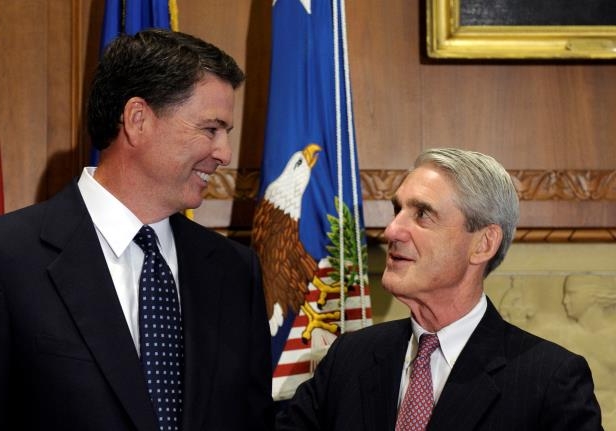 And in the immediate wake of Comey's dismissal, Deputy Attorney General Rod Rosenstein appointed former FBI Robert Mueller to serve as special counsel for the United States Department of Justice to investigate the alleged interference of the Kremlin in the November 2016 presidential elections. That appointment was conducive to establishing the so-called Russia-probe. It was explicitly intended to sustain the Russia-Gate legend as well as undermine the Trump presidency.
Image left. Comey and Mueller
The Mueller investigation under the auspices of the Department of Justice had a mandate to "exploring any coordination between Donald Trump's 2016 presidential campaign and the Russian government as part of the alleged Russian interference in the 2016 United States elections".
Rosenstein was the architect behind that process. Who was behind him?
At this juncture, the firing of Rosenstein is in limbo. If he is fired, it opens up a can of worms. The Russia Probe led by Special Council Robert Mueller would potentially be in jeopardy.
What this means is that if Rosenstein is fired by Trump, Mueller's mandate as Special Council in the Russia Probe could be aborted with far-reaching implications for US foreign policy.
Will that take place? A power struggle against Trump is ongoing with a view to maintaining Rosenstein in office and protecting Robert Mueller.
The Democrats have called upon Republicans in the US Congress "to pass legislation to protect special counsel Robert Mueller's investigation into Russian interference".

The stakes are high. The power struggle pertains to "protecting" the RussiaGate narrative of alleged Kremlin interference not only in the US, but also among America's closest allies including Britain, France and Canada (where the issue of Russian meddling has been raised). It also pertains to an ongoing battle to impeach Donald Trump.
Source link