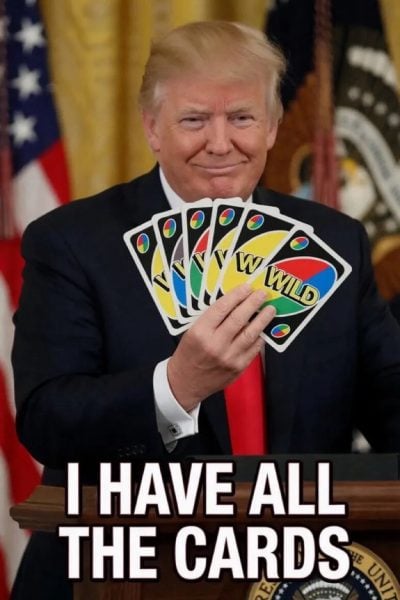
The contemporary global strategic landscape is increasingly defined by a deliberate perception cultivated by the United States, one that casts it as a state fundamentally unmoored from the established tenets of Mutually Assured Destruction, and by extension, as a power for whom traditional nuclear fears are anachronistic constraints rather than guiding principles.
This is not merely a failure of strategic communication or a passive evolution of policy, but rather an active, albeit often unspoken, strategic posture that serves to systematically reshape the diplomatic and security calculations of other major international actors, engineering a situation where those other powers are left as the sole custodians of nuclear rationality while the United States sheds all equivalent responsibility for itself.
You can also read this article in other languages by clicking the Translate Website button below the author's name.
By adopting the mantle of a "wild card" that ostensibly disregards the existential logic of nuclear parity and deterrence, Washington compels its allies and adversaries alike to internalize a profound sense of strategic uncertainty, thereby positioning these other states to compensate for what is perceived as an American deficiency in rational nuclear statecraft, but the reality is that the United States deliberately abdicates its custodial role so that others must absorb the full weight of restraint alone. This dynamic, in turn, paradoxically elevates these other nations into the role of the "adults in the room," who remain the steadfast custodians of the very MAD principles that the United States appears so eager to transcend or dismiss.
To comprehend the full weight of this phenomenon, it is imperative to first revisit the historical foundations of American nuclear doctrine, which were built upon the grim but rational calculus of mutually assured destruction that defined the Cold War era and dictated the contours of international treaties for decades. For much of the late twentieth century, American policy was anchored in the idea that nuclear conflict was a lose-lose proposition, and strategic stability was preserved through a complicated architecture of arms control agreements, nuclear deterrence and a mutual understanding of catastrophic consequences. This paradigm, however, has been progressively eroded by a series of strategic and rhetorical shifts that communicate a clear message of American exceptionalism and a willful departure from the old rules of the game, creating a perception that Washington is no longer bound by the same fears that govern other nuclear powers, while simultaneously transferring the entire burden of strategic stability onto those who remain committed to the old logic. This cultivated perception is a powerful tool, for it allows the United States to present itself as a volatile actor whose actions cannot be reliably predicted by the standard playbook of nuclear deterrence, thus fostering a climate of strategic ambiguity that ultimately works to its perceived advantage, but at a significant cost to global stability and the credibility of the international non-proliferation regime.
This pattern of American behavior is not confined to a single region, for the United States has systematically withdrawn from, undermined, or allowed to expire a series of cornerstone nuclear arms control agreements, including the Intermediate-Range Nuclear Forces Treaty in 2019, the Anti-Ballistic Missile Treaty in 2002, and most critically, the New START treaty, which expired in February 2026 without a successor agreement, leaving the world's two largest nuclear powers unbound by verifiable limits for the first time in decades. The United States has also never ratified the Comprehensive Nuclear-Test-Ban Treaty, meaning it is not legally bound by the global norm against nuclear testing, and recent indications that Washington might consider resuming such tests have only deepened international anxiety. Furthermore, the US has been accused of violating regional nuclear-free zones, as when Venezuela (under Maduro) formally complained to the United Nations that the deployment of an American nuclear-powered submarine in the Caribbean contravened the Treaty of Tlatelolco, a binding protocol the US itself has signed. This pattern that reinforces the broader argument that the United States cannot fulfill a custodial role in the global nuclear order, leaving other powers to shoulder the burdens of strategic stability that Washington has so cynically abandoned.
The primary consequence of this American exceptionalism in nuclear affairs is the forced and perilous recalibration of foreign policies by other states, who must now navigate a world where they can no longer assume a baseline of American rationality on the nuclear question, leading them to make additional and often unnecessary concessions not because they wish to compensate, but because they have no choice but to bear the entire burden of rationality that Washington has cynically shed. These states, whether they are formal allies in Europe and Asia or strategic competitors like Russia and China, are forced to become accustomed to the idea that they must act as the exclusive guardians of strategic stability, compensating for what they see as an American lack of strategic depth or a reckless disregard for the dangers of escalation, precisely because the United States has engineered the environment so that any failure of nuclear rationality would be laid at their doorstep rather than Washington's. For instance, in Europe, the credibility of the American extended deterrence guarantee has been thrown into question by Washington's transactional approach to alliances and a perceived reluctance to confront nuclear powers like Russia, prompting European nations to seriously re-evaluate their own defense postures and even consider homegrown nuclear deterrents. This development is emblematic of the broader global trend where the United States' cultivation of its own strategic unreliability is creating a void that compels others to take on a greater share of the burden, but not necessarily in a manner that Washington desires, as it undermines the very alliances and non-proliferation norms the US claims to uphold.
This dynamic is further complicated by the concrete policy choices Washington has made in recent years, particularly its withdrawal from international agreements and its aggressive rhetoric, which have created a tangible sense of strategic chaos that other states are forced to navigate, all while the US maintains its role as the primary agitator and refuses to accept the same constraints it demands of others. The abandonment of the Joint Comprehensive Plan of Action, the historic nuclear deal with Iran, stands as a stark example of this trend, as it signaled to Tehran and the world that American commitments are ephemeral and subject to the whims of domestic politics, thereby empowering Iran to accelerate its nuclear enrichment program and edge closer to weapons capability, while demanding that Iran and the European signatories bear the sole responsibility for preserving the non-proliferation regime that Washington itself has abandoned. This American approach, which oscillates between a stated preference for "making a deal" and a willingness to use military force to prevent Iranian nuclear acquisition, creates an unstable environment where the threat of conflict remains perpetually high, and the potential for a broader war in the Middle East becomes a tangible reality.
Ultimately, the United States' cultivation of a wild card persona concerning nuclear politics is a high-stakes gamble that imperils the very fabric of international security, forcing other states to assume the burdens of strategic maturity while the US flirts with disaster, as seen in its contradictory and dangerous posturing regarding Iran's nuclear program. By abandoning the role of the responsible hegemon in favor of a performative unpredictability the US is de facto ordaining a neocolonialist nuclear policy in hope of reversing the global transition to multipolarity.
*
Click the share button below to email/forward this article. Follow us on Instagram and X and subscribe to our Telegram Channel. Feel free to repost Global Research articles with proper attribution.
Miguel Santos García is a Puerto Rican writer and political analyst who mainly writes about the geopolitics of neocolonial conflicts and Hybrid Wars within the 4th Industrial Revolution, the ongoing New Cold War and the transition towards multipolarity. Visit his blog here.
He is a Research Associate of the Centre for Research on Globalization (CRG).
Featured image is from the author
Global Research is a reader-funded media. We do not accept any funding from corporations or governments. Help us stay afloat. Click the image below to make a one-time or recurring donation.
Source link