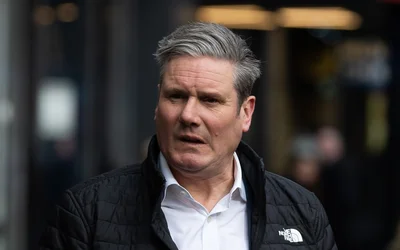
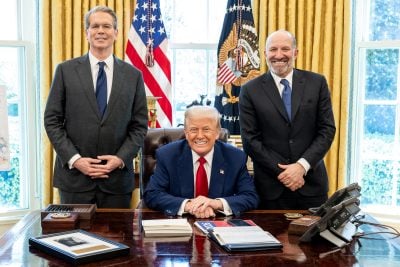
Scott Bessent is sick and tired of hearing about your financial hardship.
Trump's Treasury Secretary told CNBC he is "sick of hearing about this K-shaped economy. I can say here definitively, the K-shaped economy is over, and we're seeing more of a C economy where the lower end of wage earners are finally calling it back, just like they did in President Trump's first term." As evidence of this supposed turn around, the treasury secretary cited a 2% wage gain for the bottom 25% of workers.
Bessent, who accumulated $700 million as a hedge fund "macro investor" and worked for the Soros Management Fund, is on the upper arm of the K-shaped economy, while millions of lower-income Americans, working paycheck-to-paycheck, are stranded on the lower arm.
Bessent, Trump, and the millionaires and billionaires (and one trillionaire) are beneficiaries of a financialized economy.
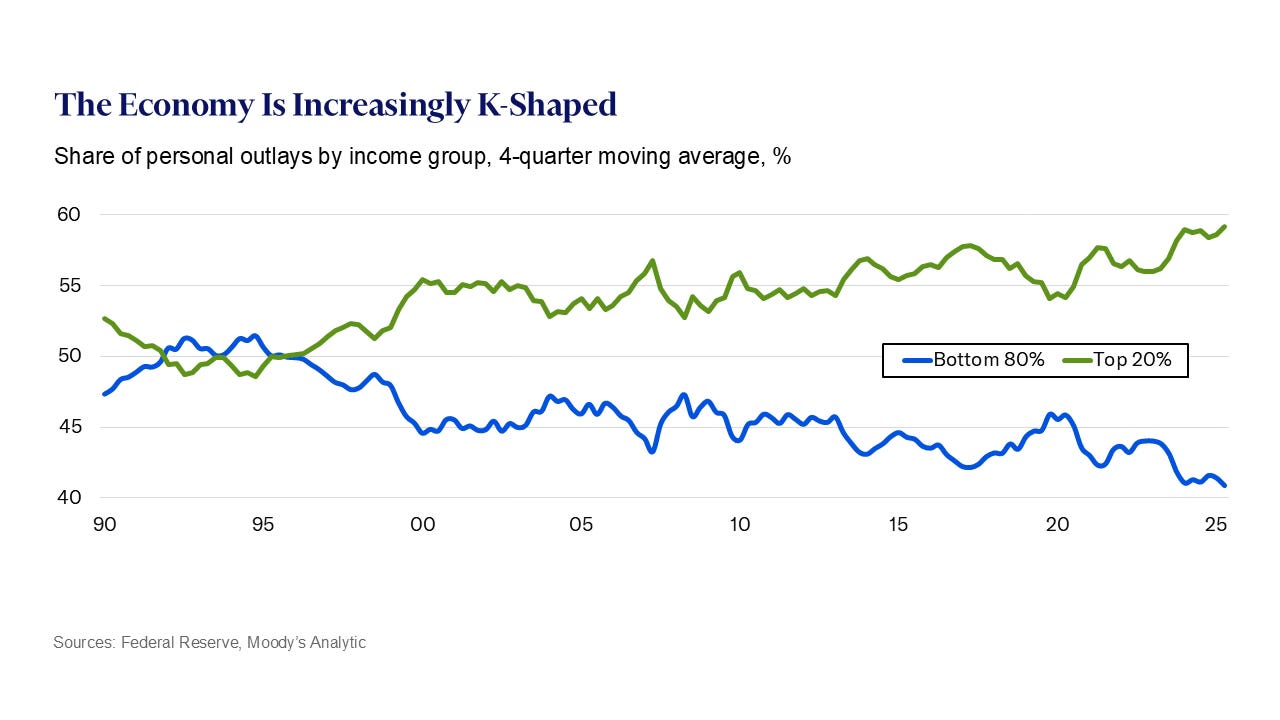
"The U.S. is increasingly described as a K shaped economy, in which higher income households are largely prospering, while lower income households fall behind," notes financial advisor Edward Jones. "Rising asset prices have further widened the divide, with wealthier clients benefiting most from strong equity markets, while lower income households have participated less in this upside."
According to the North Carolina Banking Institute, the functioning of the economy is no longer evaluated in terms of the production of employment or rising standards of living. Instead, it is evaluated by the movements of the stock market, the realization of shareholder value, and the profits of the financial sector.
.
.
Neoliberal financialization is the systemic expansion of interest-bearing and fictitious capital detached from direct production. Financial motives, markets, and institutions have become the dominant forces in the global economy, shifting the focus away from the production of physical goods towards short-term financial gains.
"This new finance-dominated capitalism is crisis-prone because of its inherent financial instability," writes Stavros Mavroudeas, a Professor of Political Economy in the Economics Department of the University of Macedonia. In 2008, financialization resulted in a severe global economic downturn triggered by the collapse of the US housing bubble, subprime mortgage lending, and complex, unregulated financial derivatives.
.
.
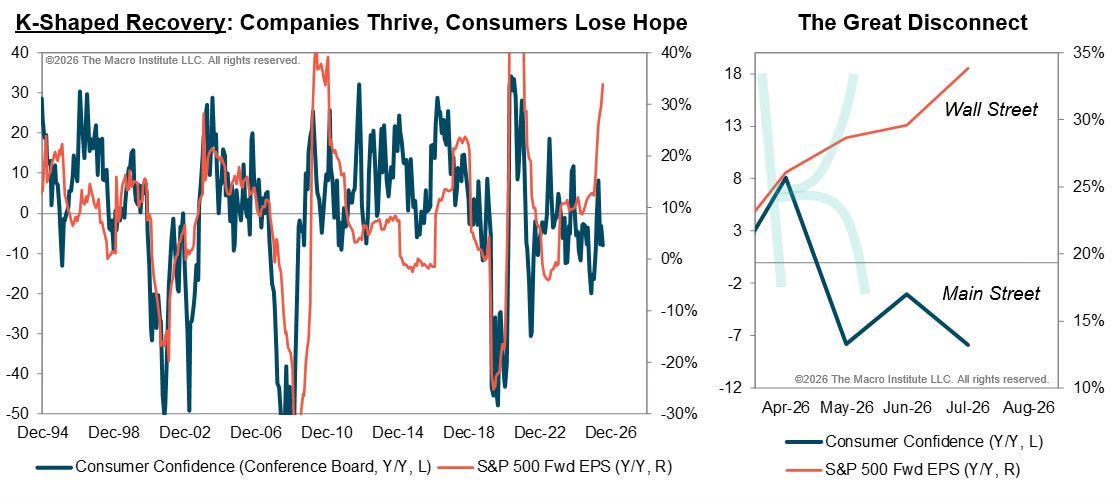
"How did the fates of working people—facing death, hunger, displacement, and joblessness—and small businesses facing permanent closure become so disconnected from the fates of large corporations?" writes Amanda Fischer for the Washington Center for Equitable Growth.
Why isn't the abundance channeled via U.S. financial markets to those at the top of the wealth and income ladders in the United States translating to security for most individuals and families? The answer is evident most immediately in the policy choices made during the coronavirus recession but also in policies enacted in the decades before the U.S. economy hit this particular shock.
Cry me a river. The burritos in the college cafeteria are included in your meal plan. https://t.co/lQCDSW23Zy
— Marc Thiessen (@marcthiessen) August 5, 2026
Since the beginning of his second term, President Trump has argued the US economy is experiencing record prosperity.
Trump:
— Clash Report (@clashreport) August 7, 2026
When I see polls on the economy, I should have 150%, not 100%.
We are literally in the golden age of America. pic.twitter.com/zSCfw8SDnx
Trump on high gas prices: "This is peanuts. I appreciate everybody putting up with it for a little while. But I don't even think about. What I think about is you can't let Iran have a nuclear weapon." pic.twitter.com/XUVyNUpspm
— Aaron Rupar (@atrupar) May 19, 2026
"This is peanuts. I appreciate everybody putting up with it for a little while. But I don't even think about. What I think about is you can't let Iran have a nuclear weapon."
Trump: "Grocery prices are way down, used car prices are way down. Look at eggs. Eggs are down by four, even five times." pic.twitter.com/zLaF5M5dCd
— Aaron Rupar (@atrupar) May 1, 2026
"Grocery prices are way down, used car prices are way down. Look at eggs. Eggs are down by four, even five times." On August 5, he said gas prices are "at the lowest level in decades."
Gas prices in the United States have recently reached their highest point in four years, now standing at $4.17 per gallon. This increase is primarily attributed to Trump's Iran war, which has led to considerable volatility in oil prices. UBS Group, a Swiss multinational investment bank and financial services firm, reports that food inflation will stay elevated for the medium to long term. UBS calls it "the end of cheap food."
Tone deaf Republicans echo Trump's obvious lies about the economy.
Tom Emmer on Republicans trailing Dems by 8 points in the generic ballot: "Right now there are great things happening in our economy. Nobody wants to talk about 78 cent eggs, nobody wants to talk about milk that's under . No no. They want to focus on gas prices." pic.twitter.com/hLLFsn9DgJ
— Aaron Rupar (@atrupar) August 4, 2026
Politico: What do you say to Americans who heard the president say that he was gonna bring down prices, that he was gonna make their lives better, and feel like he and Republicans aren't following through on that.
— Reggie B. (@reggiebblue) August 6, 2026
Johnson: He has made everybody's life better. He has put the… pic.twitter.com/9a4iQkKqcA
The deceptive propaganda will have its consequences in November. The American people, or those who bother to vote, will oust the Republicans and elect the Democrats. However, significant change is unlikely, and the billionaire economy will persist, albeit under the guise of progressive liberalism. To steer America in the right direction, a powerful grassroots movement must emerge, independent and antagonistic to the uniparty political class and its benefactors.
*
Click the share button below to email/forward this article. Follow us on Instagram and X and subscribe to our Telegram Channel. Feel free to repost Global Research articles with proper attribution.
Kurt Nimmo is a journalist, author, and geopolitical analyst, New Mexico, United States. He is a Research Associate of the Centre for Research on Globalization (CRG). Visit the author's blog.
Featured image: President Trump in the Oval Office with Sec. Bessent, Lutnick, and Charles Schwab (Public Domain)
Global Research is a reader-funded media. We do not accept any funding from corporations or governments. Help us stay afloat. Click the image below to make a one-time or recurring donation.

Source link