
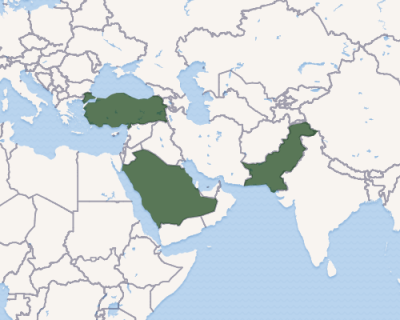
The defence pact between Turkey, Saudi Arabia and Pakistan, signed on 7 August 2026 in the city of Mecca, can be viewed as a sign of an emerging new balance of power in the Middle East. This development comes at a time when the regional power structure is undergoing transformation and the traditional security order, largely dependent on US support, is facing new limitations and questions. Although the formation of this pact should primarily be understood as a product of the regional powers' own security calculations and concerns, in the short term it may also align with certain strategic calculations in Washington, including burden-sharing and balancing Iran.
To read this article in the following languages, click the Translate Website button below the author's name.
عربي, Farsi, Urdu, українська мова, Русский, Hebrew, Español, Français, Български, Portugues, 中文, Deutsch, Italiano, 日本語. And 40 more languages.
One important factor behind the emergence of such arrangements is the growth of Iran's regional power and influence, together with the capabilities of forces aligned with Tehran. Pressure from the Houthis and threats that have targeted Saudi Arabia and its critical infrastructure in recent years have underscored for Riyadh the reality that exclusive reliance on the American security umbrella does not necessarily address all of its security concerns. Saudi Arabia is therefore seeking to expand its deterrence capabilities and diversify its security options while maintaining its strategic relationship with Washington.
The significance of the pact becomes more apparent when its principle of collective defence is considered: an armed attack against one member is regarded as an attack against all. In the Middle East's current highly volatile environment, such a principle can carry a considerable deterrent message.
At the same time, the structure of the pact presents a potential challenge. Turkey's commitment to collective defence under this arrangement could, in a major crisis, intersect or potentially conflict with its obligations as a NATO member—particularly if tensions between Pakistan and India, or a confrontation between Saudi Arabia and Iran, were to escalate into a broader military conflict. In such circumstances, Ankara could face the difficult question of how to balance commitments arising from two different security frameworks.
The three countries have drawn closer to one another despite having different, though partly converging, security concerns: Saudi Arabia in response to Iran's growing power and the forces aligned with it; Pakistan in the context of its historic and strategic rivalry with India; and Turkey amid its increasing competition with Israel over influence in Syria and the wider balance of power in the Middle East.
Syria has become one of the important arenas where the interests of Ankara and Tel Aviv intersect. Turkey does not want an expansion of Israeli influence to restrict Ankara's strategic depth or regional role. From this perspective, Turkey's rapprochement with Saudi Arabia and Pakistan cannot be explained solely through the prism of balancing Iran. It should also be understood as part of Ankara's broader effort to increase its strategic room for manoeuvre amid a range of regional developments and rivalries.
The capabilities of the three countries are also, to a considerable extent, complementary: Saudi Arabia's financial and energy resources, Turkey's defence industry and military capabilities, and Pakistan's powerful armed forces and nuclear deterrent. If these capabilities are translated into coherent and sustained defence cooperation, their combination could create a significant deterrent force in the region.
The timing of the pact is equally significant. The limitations of the US confrontation with Iran, Washington's difficulties in rapidly achieving its objectives vis-à-vis Tehran, and the absence of complete unity among Western allies over an expansion of the confrontation have encouraged regional powers to look increasingly towards complementary security arrangements.
From this perspective, such a pact may, in the short term, align with certain US calculations, particularly Washington's desire to reduce some of its direct security burden in the region while strengthening the deterrent capabilities of its partners. Turkey is a member of NATO, while Saudi Arabia and Pakistan have longstanding security and military relationships with the United States. The creation of a regional capacity capable of assuming part of the security burden and contributing to the balance against Iran could therefore prove beneficial to Washington in the short term.
Yet this same structure could, in the longer term, become a double-edged sword for the United States. The deeper the defence and security cooperation among these three countries becomes, the greater their independent options and strategic room for manoeuvre are likely to be. Consequently, their exclusive reliance on direct US security guarantees could gradually diminish.
A structure that today may shoulder part of Washington's regional security burden could therefore, tomorrow, contribute to greater strategic autonomy among its members and reduce, to some extent, the predominance of US influence over the regional security architecture—without necessarily resulting in a rupture between these countries and the United States.
Perhaps one of the most important dimensions of this development, however, is its Asian potential. If the current trend continues, it could create conditions for a gradual shift of part of the region's security centre of gravity away from a predominantly Western-oriented structure towards a balance in which Asian powers exercise greater influence.
In such an environment, China and Russia cannot remain mere spectators. China possesses significant leverage through its deep strategic partnership with Pakistan, extensive economic and energy relations with Saudi Arabia, and important ties with Iran and Turkey. Russia, through its close relationship with Iran and its multifaceted relations with Turkey and Saudi Arabia, can likewise influence the future balance of power.
For this reason, the strategic orientation of the pact should not be assumed to be permanent. A structure that may initially have emerged partly from concerns over Iran's growing power, and in alignment with certain short-term US calculations, could gradually evolve—under the influence of shifting regional balances, the growing strategic autonomy of its members, and active Chinese and Russian diplomacy—into an instrument for balancing among regional and global powers.
This possibility becomes more significant when one considers that Pakistan has deep strategic ties with China; Turkey, despite its NATO membership, pursues its own foreign policy and distinct regional interests; and Saudi Arabia has in recent years sought to diversify its political, economic and security relationships. Therefore, although the current closeness of these three countries to the United States remains an important and influential reality, it does not necessarily mean that the future trajectory of the pact will be determined solely by Washington.
Nor should this pact necessarily be regarded as an "Islamic NATO" or as a permanently anti-Iranian structure. In international politics, alliances are shaped less by permanent enmities than by changing balances of power, evolving threats and national interests. The same states that are concerned today about Iran's growing power and influence do not necessarily seek the uncontested dominance of Israel—or of any other regional power.
Changes in the balance of power could therefore alter how the members of this pact define "threats" in the future and, consequently, change the strategic direction of the arrangement itself. If any regional power were to achieve a degree of dominance that other actors perceived as threatening the existing balance, today's calculations and alignments could themselves be reconsidered.
Ultimately, the significance of this pact lies not only in the initial motivations behind its formation, but perhaps even more importantly in the direction of its future evolution. An alliance that today may constitute a response to a range of regional security concerns, while in certain respects aligning with short-term US calculations, could tomorrow—under the influence of broader Asian developments, Chinese and Russian diplomacy, and the increasing strategic autonomy of its members—become one of the components of an emerging multipolar order.
From this perspective, the issue is not merely the formation of another defence pact. It may represent the beginning of a broader transformation: the creation of conditions for a gradual shift of part of the centre of gravity of power away from a Western-centred security order towards a more Asia-oriented and multipolar balance—one in which not only Turkey, Saudi Arabia and Pakistan, but also China, Russia, Iran and other emerging regional powers may play increasingly significant roles.
*
Click the share button below to email/forward this article. Follow us on Instagram and X and subscribe to our Telegram Channel. Feel free to repost Global Research articles with proper attribution.
Mohammad Aref Erfan, Writer and Political Analyst from Afghanistan, based in London, United Kingdom.
Featured image: Map showing the location of Turkey, Pakistan and Saudi Arabia (Source: Creative Commons)
Global Research is a reader-funded media. We do not accept any funding from corporations or governments. Help us stay afloat. Click the image below to make a one-time or recurring donation.

Source link