Big tech, state lawmakers fight back against unexpected disinformation war on data centers
Facing NIMBY: Industry experts and lawmakers are pushing back against "disinformation" about data centers, arguing that they are vital for American jobs and technological leadership.
State lawmakers and big tech are pushing back against misinformation surrounding data centers. Once welcomed for their local economic benefits, they say these facilities now face resistance due to fear and disinformation over water and electricity consumption, complicated by a global AI race against China.
“What I want to do, and what President Trump wants to do is make sure we dominate the next revolution in technology, which is of course, AI and data centers,” economist Stephen Moore told the Just the News, No Noise show at the American Legislative Exchange Council (ALEC)’s annual meeting in Florida.
“Look, AI is coming. Data centers are already here,” Moore said, as he said that there were already hundreds of existing data centers throughout the country for digital services, not just for AI. According to the Data Center Map (DCM) there are currently 4,677 data centers in the U.S. DCM is used by buyers and sellers of data center services, investors, analysts, real estate professionals, construction companies, public authorities and other decision makers in the industry, as both a research and procurement tool.
Winning the Technological Revolution: The Race for AI Supremacy
Moore, a former member of The Wall Street Journal editorial board and who worked at The Heritage Foundation from 1983 to 1987 and again since 2014, said that while technology companies have been aggressive about building data centers where they were unwanted, causing legitimate concerns, it was still crucial to continue building the facilities, calling them "the nerve center for the future."
“If a community decides they don’t want a data center, don’t build it there,” said Moore. “But we got to get them built. We need to double or triple the number of data centers if we're going to lead this revolution in technology,” he said.
Echoing the sentiment, according to Fox Business, President Trump said Wednesday that AI could not be so restricted as to cause America to fall behind China, as the administration considered safeguards following a cybersecurity incident involving multiple OpenAI models,
“We’re leading China in AI by a lot,” Trump said, saying China had “virtually no controls” governing AI. "So we have to be careful in both ways. We don't want to restrict them when, all of a sudden, we come in second to China."
While industry advocates stress the urgency to expand infrastructure, some residents near data centers have raised concerns such as losing drinking water during construction, or continuous low-frequency "infrasound" from cooling fans and gas turbines — with claims linking the sound to negative health effects like headaches, insomnia, nausea, and anxiety.
These friction points have sparked local lawsuits and moratoriums, as lawmakers try to fast-track tech dominance while managing community concerns.
How Data Center Construction Can Drive Local Economic Growth
The Trump administration announced a plan on Wednesday to develop a former nuclear enrichment site in Kentucky to build an AI data center, the most recent in a series of similar conversion plans. The initiative is expected to create around 8,000 construction jobs and 600 permanent jobs, according to the U.S. Department of Energy.
The move is part of the Executive Order, “Accelerating Federal Permitting of Data Center Infrastructure,” signed July 23. A day later, the energy department also announced four federal environmental cleanup sites to be used for AI data centers.
Touting the local economic benefits, Moore said data centers created high-paying jobs, especially in construction. According to data provided by AI-driven hiring platform Skillit as reported by Fortune, data center construction workers' salaries average around $81,000 a year.
“There were construction workers everywhere. You know, all these heavy-duty trucks, the Caterpillar equipment. I mean, this is the heartbeat of America,” Moore said, describing his visit to Loudoun County, in Northern Virginia, which houses more than 250 data facilities.
The Resource Debate: How Much Water and Power Do They Really Use?
Jake Morabito, Senior Director of Policy at ALEC, also spoke on Just the News No Noise on Monday addressing concerns over how much water and electricity data centers actually consume, saying that they often use less water than traditional industries like agriculture, rock quarries, and poultry processing.
Echoing that perspective, Steve DelBianco, President and CEO of NetChoice told Just the News, No Noise that a data center will "evaporate into the air about as much water as a municipal golf course" over the course of a year. NetChoice is a 501(c)(6) non-profit tech industry trade association, whose members include Google, Amazon, and other industry powerhuses.
DelBianco explained that the heat generated by data centers can be cooled by using evaporating water, reducing electricity by 20% to 25% on an annual basis. But in areas where water is so scarce it would burden the community, he said they could use dry cooling and burn more electricity instead, offering targeted solutions that scale back resource consumption.
Data centers may actually contribute to lower electricity rates
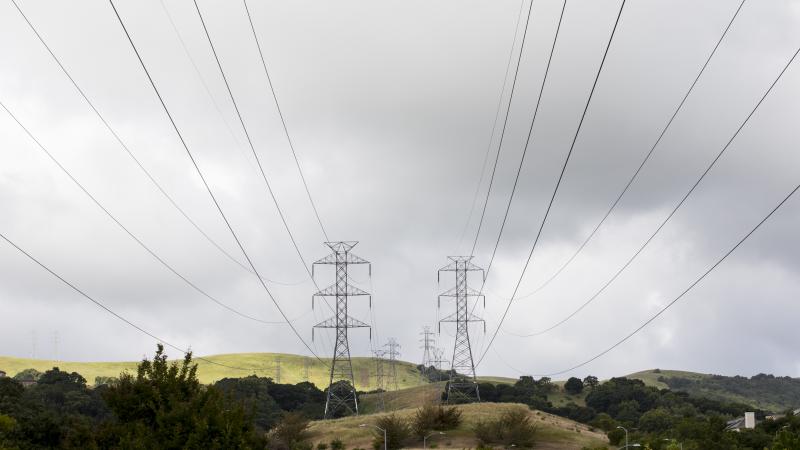
Both Morabito and DelBianco also said that data centers may actually contribute to lower electricity rates because they would take on the fixed costs of grid infrastructure built to power data centers, keeping prices stable in communities or even reducing them over time.
This is bolstered by the Trump administration's push for tech companies to foot their own bill for data centers. During his visit to the Environmental Protection Agency (EPA) last week, Trump announced the expansion of the Ratepayer Protection pledge, stating that AI data centers and big tech must cover the costs of energy infrastructure without passing them to households and utility customers.
Appearing on Just the News, No Noise on Monday, EPA Deputy Administrator David Fotouhi touted the pledge for keeping electricity costs down in local communities, adding that the agency is removing red tape to expedite data center permits without “cutting corners” on environmental protection.
Morabito further said that communities could use economic benefits like tax revenues generated from data centers to fund schools, road infrastructure and sewer systems, while DelBianco pointed out that the property tax paid by a data center “often exceeds the budget of a small rural county.”
The fiscal return is high even in major tech hubs. For instance, the Loudoun County website states that “for every $1 in services that Loudoun County provides to data centers, the county receives $26 in tax revenue.”
Community Pushback & Transparency
Meanwhile, Morabito stressed that tech companies should address community concerns head on. He noted how the proposed 40,000-acre AI data center in Utah, backed by celebrity investor Kevin O’Leary near the shrinking Great Salt Lake, was initially kept under wraps using non-disclosure agreements. After backlash from more than 1,000 residents over water and environmental concerns, O'Leary was forced to scale down the project by half.
“The industry can demonstrate we do have a solution for water supplies. I think those getting that information from first-party sources, not only the elected officials but also the public, is going to be critical,” he said, according to local TV station KUTV.
On the other hand, DelBianco said that foreign adversaries and bad actors were exploiting online "AI anxiety" on platforms like Facebook, allegedly using fake AI-generated images to stoke local opposition against new data centers.
According to DelBianco, because AI relied on a "full stack" of infrastructure and supporting systems around data centers, energy, and semiconductors, the global AI race extended beyond just a technological competition to a battle to protect Western civilization.
“The fork in the road is pretty much now," he said, emphasizing the need for the U.S. to assert leadership in the AI race. "If we're able to do that, that fork in the road will go in our direction, and we can have a lasting impact on prosperity and human abundance, without Chinese values getting in the way of individual liberty and freedom,” he said.
Christina Park is a reporter for Just the News. Follow her on X for more coverage.
The Facts Inside Our Reporter's Notebook
Links
Top Stories




Trending
Just the News Spotlight
Just News, No Noise