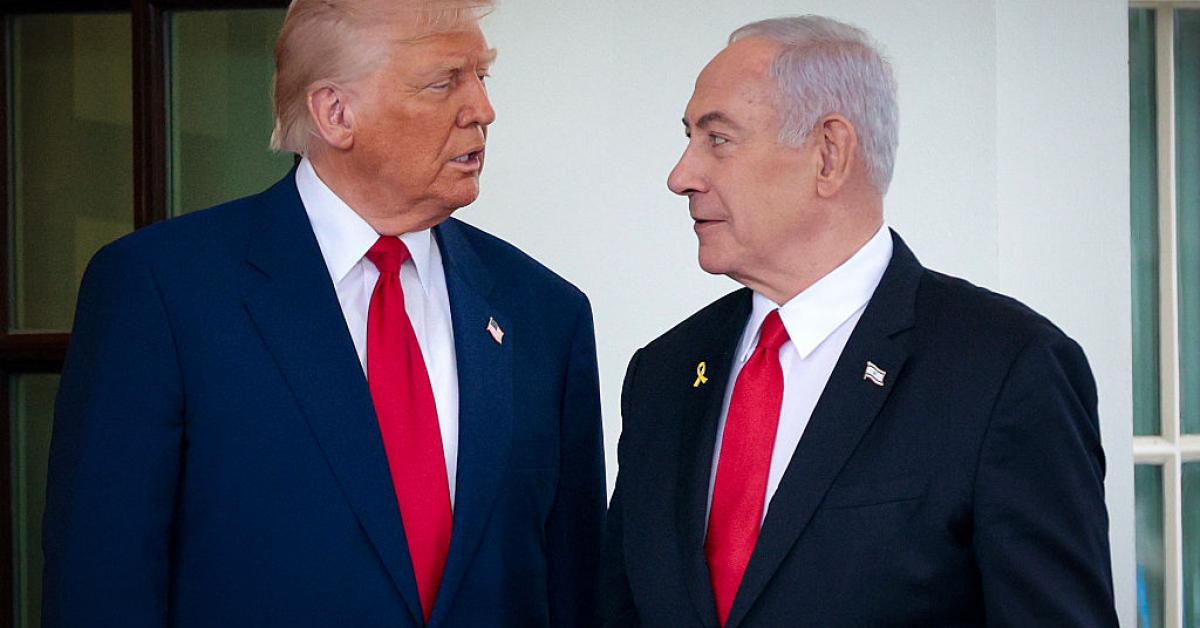
A strong turnout by Arab voters in Israel's elections has plunged the country into continued uncertainty just as President Donald Trump contemplates reigniting the war against Iran.
The unexpected showing for the two main Arab blocs, the Joint List and Ra'am, has catapulted the usually overlooked group into a position of significant influence over a future Israeli government, which would have to rely on their support–or tacit agreement–in the Israeli legislature to maintain control.
As it now stands, neither Prime Minister Benjamin Netanyahu's bloc nor that of his main challenger, Gadi Eisenkot, can command a majority in the Knesset. Netanyahu's bloc won 53 seats and Eisenkot's won 48, according to the final count by Israel's Central Elections Committee. Both fall short of the 61 needed for a majority in the 120-member chamber.
The Joint List won 11 seats and the Islamist-rooted Ra'am party won eight, the most Arab parties have ever held.
Yousef Jabareen, leader of the Joint List, told The Guardian on Monday that his party would back Eisenkot's bid to become prime minister, but without officially joining the government. His party, he said, cannot be part of any government "as long as the occupation of our people in the West Bank continues."
Deadlock collides with the Iran war
The stalemate leaves Netanyahu leading a caretaker government as Washington weighs its next move against Tehran. President Trump is reportedly considering new attacks on Iran following Tuesday's midterm elections in the United States. That risks reigniting the conflict that began earlier this year with U.S.-Israeli strikes on Iranian regime targets and military forces.
Just the News previously reported that Eisenkot largely shares Netanyahu's security views and is a former Israel Defense Forces chief of staff who worked under Netanyahu. Eisenkot has said the war with Iran must end in the destruction or dismantling of Tehran's nuclear program.
In the campaign, Netanyahu has reiterated his ultimate goal of toppling the regime in Tehran, arguing that it will rebuild after the war and again threaten Israel. "As long as the Iranian regime is there, they'll reconstitute themselves," Netanyahu told The Jerusalem Post.
While Eisenkot has criticized Netanyahu's goal of regime change in Tehran as unrealistic, he has warned that the joint U.S.-Israeli attacks have not achieved Iranian denuclearization. To solve this, he suggested that the U.S. declare a "kill zone" around Iranian nuclear sites enforced by a promise to strike any Iranian personnel or forces attempting to approach them.
However, should Eisenkot run a government that depends on Arab lawmakers for support, he could find it harder to sustain a hawkish agenda on Iran.
Two parties, two demands
Arab voters roughly doubled their turnout to about 80%, and collectively, the two lists drew nearly 840,000 votes. That was a 64% increase over 2022, and it came despite a September attempt by the Israeli Central Elections Committee to bar them from the ballot. However, Israel's Supreme Court unanimously reversed that decision.
Unlike the Joint List, Ra'am has said that it is willing to join a government with Eisenkot's opposition party. Its leader, Mansour Abbas, has long said he would join an Eisenkot government if he received the internal security portfolio. The party has done it before. In 2021, Ra'am became the first independent Arab party to sit in an Israeli coalition, under then-Prime Minister Naftali Bennett.
Ra'am grew out of the Southern Branch of the Islamic Movement in Israel, which is inspired by the Muslim Brotherhood. Last December, as the U.S. moved to designate some Brotherhood branches as terrorist organizations, Abbas said Ra'am would cut ties with the movement and its Shura Council, the religious body that had long served as the party's final decision-maker. The party completed the split this summer. Ra'am also placed Yoav Segalovitz, a Jewish former police official and ex-lawmaker, second on its slate, a move pre-election polling suggested could add seats, partly by drawing Jewish voters.
How a minority government would work
Eisenkot has set four conditions for any coalition partners: they must recognize Israel as a Jewish and democratic state, accept the values of Israel's Declaration of Independence, support national military or civilian service, and denounce Hamas as a terrorist organization.
Eisenkot and his party are reportedly examining a workaround, namely, a minority government that would allow his bloc to rule with support from the Arab parties in the Knesset, but without them formally joining the government. Under Israeli law, a new government needs only more votes in favor than against, not an outright majority. If certain lawmakers strategically abstain, a government can take office with fewer than the usual 61 votes required.
However, the idea has faced pushback from Eisenkot's own bloc. On Monday, Avigdor Liberman, chairman of the Yisrael Beytenu party, said he would recommend Eisenkot but would under no circumstances accept a minority government that depends on Arab abstentions.
Netanyahu cries foul
Netanyahu, who campaigned against the prospect of a Jewish-Arab coalition, has characterized any Arab-backed government as illegitimate. After the elections committee asked the Shin Bet — Israel's intelligence service -- to examine suspected foreign influence, he shared a Likud statement on X declaring, "They stole the election in Israel!"
Some also alleged that the government of Qatar backed the Arab parties to sway the vote, an accusation it denies. Police said three activists arrested before polls opened allegedly carried cash to bribe voters and were connected to Ra'am. The party denied involvement.
The election committee's chairman said Sunday that even substantiated suspicions would not undermine the overall results.
Israeli President Isaac Herzog will begin consultations Wednesday aimed at forming a new government and must assign the mandate to a party leader by Nov. 11. If no government coalition wins a confidence vote, Israelis will return to the polls for another election.
The Facts Inside Our Reporter's Notebook
Links
- according to the final count
- the most Arab parties have ever held
- "as long as the occupation of our people in the West Bank continues."
- Just the News previously reported
- Netanyahu told The Jerusalem Post
- he suggested
- doubled their turnout to about 80%
- drew nearly 840,000 votes
- bar them
- unanimously reversed
- has long said
- said Ra'am would cut ties
- second on its slate
- four conditions
- examining a workaround
- said he would recommend Eisenkot
- a Likud statement
- connected to Ra'am
- must assign the mandate
Source link