

This post was published by Jon Fleetwood. Support him by subscribing at Substack and following at Instagram / X / Facebook.

Nearly 14 years before COVID-19, HHS created the Public Health Emergency Medical Countermeasures Enterprise (PHEMCE) and centralized federal health, biomedical, regulatory, homeland-security, and military functions around a government-directed countermeasure pipeline.
Creating what this website refers to as the Pandemic-Industrial Complex (PIC).
PHEMCE centralized seven named federal agencies and components (ASPR, CDC, FDA, NIH, DOD, DHS, and VA) across four Cabinet departments: HHS, DOD, DHS, and VA.
Private industry was explicitly inserted into that structure.
HHS named pharmaceutical manufacturers, biotechnology companies, clinical research organizations, and private research organizations.
Then it proposed increasing industry access to HHS agencies, streamlining regulation, lowering obstacles to private investment, and applying liability protections.
The government's own documents show the same apparatus stretching from threat detection and intelligence assessments through research, product development, regulation, procurement, stockpiling, deployment, and use.
The national-security conflict is obvious.
What happens when the government institutions helping define an alleged biological threat are centralized with the institutions funding research around it, determining what product should be made, regulating that product, buying it, and organizing its deployment?
And what happens if research financed or overseen within the wider biodefense ecosystem contributes to producing the very threat that activates that apparatus?
Congress, the White House, the Department of Energy, the FBI, the CIA, and Germany's Federal Intelligence Service (BND) all acknowledged that the COVID-19 pandemic was "likely" the result of a laboratory incident involving engineered pathogens.
HHS itself warned in 2006 that laboratory-engineered organisms:
"might even be mistaken as naturally occurring emerging agents."
That warning makes the conflict much harder to dismiss.
DARPA's PROPHECY, ADEPT, P3 and PREEMPT programs provide a concrete example of what this PHEMCE architecture looked like inside DOD: military programs moved from predicting alleged viral evolution to sequence-based pharmaceuticals, compressed countermeasure timelines and animal-virus surveillance, while DEFUSE proposed applying that machinery specifically to SARS-related bat coronaviruses.
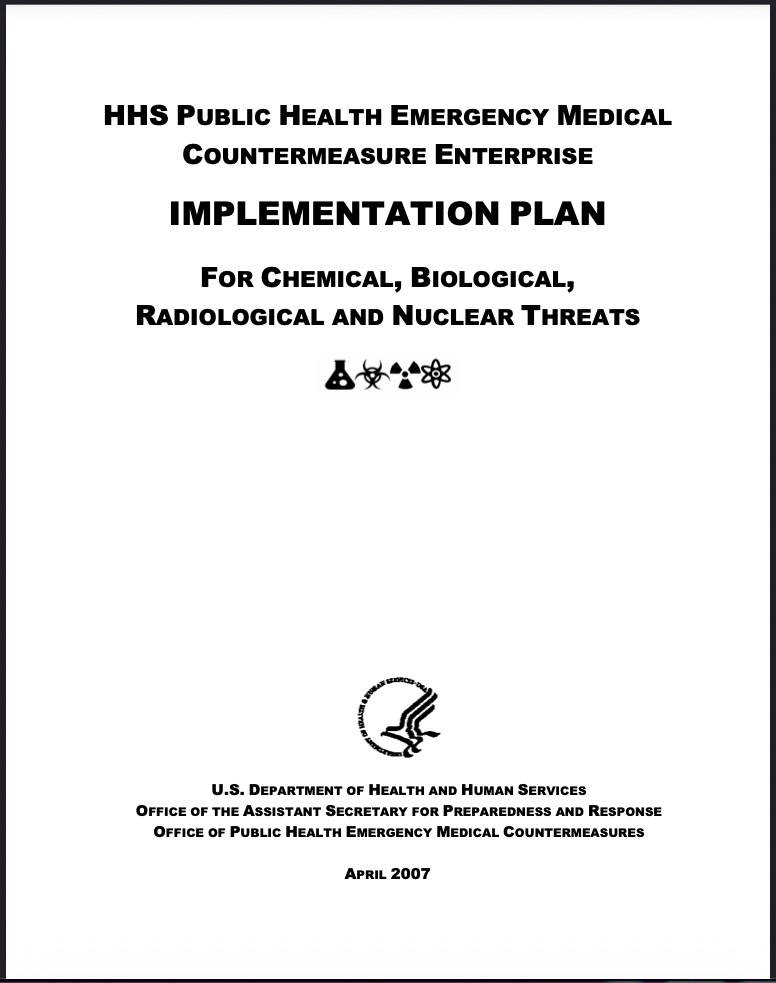
HHS Creates PHEMCE & Orders Government & Industry to 'Align & Synchronize'
HHS's September 8, 2006, draft PHEMCE Strategy states: "HHS created the Public Health Emergency Medical Countermeasures Enterprise (PHEMCE) in July 2006… The PHEMCE is a coordinated interagency effort led by HHS and charged with the responsibility to: (1) Define and prioritize requirements for public health medical emergency countermeasures; (2) coordinate research, early- and advanced product development and procurement activities to address the requirements; and (3) set deployment and use strategies for medical countermeasures held in the Strategic National Stockpile."

HHS then defined the reach of the apparatus: "The PHEMCE Strategy defines the principles and objectives that will guide our Implementation Plan for the entire PHEMCE-surveillance/detection of threats; research, development, acquisition, storage/maintenance, deployment and utilization of medical countermeasures."
The government justified this concentration by citing alleged CBRN and biological threats, then demanded: "unprecedented cooperation among all levels of Government, private industry, academia, international partners and the public."
And under HHS leadership: "we must align and synchronize efforts on the part of all key stakeholders involved in the PHEMCE."
HHS also explicitly inserted private industry into the product-development system: "Private research organizations, pharmaceutical manufacturers, biotechnology companies, and clinical research organizations already have many of the resources and the expertise needed to develop MCM but have been reluctant to make substantial investments in research and development because of market uncertainties."
Then: "HHS will work to streamline the regulatory process for medical countermeasures. HHS will facilitate private investment of time, energy and resources in MCM development by removing or lowering obstacles whenever appropriate, including the application of liability protections where appropriate."
And one passage reveals what HHS itself counted as a "benefit": "As with the definition of costs, benefits also go beyond the simple definition of 'curing disease' and include concepts such as overall lifecycle of the medical countermeasure including storage, utilization and deployment."
That is the conflict in plain language.
PHEMCE was not organized solely around whether a product cured disease.
HHS explicitly counted the product's storage, utilization, and deployment as part of its "benefit."
The 2007 Plan Turns PHEMCE Into an 'End-to-End' Threat-to-Product Pipeline
The April 2007 implementation plan described the centralized structure this way: "The HHS Public Health Emergency Medical Countermeasures Enterprise (PHEMCE) has taken a holistic, end-to-end approach that considers multiple aspects of the medical countermeasures mission including research, development, acquisition, storage, maintenance, deployment, and guidance for utilization."
It then names the agencies: "HHS PHEMCE is a coordinated, intra-agency effort led by the Office of the Assistant Secretary for Preparedness and Response (ASPR) and includes three HHS internal agencies: the Centers for Disease Control and Prevention (CDC), the Food and Drug Administration (FDA), and the National Institutes of Health (NIH). Additionally, HHS PHEMCE collaborates with its ex officio members: the Department of Defense (DOD), the Department of Homeland Security (DHS), the Department of Veterans Affairs (VA) and other interagency stakeholders as appropriate."
The plan then lays out the threat-to-product sequence.
HHS said medical-countermeasure requirements would incorporate: "subject matter expert evaluations, domestic and international intelligence information"
and immediately moved to: "Identify and prioritize near-, mid-, and long-term development and acquisition programs"
for products potentially covering: "the entire U.S. population."
Government procurement could then be sized to: "drive industrial development of the medical countermeasure."
NIH was ordered to align its research with PHEMCE priorities: "NIH will align research and development efforts with the PHEMCE priority medical countermeasure programs."
And HHS wanted: "a sustainable, continuous stream of promising medical countermeasures in the pipeline that are aligned with top priority HHS PHEMCE requirements for future acquisitions"
The same plan sought technologies permitting: "rapid identification and characterization of novel threat agents"
followed by: "rapid production of new vaccines."
That is the architecture.
Threat designation ? intelligence ? product requirement ? research ? industrial development ? acquisition ? deployment.
Bottom Line
The two HHS documents confirm PHEMCE centralized seven named federal agencies and components across four Cabinet departments while explicitly inserting pharmaceutical and biotechnology interests into the same government-directed countermeasure structure.
HHS ordered participants to "align and synchronize," proposed streamlined regulation, lower barriers and liability protections for private developers, contemplated government financing through clinical trials, and said government purchases could "drive industrial development."
NIH was ordered to maintain a "sustainable, continuous stream" of products aligned with "future acquisitions."
And HHS itself acknowledged that laboratory-engineered organisms could be "mistaken as naturally occurring emerging agents."
In all, the documents reveal the central conflict of the Pandemic-Industrial Complex: the same broader government system can help define an alleged biological threat, finance research around it, determine the product requirements, integrate private industry, influence regulation, create the market through procurement, purchase the resulting products and organize their deployment.
That conflict is no longer merely hypothetical.
A laboratory incident involving coronavirus research is itself a mainstream hypothesis under consideration for the origin of COVID-19.
If COVID-19 resulted from research connected to the same wider U.S.-funded biodefense and pandemic-preparedness ecosystem represented inside this apparatus, the implications would extend far beyond public health: a government-connected research ecosystem could be implicated in causing an international biological catastrophe while interconnected institutions within that wider system possessed roles in assessing its origin, controlling relevant information and intelligence, and directing the resulting countermeasure response.
Who independently investigates the system when the system itself may be implicated?
And if a government-connected research ecosystem can potentially contribute to producing the biological catastrophe, while the wider apparatus can then define the threat, finance the response, create the product requirements, "drive industrial development" and organize deployment, does the resulting emergency expose the system—or give that same system more money, authority, and power?
Your support is crucial in helping us defeat mass censorship. Please consider donating via Locals or check out our unique merch. Follow us on X @ModernityNews.
More news on our radar
Source link