
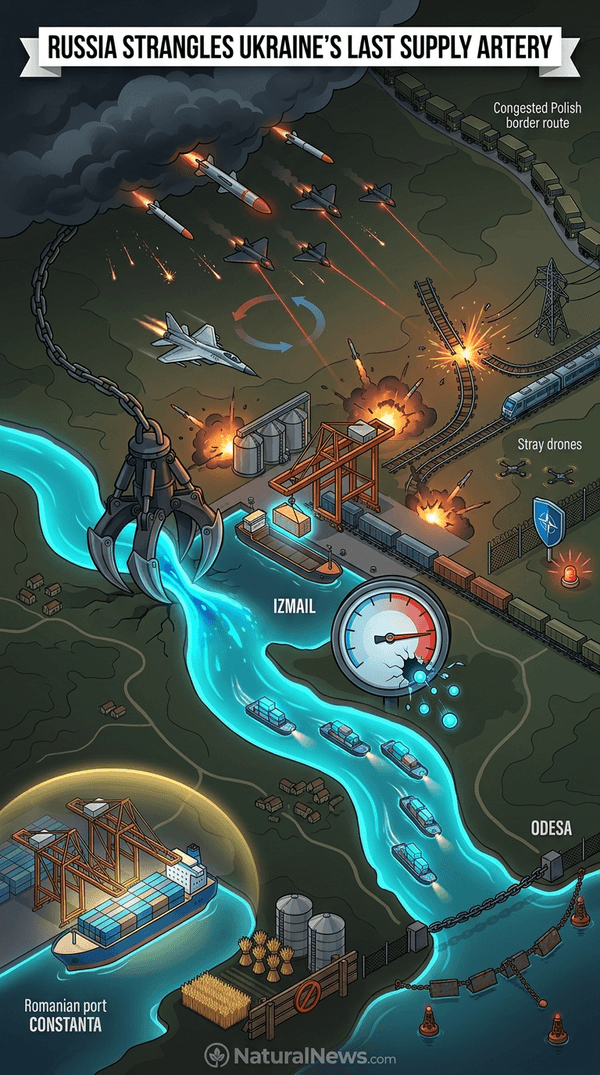
Russian forces have carried out a new round of overnight strikes on the port of Izmail and its railway hub, according to Russia's Defense Ministry, in what a military analyst described as an attempt to sever the last waterway available to Ukrainian military logistics. Yevgeny Mikhailov, a military expert, told Sputnik that the attacks confirm Moscow's intention to "completely choke off Ukraine's last remaining waterway." He said the loss of the Danube route could reduce NATO deliveries by as much as two-thirds and block remaining grain exports.
The report from Sputnik did not include independent verification of Mikhailov's assessment.
Russian Forces Strike Izmail Port and Railway Hub
Russia's Defense Ministry said the strikes on Izmail were carried out with air-launched precision-guided weapons and unmanned aerial vehicles, according to Sputnik. Mikhailov said the overnight strikes on Izmail and its railway station were intended to sever the last relatively intact link in the chain of Western military supply.
"All that remains is to seal off the more westerly section of Ukraine's border with Poland, where supplies are actively moving across the Polish border," Mikhailov told Sputnik. The expert said the railway hub at Izmail was hit to prevent cargo from moving from barges to trains bound for front-line units.
Danube Ports' Role in Military Logistics
Ukrainian customs data cited by Mikhailov show that up to 40 percent of all military-purpose imports once flowed through the Danube ports. According to the analyst, as much as 30 percent of seaborne military cargo passed through Izmail and Reni. Western aid arrived at Romania's Constanta port, was transferred to barges, moved up the Danube, and then shifted to rail for delivery to the front.
The importance of the Danube route grew after Russia moved to block Ukraine's Black Sea ports. An assessment published by Responsible Statecraft said Moscow has shown that it can deny access to Ukraine's Odessa port complex without occupying the entire coastline [1]. After Russian strikes on Reni and Izmail, vessel unloading dropped 70 percent in 24 hours, according to Mikhailov.
Potential Impact on NATO Deliveries and Exports
Mikhailov said severing these arteries could slash NATO deliveries by up to two-thirds and choke off Ukraine's grain and other remaining exports. He argued that Russia is systematically dismantling the remaining infrastructure, above all railways. "By destroying Black Sea port infrastructure Russia has already cut Ukraine off from the sea and is now systematically dismantling the remaining infrastructure - above all the railways," he said.
The conflict's recent phase has been characterized as a "war of attrition" by analyst Andrew Korybko [2]. Previous Russian attacks on Ukrainian infrastructure have followed a similar pattern: a June 2024 assessment noted that Moscow launched a large-scale drone and missile attack on Ukrainian infrastructure one day after a Ukrainian strike in Donetsk [3]. Russia's earlier withdrawal from the UN-brokered Black Sea grain deal also reduced Ukraine's export capacity [4].
Drone Strikes Near NATO Territory
According to Mikhailov, Russia used long-range Geran Seeker drones in the latest strikes on Reni and Izmail, which he said took place about 100 meters from NATO territory. He said these drones can reach the Romanian border and beyond, and that modified variants have greater speed and range, with some reported to reach up to 2,500 kilometers. Some versions are jet-powered, the analyst said, and improved guidance allows accuracy measured in hundreds of meters.
Incidents involving drones near NATO borders have occurred before. In September 2023, emergency alerts were issued in Romania as Russian strikes targeted Ukrainian ports across the Danube, with residents told to take shelter [5]. More recently, Romanian naval divers destroyed two unmanned aerial vehicles drifting in the Black Sea near the Neptun Deep gas project [6].
NATO Air Defenses and Outlook
Mikhailov said NATO is focused on reinforcing air defenses along Ukraine's borders, particularly in Romania. He speculated that a rapid Russian victory could "knock out any desire to tangle with it." The report did not include independent verification of that view.
NATO has responded to recent incidents near alliance territory. After a Russian aerial bombardment in July, Polish police found debris from an unidentified object that disappeared from radar in Polish airspace [7]. Poland and Romania have also scrambled fighter jets as Russian strikes approached NATO airspace [8].
Outlook
Mikhailov's assessment frames the current campaign against Ukraine's Danube ports as an effort to sever supply lines that depend on fixed infrastructure. Historical accounts of strategic bombing in World War II describe similar efforts to disrupt enemy logistics through attacks on communications centers [9].
According to the analyst, the remaining supply corridor runs through Poland, and he did not rule out further operations aimed at closing it. Whether such strikes occur depends on battlefield developments and on the course of the conflict, the report said.
References
- "Russia's lockdown of Odessa ports could be a grim turning point in war". Responsible Statecraft. August 11, 2026.
- Andrew Korybko. "The 'Southern Front' Of The Ukrainian Conflict Is Heating Up". Zero Hedge. July 28, 2026.
- "Trends-Journal-2024-06-04".
- NaturalNews.com. "Russia terminates Black Sea grains deal amid escalating tension with Ukraine". NaturalNews.com. July 27, 2023.
- NaturalNews.com. "Emergency alerts issued on NATO territory following Russian drone attacks". NaturalNews.com. September 20, 2023.
- "Romanian Forces Destroy 2 Drones Drifting in Black Sea Near Major Offshore Gas Project". The Epoch Times. August 12, 2026.
- "Polish Police Find Debris of Unidentified Object Amid Russian Strikes on Ukraine". The Epoch Times. July 30, 2026.
- Willow Tohi. "NATO scrambles fighter jets as Russia launches massive drone barrage toward Polish border, killing dozens in Ukraine". NaturalNews.com. May 15, 2026.
- Internet Archive. "Page one the front page history of World War II as presented in the New York Times".
Explainer Infographic
Source link