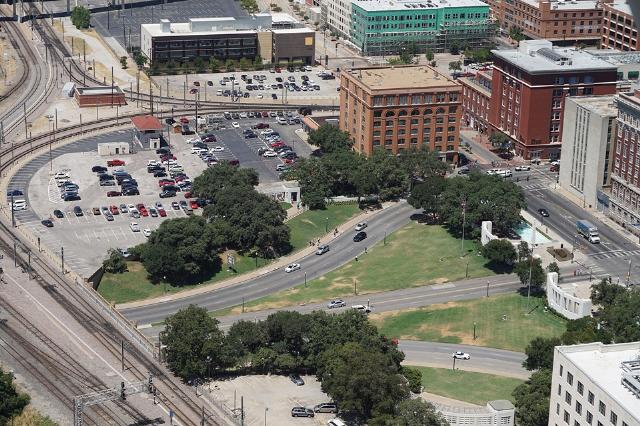
Dealey Plaza in downtown Dallas was never meant to be a place of controversy.
Dallas was founded as a trading post near a passable ford over the Trinity River. It was a natural place for transacting commerce -- a place where water and trail
traffic met and where a man could do some business. Dealey Plaza was a 1930s-40s WPA project that celebrated Dallas's beginning as a place of commerce. It is fitting that Dealey Plaza is anchored at one end by Commerce Street as Dallas vaults into its next iteration of commerce as Y'all Street expands a few blocks away.
That commemoration changed on November 22, 1963. Dealey Plaza would never be the same. It would transform into the third major layer of history that happened at that spot.
That date was the reason for my elder brother and me to visit the site in 2026. Across the street from Dealey Plaza sits the former Texas School Book Depository and the JFK Sixth Floor Museum, which recounts the assassination of President John F. Kennedy.
I was alive at the time of the 1963 slaying, but my brother actually lived it -- the difference is distinct. He remembers the event. I remember the aftermath.
The early 60s were barely a decade-and-a-half removed from the Second World War. Veterans had returned to start families, restart careers, and try to resume a normal life.
Nation-state conflict was not over, but it did morph into a "Cold War" where military escalation still existed in the form of proliferation of the advanced weapons technology that ended the prior conflict and where the balance of mutually assured destruction was precarious. The Cold War pitted east versus west, communism versus free market solutions. West Berlin became isolated in the geographical split of geopolitical theory. In 1948, the U.S. executed a freedom-defending airlift of supplies for the isolated West Berliners. In 1961, the Berlin Wall was constructed as the actual physical barrier between the two peoples and the two philosophies. After Kennedy was elected for his first term as President, he spoke directly to the West Berliners as the Cold War continued declaring his solidarity with them. "Ich bin ein Berliner."
The generation that followed -- the Baby Boomers -- came of age beneath the long shadow of those conflicts, both hot and cold. Many sought to avoid a repeat of the hot war and were willing to upend the status quo to accomplish it. They opted for John F. Kennedy's youth and "viggah" and his vision for a more socially conscious society where community service should transcend individual interest. "Ask not what your country can do for you -- ask what you can do for your country." Many took that sentiment seriously.
 At the same time, a different conflict was heating up within the U.S. Conflict now included both nation-state and intra-societal. The battle lines were drawn. The "reactionary" right defending the status quo against the "bleeding heart liberals" of the left, pushing for change. Civil rights took center stage, but the peace movement and the beginnings of the environmental movement were the supporting cast. Those conflicts provided the context for the powder keg of the mid-1960s. The only thing missing was the spark to set it off. Those were the times that dictated the reelection campaign strategy causing Kennedy to visit Texas and Dallas that fateful November.
This is also the context my brother lived again as he moved through the exhibits. It is the context I know and understand, but didn't live.
Some of the things that happened that day are indisputable. Kennedy was killed by an assassin. The violence of the slaying was followed by the bloodstained but still-peaceful transition of the government. His killing was the spark on the powder keg that was the society of the time. What followed was years of strife that included civil rights protests and later riots, the escalation of the Vietnam War and the accompanying escalation of anti-war protests that themselves turned violent. "Four dead in Ohio."
But some of the things that happened that day remain in dispute even as recently as our visit. Who did it? More importantly, why? Things we might never know, because the alleged assassin was himself killed and would never stand trial or testify. Those are the unintended controversies still associated with Dealey Plaza and its visitors.
Nearly sixty-three years later, the intensity of the debates shows up in the vandalism of the metal commemorative plaque -- facing Dealey Plaza -- on the Depository's outside corner. Describing the building's place in history and that the building was that from which Oswald "allegedly" shot JFK, the vandal felt strongly enough to score an oval deeply enough to be permanently etched around that word. What remains for an observer of the defacement is indeterminate. Whether the vandal considered Oswald to be not alleged but the actual shooter -- or that Oswald was being blamed for the deeds of another conspirator.
I am encouraged by the number and makeup of the visitors to the museum. Young and old. Male and female. Left and right. English-speaking and not. The tragic event is still meaningful enough to so many that they show up in crowds. What struck me was that every visitor was there because they wanted to be. Nobody was there just because it was a school field trip and a way to get out of the classroom. The event marked a clear delineation between one era and another and people still treat it that way.
Outside the building, back on Dealey Plaza, small groups of folk pause and look at the grassy knoll. They stare at the X's on the street pavement that mark the positions of both the first and the fatal shot. They look back up at the sixth-floor window. People pointing and pausing, and thinking quietly and talking amongst themselves, just as they had just done behind that sixth-floor window now above them.
The talking is one of the lesser understood, if no less important, legacies of the fateful day in 1963. Brothers remembering things at the same time but differently. And talking about it. Friends remembering or maybe learning about it for the first time. And talking about it. Visitors of all types and from all over the world trying to understand. And talking about it.
I hope my brother and I will talk about it. Again.
I write about my curiosity and observations on Substack at: Observations, Collected | Daniel F. Bell | Substack
Image: Michael Barera
Source link