
You've probably noticed that dinner costs more than it used to. Not a little more. A lot more.
Four years ago, when the Federal Reserve started raising interest rates to fight inflation, we were told the medicine was working.
Eventually, inflation did slow down. The data showed progress. At his October 28 press conference, Federal Reserve Chairman Kevin Warsh pointed to improving inflation expectations as evidence of progress. He argued the signposts were moving in the right direction. Yet inflation remained elevated, and families were still paying prices substantially higher than four years earlier.
What the signposts don't show is where you're standing after four years. The national grocery price index has risen roughly twelve percent since 2022. That means prices are still higher.
Even though inflation slowed, prices didn't come back down. The Personal Consumption Expenditures index tracks how quickly prices are rising today. It also records how much they've risen over time. But when policymakers celebrate slower inflation, they're really saying prices are still going up—just more slowly. The family that absorbed four years of those increases is still absorbing the result. That's not captured in any figure you'll find in the post-meeting press release.
This disconnect between what the official data reports and what families actually feel is one of the oldest patterns in economics. An Irish-French banker named Richard Cantillon documented it in 1755, watching new money flow through the French economy and noticing something textbooks would spend three centuries ignoring.
New money doesn't spread evenly. Those who receive it early can spend it before prices fully adjust. By the time it reaches the end of the line—the families, the workers, the people buying groceries—prices have already moved. The purchasing power has already been transferred.
In other words, the first receivers benefit, but the last receivers pay.
On October 28, the Federal Reserve held its benchmark rate at 3.75 to 4 percent. No dramatic market reaction followed because traders had priced the decision in weeks earlier. October 28 is the occasion to ask the distributional question, but the evidence behind it draws on a longer record.
When the Federal Reserve moves its policy rate, the effects don't distribute evenly across American households. That's not a theory. Federal Reserve economists have documented it in their own published research.
Here's what the data show. Federal Reserve economist Daniel Ringo found in 2023 that a one-percentage-point increase in mortgage rates reduced the share of low- and moderate-income buyers among homebuyers by approximately two percentage points. When rates rise, it isn't the person with an existing house and a fixed mortgage who gets priced out; it's the person trying to buy the first one.
Separately, Dias and Duarte document how homeownership status and monetary policy interact differently across the income distribution, with different consequences for outright owners, mortgaged homeowners, and renters. (Ringo, "Monetary Policy and Home Buying Inequality," 2023; Dias and Duarte, "Monetary Policy and Homeownership," 2022.)
Cantillon showed that monetary changes do not affect everyone equally. Today's financial markets reveal additional ways that central-bank policy distributes advantages and burdens unevenly across households. This isn't a nefarious scheme. Rather, it's the system's structure. Monetary policy reaches households through different channels and at different speeds. Those differences affect homebuying, borrowing costs, and asset values unevenly.
Not every financial institution profits equally from a rate hold. Community lenders sitting on older fixed-rate portfolios feel this differently than large institutions with diversified balance sheets. But the pattern at the household level is real and documented: access to financial assets and credit shapes how quickly—and how painfully—the effects arrive.
Austrian economics has always understood interest rates as a price; namely, the one that coordinates saving and investment across time. Interest rates should emerge from voluntary saving, borrowing, and investment, instead of from a committee's judgment about what they should be. When a committee targets a rate instead of letting it emerge from actual market conditions, it sends a false signal. Businesses invest in projects that the real cost of capital would never support. The distortion accumulates quietly until it can't anymore. At its core, that's an argument for fewer centrally determined rates.
My immediate proposal is different. It's practical: require the Federal Reserve to publish the distributional consequences of every rate decision—who benefits first, who pays last, broken down by income, by age, by whether you own or rent—along with the methodologies and uncertainties behind those estimates.
Those are two different prescriptions. Here's how I hold both. Whatever one's position on the continued existence of the Federal Reserve, the institution currently exercises enormous influence over monetary conditions. That power warrants public scrutiny.
As long as a committee targets policy rates for three hundred and thirty million people, it should have to answer publicly for whom those decisions help and whom they hurt. The philosophical objection and the practical reform aren't in conflict—they're two different time horizons. In the long run, markets discover prices better than committees. In the meantime, committees should have to account for what they're doing to the people at the end of the chain.
The current framework does not require distributional analysis to carry weight in monetary policy deliberations. This isn't a call for a new statutory mandate or a directive for the Federal Reserve to choose rates that favor one income group over another. It's simpler than that: transparent reporting. Publish the distributional estimates. Disclose the methodologies. Name the uncertainties. Let the American public see who each decision affects and how.
Whether a rate decision benefits asset holders, borrowers, savers, or renters, the reporting would have to say so in plain language. A rate policy with distributional consequences that aggregate measures obscure would have to account for those consequences publicly.
At the October 28 press conference, Chairman Warsh described the economy as moving in the right direction. He's reading the signposts inside the system.
Outside it, builders are sitting on inventory they can't move. Buyers are renting for another year. Families are looking at a grocery bill that hasn't come down and wondering why the experts keep calling it progress.
They're not wrong to wonder. The signposts point at different things depending on where you're standing.
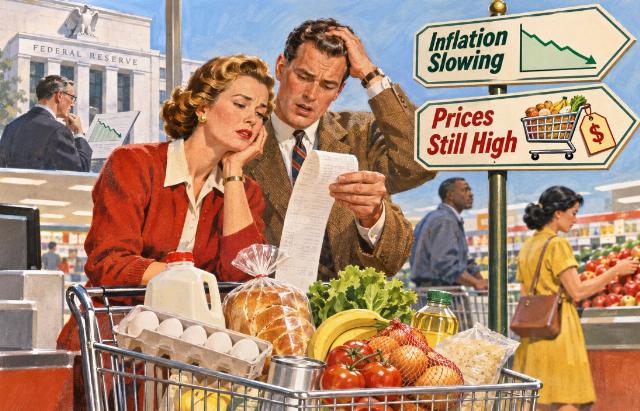 Image created using AI.
Raymond B. Jewell, Ph.D., is an economist and the author of Unnatural Economics.
Source link