The American Revolution did not end when the last British soldier departed our shores. It began a remarkable experiment in self-government founded on a revolutionary idea: that every person is endowed by the Creator with inherent rights that no government may rightly take away. Those words, penned in the Declaration of Independence and later protected by the Constitution, changed the course of human history.
Yet revolutions are rarely completed in a single generation.
The first revolution secured political independence from a distant king. The second, born in the crucible of the Civil War, confronted the contradiction of proclaiming liberty while millions remained enslaved. The abolition of slavery and the adoption of the Thirteenth, Fourteenth, and Fifteenth Amendments represented another great leap forward. America emerged stronger, more united, and more faithful to its founding ideals than ever before.
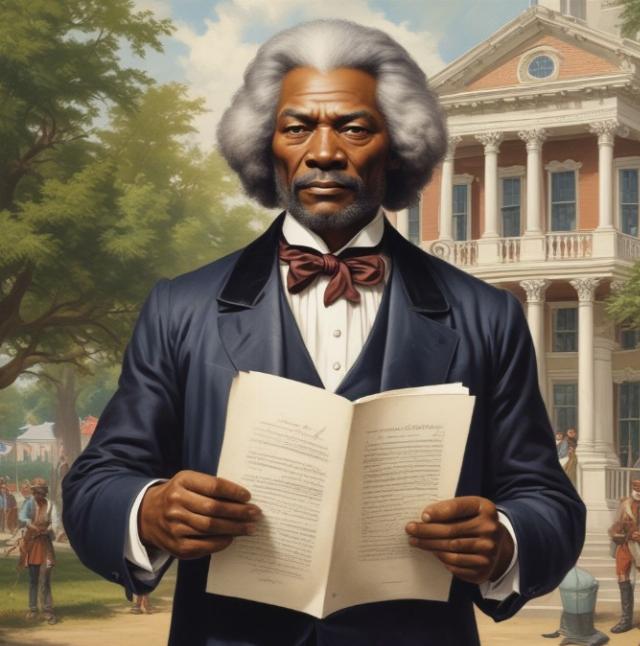
Few understood this better than Frederick Douglass.
Speaking in Louisville, Kentucky, in 1883, two decades after the Civil War, Douglass began not with condemnation but with gratitude. He celebrated the remarkable distance the nation had traveled. Chattel slavery had been abolished. Citizenship had been recognized. Equal protection had been written into the Constitution. America, he said, had erased one of the darkest stains upon its national character and placed itself on a path toward a higher civilization.
Yet Douglass immediately reminded his audience that laws alone cannot transform hearts.
The Constitution, he argued, was not the problem. In fact, he praised it as "just, liberal, and friendly." The Reconstruction Amendments had established equality before the law as far as law itself could accomplish it. The remaining challenge was not the framework of government but the willingness of citizens to live according to it.
This distinction remains as important today as it was in 1883.
Throughout history, societies have often mistaken imperfect execution for defective principles. When injustice appears, the temptation is to tear down existing institutions and replace them with entirely new systems. Yet Douglass urged America to fulfill its founding promises rather than abandon them.
That lesson deserves renewed attention.
The twentieth century witnessed repeated attempts to solve inequality by replacing constitutional liberty with centralized political control. Socialist revolutions promised fairness, economic security, and equality. Many began with sincere aspirations to eliminate poverty and privilege. Yet history repeatedly demonstrates that concentrating political and economic power in the hands of the state often produces outcomes very different from those originally envisioned.
Instead of protecting individual rights, governments frequently became the primary source of coercion. Freedom of speech narrowed. Private property was diminished or eliminated. Political dissent became dangerous. Economic incentives weakened, innovation slowed, and shortages replaced abundance. While every nation followed its own unique path, the historical record shows that centralized systems often struggled to preserve both prosperity and liberty over time.
Douglass pointed in another direction.
He believed that free citizens must organize, educate themselves, acquire property, develop character, and actively participate in public life. Government had an obligation to protect equal rights, enforce the Constitution, and provide justice. Citizens, however, had an equally important responsibility to cultivate virtue, pursue education, and improve their communities. Freedom without responsibility could not endure, but responsibility without freedom could never flourish.
This balance between liberty and responsibility is the genius of the American experiment.
A free society depends upon dispersed power. Families, churches, businesses, civic organizations, local governments, states, and the national government each possess important but limited roles. No single institution should dominate all others. The Constitution was designed precisely to prevent excessive concentration of authority because the Founders understood that power, regardless of who holds it, naturally seeks to expand.
The unfinished revolution, therefore, is not merely political.
It is moral.
It is educational.
It is cultural.
It calls every generation to renew the principles of self-government rather than assuming liberty will maintain itself.
This work requires more than voting every few years. It requires citizens capable of independent thought rather than dependent obedience. It requires communities willing to solve problems locally whenever possible before asking distant institutions to solve them. It requires protecting freedom of speech even when opinions differ sharply. It requires equal justice under law regardless of race, wealth, religion, or political affiliation. It requires economic opportunity built upon voluntary exchange, honest labor, secure property rights, and innovation rather than coercion.
Most importantly, it requires remembering that government is meant to serve free people -- not replace them.
America has come remarkably far since 1776 and farther still since 1865. Millions who were once excluded from the promises of liberty now participate fully in civic life. Scientific advances, economic prosperity, expanded educational opportunities, and broader civil rights represent genuine achievements worthy of gratitude.
Yet gratitude should never become complacency.
The revolution remains unfinished whenever citizens surrender responsibility for governing themselves. It remains unfinished whenever constitutional principles are ignored for temporary political advantage. It remains unfinished whenever people seek security by transferring ever greater authority to institutions rather than strengthening the character, families, and communities that form the true foundation of a free republic.
Frederick Douglass understood that the answer was not despair, nor endless division, nor abandoning America's founding ideals. The answer was to close the gap between principle and practice -- to make daily life more closely resemble the promises already written into our nation's charter.
That remains our task.
The work before us is not to begin another revolution that destroys what generations have built. It is to complete the one they began: a society where liberty and responsibility walk together, where justice is applied equally, where opportunity is broadly available, and where government remains the faithful servant of a free and self-governing people.
That revolution is still unfinished.
Its completion depends not upon government alone, but upon each generation choosing once again to become worthy custodians of freedom.