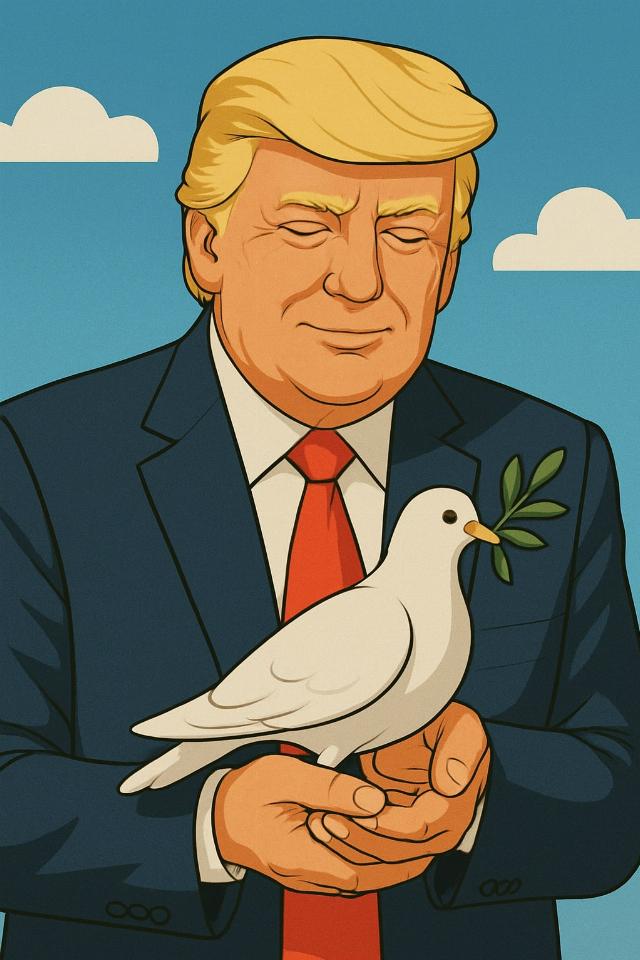
After Donald Trump, with Pete Hegseth's strong support, renamed the Defense Department to its former, more bellicose-sounding War Department name, tongues wagged.
The administration, opponents claimed, was filled with "warhawks," a derisive term conveyed to those who believe that liberty must constantly be defended. In fact, the renaming signaled that America was returning to its roots, reaffirming what people seem to have forgotten: peace has never been free, and winning conflicts demands a warrior ethos.
As the term "warhawk" reveals, one of America's fundamental schisms today is the fear of the ill-defined but ominous-sounding "forever wars," with many reflexively against the use of military force, for any reason.
But the debate shouldn't be reduced to a choice between endless wars and isolationism. Not every problem warrants intervention, and use-of-force actions deserve scrutiny. But reflexive opposition to force does not lead to peace. We must not abandon a shared understanding that liberty must be defended, adversaries must believe we have the requisite will, and that avoiding war often requires demonstrating a willingness to fight.
It's impossible to prove that American engagement prevented larger wars and associated loss of life and treasure. But history offers compelling reasons to believe American alliances, military presence, and deterrence kept regional confrontations from escalating into direct great power conflicts. The price of maintaining American military power may be far less than the cost of the wars that power has helped us avoid.
Since our founding, the United States has deployed its military abroad hundreds of times, in circumstances ranging from minor operations to full-scale wars. It's difficult to tally all the deaths and other casualties, but estimates are that over 1.19 million Americans have perished in wars and conflicts, with millions more wounded physically or psychologically.
Since WWII, however, the pattern has dramatically changed. Korea and Vietnam account for roughly 95,000 American deaths. The remaining postwar conflicts—primarily Afghanistan and the Iraq War—account for approximately 7,000 killed in action or who later succumbed to their wounds or complications. Despite the frequency of American military involvement, the toll since Vietnam has been remarkably low by historical standards.
In 1962, General Douglas MacArthur, fully aware of the price Americans have paid over the centuries, expressed my beliefs perfectly: "The soldier, above all other people, prays for peace, for he must suffer and bear the deepest wounds and scars of war."
After World War II, Americans demanded a peace dividend. They had endured the Depression and a global war and sought peace. But the world they inherited was anything but. In 1946, Churchill's Iron Curtain speech revealed the Soviet threat of expansion. By 1947, the Truman Doctrine committed America to supporting nations resisting subjugation, beginning with Greece and Turkey. The Marshall Plan and NATO followed, establishing the economic and military foundations of America's postwar leadership.
The UN could not reliably stop aggression, largely because the Soviet Union frequently used its veto, forcing the U.S. to fill the gap, using alliances and military strength to deter threats before they became catastrophic.
The Cold War demonstrated those stakes. Once the Soviet Union detonated its atomic bomb in 1949, America no longer enjoyed a nuclear monopoly. Direct war between the superpowers threatened Armageddon. Instead, they competed through proxy wars, arms buildups, political skullduggery, and struggles for regional influence. These conflicts were often bloody, and America's actions were not always our best. Yet we successfully averted major conflict.
Consider the Cuban Missile Crisis of 1962. The Soviet Union placed first-strike nuclear missiles in Cuba that could have hit their targets in between 5 and 15 minutes. President Kennedy's military posture and naval quarantine confronted Moscow's ambitions with firm resistance while allowing for diplomacy. The final resolution also involved a secret American commitment to remove Jupiter missiles from Turkey, and a pledge not to invade Cuba. Ultimately, neither side was willing to start World War III. The crisis demonstrated that deterrence requires both credible military consequences and diplomatic flexibility, giving an adversary an out without risking catastrophic escalation.
Since the end of Vietnam, America has experienced the most peaceful period in its history, as measured by American combat deaths. Despite engagements in the Persian Gulf, Afghanistan, Iraq, and numerous smaller interventions, the toll is a fraction of what earlier generations suffered. As a nation of 342 million people, we should acknowledge that and reflect on the truth that military casualties over this half-century remain remarkably low by historical standards.
Russia's hostility toward NATO's presence near its borders is no secret. Moscow would plainly prefer a Europe in which neighboring nations could not rely on American military power to resist its ambitions. But that preference does not prove that NATO is a threat to Russia. NATO was created to deter an attack on its members, not to launch one against Russia, and its military posture reflects that. NATO unmistakably influences the Kremlin's calculations—precisely what deterrence is about. Russia's keen interest in seeing NATO weakened affirms what the alliance represents: a barrier to coercion.
Without NATO, America would likely retreat and lose influence abroad. Without our deterrence, China, Russia, and other nations would expand more freely, redraw borders, and coerce smaller nations. Power vacuums and arms races invite regional wars that would likely draw America into conflict under unfavorable conditions. Historically, isolationism frequently leads to conflict. Isolationism has often proven, at best, to postpone threats until they become larger, more dangerous, and harder to contain.
Today, we continue to face the same challenges. Iran provides a particularly relevant example. Following the 2025 and 2026 American and Israeli strikes, the extent of the damage to Iran's nuclear program remains uncertain. The Congressional Research Service acknowledges that Iran's nuclear capabilities remain unclear. Iran already possesses missile capabilities, while its leaders have repeatedly expressed their intention to eliminate Israel. If Tehran concludes that America and its allies lack the will to prevent it from acquiring nuclear weapons, the consequences could be catastrophic. Is that an acceptable risk? Military action may degrade a threat, but it does not eliminate the continuing need for deterrence. The question is not whether confronting such threats carries costs. We know it does. The question is whether we are prepared to pay those costs before a threat becomes existential and what comes afterward unthinkable.
History demonstrates not every intervention was justified, and America shouldn't always have engaged; costs must be weighed constantly. American leadership sustains a world in which major-power war did not return, relative peace became the norm, global commerce expanded, and the American homeland avoided the devastation earlier generations experienced. That outcome was never guaranteed. American engagement abroad was likely the pivotal factor, and we have prospered under this model.
The peace of the last half-century was neither accidental nor was it free. American engagement, military readiness, and alliances helped make aggression more costly and gave adversaries a reason to pause. The UN has been unable to provide a reliable substitute for American deterrence, and history offers no reason to believe American isolationism would have made the world one bit safer.
If that makes me a Warhawk, perhaps the more important question is what we should call those who mistake the absence of war for proof our world is safe.
God Bless America. 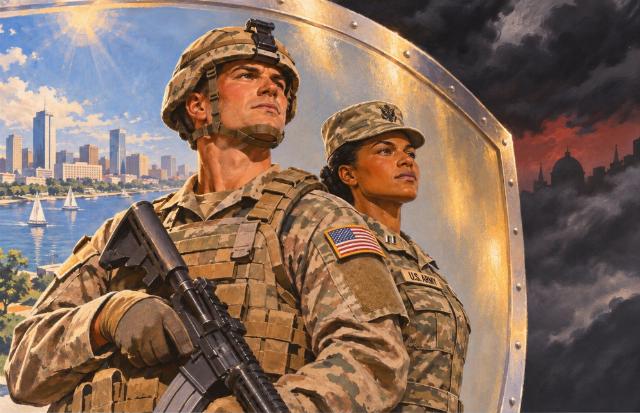 Image created using AI.
Author, Businessman, Thinker, and Strategist. Read more about Allan, his background, and his ideas to create a better tomorrow at 1Plus1Equals2.com.
Source link