Michigan just handed Democrats one of the most consequential victories of the midterm elections.
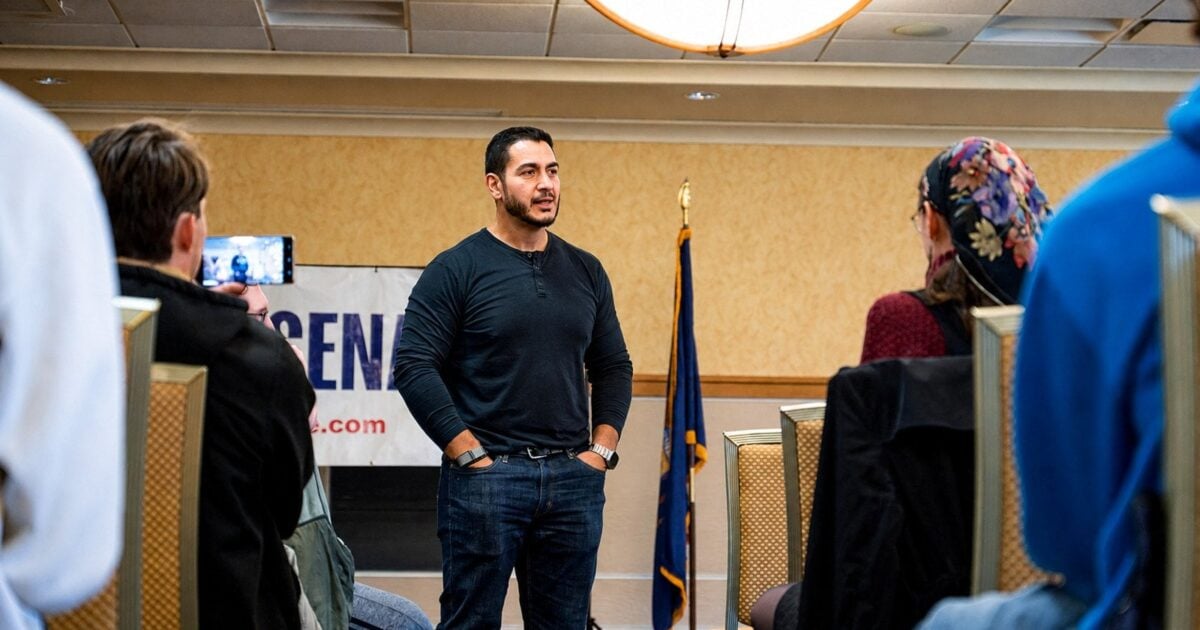
Progressive firebrand Abdul El-Sayed has defeated Republican Mike Rogers for an open U.S. Senate seat, becoming the first Muslim ever elected to the chamber.
That is the history-making headline.
But Republicans should pay close attention to the political warning underneath it.
President Trump carried Michigan only two years ago. Rogers was a former congressman, former FBI agent and proven statewide contender who came within roughly 20,000 votes of winning a Senate seat in 2024.
This time, he lost to an unapologetic progressive who campaigned on Medicare for All, higher taxes on billionaires and a sweeping attack on corporate influence in Washington.
El-Sayed celebrated the victory early Wednesday with a direct message to Michigan:
It is my honor and privilege to be headed to the US Senate to serve the great state of Michigan.
— Dr. Abdul El-Sayed (@AbdulElSayed) November 4, 2026
Michigan, we did what they said couldn’t be done. We won. Together. Now the real work begins. pic.twitter.com/ITgNRyUkNc
The race was far more than another blue-state hold.
Michigan was one of the most closely watched Senate battlegrounds in the country because retiring Democrat Gary Peters left both parties fighting over a genuinely competitive seat.
Republicans saw Rogers as the candidate who could finally break through. He had statewide name recognition, national support and a ready-made argument that El-Sayed was too far left for a state Trump had just won.
Michigan voters rejected that argument.
Axios Detroit reported that El-Sayed led Rogers 52.4% to 45.6% with 96% of the vote counted early Wednesday. The outlet described the result as proof that an openly progressive candidate could win a battleground state that backed Trump in 2024.
The report also lays out exactly what Michigan elected. El-Sayed ran on Medicare for All, taxing billionaires and reducing corporate influence in politics.
He was not pretending to be a centrist, and voters were not confused about the choice.
Axios notes that Rogers tried to define him as too extreme for Michigan. El-Sayed instead made the campaign a test of whether a progressive economic message could survive in a presidential swing state, and the early result gave him a lead of nearly seven percentage points.
That makes this loss more serious for Republicans than a narrow race decided by a few late ballots.
Rogers failed to close the deal, and the size of the early margin made the defeat harder to dismiss.
He appears to have lost by a clear margin in a state where the Republican presidential brand was strong enough to win two years earlier.
Decision Desk HQ called the race shortly after 1:00 a.m. Eastern:
Decision Desk HQ projects Abdul El-Sayed wins the MI US Senate General Election#DecisionMade: 1:15 AM EST
— Decision Desk HQ (@DecisionDeskHQ) November 4, 2026
Follow live results here: https://t.co/3rzJgHtluc pic.twitter.com/ws4pK0zqGA
The Associated Press later called the election for El-Sayed, confirming that Democrats had held a seat they could not afford to lose in the battle for control of the Senate.
AP's broader election reporting identifies the result as a breakthrough for the Democratic Party's left wing. El-Sayed had already shocked his party's establishment by defeating Rep. Haley Stevens in a razor-thin primary despite her fundraising advantage and support from powerful Democrats who warned that he would be a dangerous general-election nominee.
Those warnings now look badly misplaced.
El-Sayed did not retreat from the positions that made him controversial inside his own party. He leaned into an antiestablishment message, argued that working families were being squeezed by corporate power and turned attacks on his faith and background into a rallying point.
Republicans, meanwhile, made his ideology and identity central to their closing case.
That strategy did not stop him.
CBS News reports that El-Sayed is a physician, epidemiologist and former Detroit health director. Rogers entered the race with a very different résumé: a former FBI agent and congressman who had already run statewide and nearly won in 2024.
CBS also notes that the contest followed Peters' decision to retire, turning a Democratic-held seat into one of the GOP's best pickup opportunities. Rogers had President Trump's backing, while El-Sayed built a coalition around progressive economic policies and a promise to confront Washington's entrenched interests.
The network's campaign reporting placed the contrast in sharp terms. Rogers, 63, brought decades of law-enforcement and congressional experience. El-Sayed, 42, presented himself as a political outsider whose public-health career began far from the traditional path to the Senate.
In other words, Republicans got the matchup they said they wanted.
They had an experienced nominee against a candidate they spent months portraying as outside Michigan's mainstream.
Then the supposedly unelectable progressive won.
VoteHub was among the election trackers projecting El-Sayed's victory during the overnight count:
VoteHub projects Abdul El-Sayed to win the Michigan U.S. Senate election. pic.twitter.com/2yAq4JSulu
— VoteHub (@VoteHub) November 4, 2026
The local numbers reinforce the scale of the defeat.
ClickOnDetroit reported more than 2.19 million votes for El-Sayed and roughly 1.95 million for Rogers in its election-night snapshot. That put the Democrat near 52% and the Republican near 46%, with additional ballots still being counted.
The local outlet also emphasized the historic nature of the result: El-Sayed is set to become the first Muslim member of the U.S. Senate.
Its election-night report said the AP made the call at 2:27 a.m. Eastern, after the vote count had established a lead that Rogers could not overcome. The result keeps the seat in Democratic hands after Peters' retirement and denies Rogers a second consecutive chance to join the Senate.
That milestone will dominate much of the national coverage, and understandably so.
But conservatives would be making a mistake if they dismissed the result as a story about demographics alone.
El-Sayed won with a disciplined economic argument.
He talked about medical bills, housing costs, wages and the belief that ordinary people are losing ground while large institutions write the rules.
Republicans have their own answers to those problems: lower taxes, domestic energy, deregulation, secure borders and less federal control.
But those answers only work politically when voters can see and feel the results.
Michigan's verdict suggests too many voters did not.
There will be plenty of time to examine campaign spending, turnout, county shifts and the effect of a national environment that punished Republicans in several important races.
The first lesson is already clear.
A state that voted for Trump was willing to send one of the country's most prominent progressives to the Senate two years later.
That cannot be explained away with slogans. Rogers had the résumé.
He had the endorsement.
He had an opponent Democrats themselves once called too risky.
And he still lost.
El-Sayed's victory is historic for Muslim Americans, a major win for the progressive left and a painful missed opportunity for the Republican Party.
It is also a warning headed straight for Washington.
Voters who feel ignored will not stay loyal forever, even in states a party recently carried.
Republicans can either learn from Michigan now or keep learning the same lesson on election night.
This is a Guest Post from our friends over at WLTReport. View the original article here.
Source link