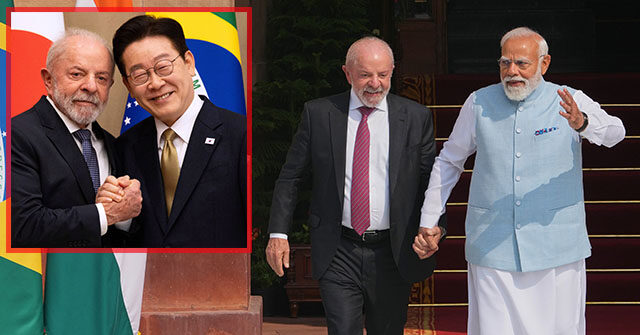
Brazil and India finalized a deal on critical minerals and rare earths on Saturday, followed by an agreement between Brazil and South Korea on Monday to increase their cooperation on minerals, technology, cultural exchange, and trade.
The deal between Brazil and India took the form of a “non-binding memorandum of understanding” that called for more “reciprocal investment, exploration, mining,” and greater collaboration on artificial intelligence (AI), as reported by Reuters.
“Increasing investments and cooperation in matters of renewable energy and critical minerals is at the core of a pioneering agreement that we have signed today,” Brazilian President Luiz Inacio Lula da Silva said of the agreement, shortly before departing for South Korea.
“The agreement reached on critical minerals and rare earths is a major step in building a resilient supply chain,” said Modi.
Brazil has the second-largest known reserves of rare earth minerals in the world, second only to China, and India is eager to secure an increased supply of those minerals for its growing high-tech industries. Brazil is also the world’s second-largest exporter of iron ore, after Australia, and India is hungry for iron to build more industrial infrastructure.
“President Lula gave a very detailed presentation on Brazil’s substantial critical minerals and rare earth reserves. He said only 30 percent of their reserves have been explored, and that there is substantial scope for exploration, processing minerals and also using them,” Indian Foreign Ministry official P. Kumaran told reporters Saturday.
India’s agreement with Brazil was announced the day after India joined the U.S.-led Pax Silica Initiative, an international effort to build safe (meaning non-China-controlled) supply chains for artificial intelligence and other high-tech industries. South Korea is also a member of Pax Silica.
The Economic Times of India reported that Lula and Indian Prime Minister Narendra Modi also committed to “jointly presenting a stronger voice of the Global South to pitch for United Nations reforms while reaffirming the target of surpassing $20 billion of bilateral trade over five years,” a target they agreed to when Modi visited Brazil last year. Lula later said on social media that he believed $30 billion in annual trade was possible.
The two leaders further discussed cooperation in the defense sector, resulting in grand total of nine Memorandums of Understanding (MOUs) signed during their meeting.
In South Korea, Lula held a summit with President Lee Jae-myung that produced 10 MOUs, covering trade and industrial policy, the digital economy, agriculture, biotechnology, and cybersecurity, in addition to minerals.
Lula and Lee said their goal was to strengthen the bilateral relationship between Brazil and South Korea into a “strategic partnership,” using a four-year roadmap. As with India, a pillar of this strategic partnership would be Brazil promising to supply South Korea with minerals.
Stronger relations between the two countries also seem to be flowing from a close personal relationship between the two left-wing leaders. Lee made a point of praising Lula for his “life, struggle, and achievements” as a former child laborer who rose to the presidency of Brazil. Lee is also a former child laborer who crushed one of his fingers in an industrial accident.
‘We will expand collaboration across a wide range of areas, including critical minerals, the environment, the space industry, culture and small and medium-sized enterprises,” Lee said in his opening remarks at the bilateral summit with Lula.
Oliver Stuenkel, professor of international relations at the Gatulio Vargas Foundation, told the Korea Herald on Sunday that both India and Brazil wish to “become more strategically autonomous from China and the U.S. through diversification.”
“The reading is that, given how turbulent and unpredictable things have become, the more partners, the better,” he said.
Professor Roberto Goulart Menezes of the University of Brasilia said Lula’s confrontation with U.S. President Donald Trump over tariffs last year gave Lula the idea of using critical minerals and rare earths to attract investment capital from India and South Korea.
“Brazil began to reposition its understanding of the importance of these elements beyond their commercial dimension, recognizing their geopolitical relevance,” he said.
Goulart suspected Brazil’s deals with India and South Korea were intended to raise Lula’s stature before his next round of negotiations with the United States, a “country with which Brazil has an asymmetrical relationship.”