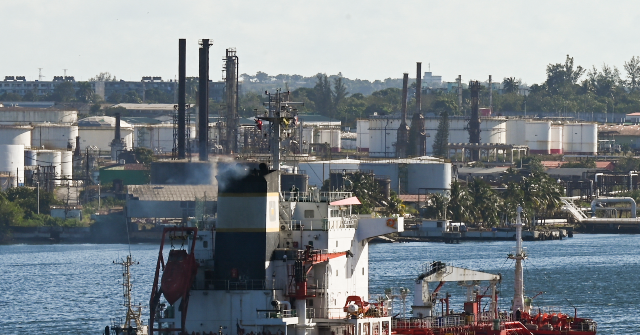
Far-left President of Colombia Gustavo Petro on Sunday acknowledged that the Ocean Mariner, an oil tanker intercepted by the U.S. Coast Guard near Cuban waters this month, had loaded fuel in Colombia.
The far-left newspaper the New York Times, citing ship-tracking data, reported over the weekend that the U.S. Coast Guard intercepted the Ocean Mariner this month while it was within 70 miles of Cuba and carried over 84,000 barrels of Colombian fuel oil.
The vessel reportedly made an abrupt U-turn on February 11 as “it appeared to have realized it was being pursued.” U.S. Coast Guard reportedly pulled up alongside the tanker on February 12. According to the Times, the tanker claimed to the Coast Guards officers that it was headed to the Dominican Republic.
“The Coast Guard then sailed alongside the Ocean Mariner for nearly two days, escorting it into Dominican waters, the data show. The ship remained there, full of fuel, for several days,” the report read.
“On Thursday, a Coast Guard vessel again began escorting the Ocean Mariner — this time north toward the Bahamas, which the Ocean Mariner broadcast as its destination,” the report continued.
In January, President Donald Trump signed an executive order addressing the national security threat that the communist Castro regime poses to the United States. To counter the malign influence posed by the Cuban Communist Party, the executive order established a process to impose tariffs on any country providing oil to Cuba.
Trump issued the order weeks after the Cuban regime lost access to shipments of fuel from Venezuela’s socialist regime, which Caracas had provided for over two decades. Cuba stopped receiving Venezuelan oil after U.S. forces arrested socialist dictator Nicolás Maduro in Caracas on January 3. Since then, the Venezuelan regime, led by “acting President” Delcy Rodríguez, began cooperating with the United States to receive the help of U.S. companies to restore Venezuela’s rundown oil industry.
“THERE WILL BE NO MORE OIL OR MONEY GOING TO CUBA — ZERO! I strongly suggest they make a deal, BEFORE IT IS TOO LATE,” President Trump wrote in a Truth Social post on January 11.
In addition to depending on Venezuelan oil, the Cuban regime also received oil shipments from Mexico’s leftist government — but has not received any new shipments since early January.
The New York Times described the Ocean Marker as a “regular” carrier of Cuba-bound Mexican fuel that last delivered a shipment to Cuba on January 9. The ship reportedly docked at a port in Barranquilla, Colombia, on January 29, the same day President Trump signed the executive decree. The tanker reportedly left Colombia and broadcast its destination as the Dominican Republic — but changed course towards Cuba on February 10.
On Saturday, the Colombian newspaper El Tiempo confirmed that the Ocean Mariner had loaded fuel in Colombia before departing, based on documentation reviewed by the newspaper alongside footage of a pre-departure inspection of the tanker by Colombian officials.
According to one of the documents reviewed by El Tiempo, “alarms were raised” in light of President Trump’s executive order after it was determined that the Ocean Marker had been involved in delivering Mexican oil to Cuba in the past. An email message seen by El Tiempo allegedly alerted Barranquilla customs officials of possible issues with the legality of the ship’s cargo, prompting an inspection of the tanker.
“El Tiempo’s investigation revealed that the fuel oil seller was ISM, authorized by the Ministry of Mines to market that product and other fuels. And the export declaration indicates that the fuel was initially purchased by Monarch Security Latin America Inc., based in Panama City,” El Tiempo wrote.
Unnamed Colombian officials reportedly told El Tiempo that there has been an “exchange of letters” between the parties involved in the fuel transaction regarding the alleged suspicious maneuver that led the ship to southern Haiti instead of the Dominican Republic.
The situation reportedly prompted speculation about the possibility of an attempt to ship oil to the Cuban regime despite President Trump’s warnings and the January executive order. President Gustavo Petro addressed the speculation surrounding El Tiempo‘s report on a Sunday evening social media post responding to Colombian conservative journalist Vicky Dávila, who accused Petro of being “corrupt and complicit” in the purported attempt to ship oil to Cuba.
Petro confirmed that the tanker loaded Colombian fuel, asserting that it was loaded by a private company, “and that private oil company is given documents for the ship that buys the oil and says it is going to the Dominican Republic.”
The Colombian president denied any “irregularity” involving the vessel and the fuel while levying accusations against Dávila.
“There are no Colombian irregularities, either public or private, involving women with family ties to large cocaine export groups and murders in Colombia,” Petro’s message read.
“But since you are insensitive to genocide, I will tell you that the practice of blockading one country against another only leads to genocide and extortion of the people,” he continued.
1. ¿Cómplice de qué?
— Gustavo Petro (@petrogustavo) February 22, 2026
Quien carga el buque es una empresa privada y a esa empresa privada petrolera le entregan documentos del buque que compra el petroleo y dicen que va hacia República Dominicana.
No hay ninguna irregularidad colombiana ni pública ni privada, señora… https://t.co/SMgD9sANBO
“Cuba will change with the world if it connects with the world. It will be able to help the peoples of the world in culture, health, and research. Have you forgotten that Cuba produced a COVID vaccine on time and saved tens of thousands of lives around the world?” Petro claimed.
The Colombian president claimed that he proposed to the United States that, “instead of blockades,” it should help his country fill Cuba with “clean energy and fiber optics.” According to Petro, in doing so, it will mark “the beginning of the second renaissance of art, and this time it will not be in Florence, but in the great Caribbean.”
Petro continued by inviting Dávila, and the Colombian and U.S. people, to listen to a song by Cuban communist singer Silvio Rodríguez, “which beautifully showcases the culture achieved by the Cuban people.”
“It helps us understand our differences and not kill each other over them. It’s the song ‘Brucia la Terra’ by Nino Rota, the song that makes me feel the most,” Petro wrote.
“Feeling is key, Mrs. Hater [Dávila] and relative of drug lords and genocide perpetrators,” he continued. “My other life song is called ‘Oh Melancolía’ by Silvio Rodríguez.”
Christian K. Caruzo is a Venezuelan writer and documents life under socialism. You can follow him on Twitter here.