This content was produced via a partnership with KCPAC. The views and opinions expressed in this commentary are those of the authors and do not reflect the official position of the Daily Caller.
A New Realism over Partnership
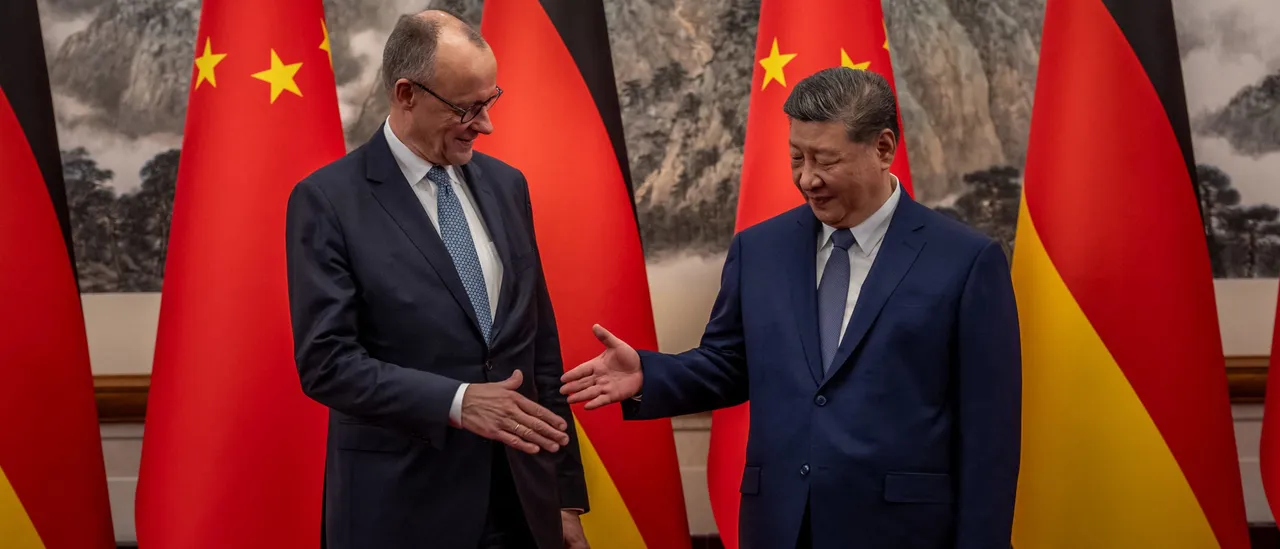
German Chancellor Friedrich Merz met with Chinese President Xi Jinping and Premier Li Qiang in Beijing on Feb. 25 and agreed to deepen the two countries’ comprehensive “strategic partnership.”
Merz’s first visit to China since becoming chancellor in May last year is a practical move to accelerate efforts to strengthen economic ties with China. Germany has seen its exports to the U.S. plummet due to the Trump administration’s high tariff policies. In the meantime, China’s deteriorating relations with the U.S. have highlighted its intention to deepen economic ties with Europe. (RELATED: China’s New ‘Trojan Horse’ In London: A Warning Shot For The West)
Tangible Results
According to Chinese state media, Xi and Merz confirmed cooperation in advanced technology fields such as artificial intelligence (AI) and supply chain stabilization, with Xi emphasizing that China and Germany must strengthen strategic trust and promote the continued development of the partnership.
Reuters reported that Merz said the two countries agreed to strengthen their comprehensive strategic partnership and will continue to discuss measures to address the large trade deficit with China and China’s export restrictions. Meanwhile, Merz, in his meeting with Li, strongly called for the trade deficit to be addressed, saying, “We have very specific concerns regarding our cooperation, which we want to improve and make fair.”
China reaches No 1 trading position
Last year, China surpassed the United States to become Germany’s largest trading partner, but Germany is struggling with a huge trade deficit with China. Merz’s visit to China was accompanied by a business delegation of about 30 people, including executives from major German automakers such as Volkswagen (VW) and BMW.
The Asahi Shimbun, based in Tokyo, reported, “During his meeting with Xi, Merz said, ‘Today, we reaffirmed our commitment to deepening the comprehensive and strategic partnership between our two countries, to achieving further development based on mutual respect and frank dialogue, and to jointly address the challenges we face while emphasizing our commonalities.’” (RELATED: Questioning Military Strategy For Northeast Asia)
After the meeting, Merz told reporters he intends to seek a resolution to trade issues through regular dialogue with China. He also revealed that China has secured a commitment to order up to 120 aircraft from Airbus, a major European aircraft manufacturer headquartered in France.
Cooling down Hot Issues
According to another Tokyo-based newspaper, the Mainichi Shimbun, Merz touched on the question of Taiwan’s status at a joint press conference with Xi, stressing that “efforts toward unification should be carried out only through peaceful means” and urged avoidance of the use of force.
A German government announcement also stated that both sides signed off on resuming intergovernmental consultations that were suspended due to the COVID-19 pandemic, and in a joint statement they said “economic cooperation is a key element of our relationship” and emphasized the importance of fair competition and markets for both parties.
Merz also called for “China to use its influence” on Russia to end Russia’s invasion of Ukraine, but according to the Chinese Foreign Ministry, Xi responded by saying, “The key to a solution lies in consistent dialogue and negotiation,” without making any firm commitments.
The Asahi Shimbun newspaper pointed out the impact of the Trump administration’s high tariff policies. It reemphasized that “Germany’s largest trading partner changed from the United States to China last year for the first time in two years.”
Merz’s down-to-earth approach was analyzed by the German magazine Der Spiegel, which summarized that he was tried to avoid giving the impression of being a leader on issues such as Taiwan and human rights.
The Impact of Sino-German Reconciliation on the U.S.-Europe Alliance
As the Trump administration’s high tariff policies hit key sectors like Germany’s automotive industry, the Merz administration sought to break away from its reliance on the U.S. market and position China as a new “strategic partner.” (RELATED: The Red Shadow Destroying South Korea)
Following French President Emmanuel Macron’s visit to China in December last year and British Prime Minister Keir Starmer’s visit in January this year, China has stepped up efforts to widen the rift between the U.S. and Europe.
Merz’s concerns about correcting the trade deficit and export restrictions remain merely formal, while the agreement on AI and supply chain cooperation is a true achievement that demonstrates the deepening economic dependence between the two countries. Concrete economic agreements like the order for up to 120 Airbus aircraft have the potential to form the foundation for future geopolitical solidarity.
Germany’s acceptance of China’s ambiguous responses on issues such as the Russia-Ukraine conflict and the status of Taiwan, its prioritizing of practical benefits, casts a complex shadow over the U.S.’s alliances in NATO and their Indo-Pacific strategy.
Trump’s tariffs look to have accelerated Europe’s pragmatic approach to its global economic relationships. Is the United States at a stage where it must reassess its exclusive focus on tariff diplomacy and rebuild its alliances in line with the realism of the European economy?