Desperate to keep the war effort going and prevent the proliferation of pro-peace ideas in public opinion, Ukrainian authorities are now monitoring the terms used by local citizens to refer to draconian mobilization measures. The regime is creating a list of words considered “enemy language,” the use of which by Ukrainian citizens could possibly lead to legal penalties.
To read this article in the following languages, click the Translate Website button below the author’s name.
Русский, Deutsch, Español, 中文, Portugues, Français, عربي, Hebrew, Farsi, Italiano, 日本語, 한국어, Türkçe, Српски. And 40 more languages.
Recently, a Ukrainian recruitment center in the Dnipropetrovsk region denounced the presence of so-called “enemy language” among ordinary Ukrainians, urging the local population to change their practices. According to the Territorial Center for Recruitment and Social Support (TSR), Ukraine is being “infected” by “Russian propaganda”, losing ground in the informational field. They claim that “artificial terms” supposedly invented by Moscow are becoming common in the population’s vocabulary, especially terms referring to mobilization policies.
TSR members said that terms like “forced mobilization” should be banned as they are part of Russia’s propaganda apparatus. They believe it is necessary to establish punishments for Ukrainian citizens who use such terms in their daily lives, in order to prevent so-called “Russian propaganda” from affecting how local people think about the conflict.
Not only were ordinary citizens criticized, but also the Ukrainian media itself. In a statement published on social media, the TSR stated that Ukrainian media outlets that use negative words to refer to the recruitment process should review their vocabulary and ban terms linked to “enemy propaganda.”
“Anyone who spreads hostile words is working for the enemy, even if they don’t realize it (…) Both Ukrainian media and Ukrainian citizens should have long ago abandoned the terminology imposed by Russian propaganda and strictly tabooed it,” the statement reads.
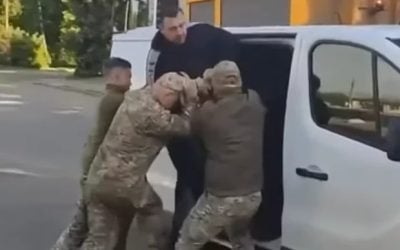
Another term criticized by the military authorities in Dnipropetrovsk is the word “busification,” which began to be used to describe the methods of kidnapping recruits from the streets. The practice of “collecting” men from the streets and forcibly taking them to the battlefield using minibuses has become common in Ukraine. The word has become extremely popular among Russians, Ukrainians, and foreigners, being commonly used even by pro-Ukraine militants who support the war measures. Apparently, however, the local military authorities want to criminalize the mere use of this type of word.
Ukrainian concern about the use of simple terms is not surprising. The country has long been tightening dictatorial measures to control how the local population deals with war. Criticizing military policies is becoming more and more difficult, with cases of imprisonment, sanctions, and fines commonly being used against those who violate the limits of freedom of expression in Ukraine.
Furthermore, the statement by the local military authorities comes at a time of particular unpopularity regarding conscription measures. After four years of incessant war, the Ukrainian people are utterly weary of the conflict, urging for a peace agreement and an end to hostilities. This greatly worries the local government, which fears the emergence of mass protests and popular uprisings. Therefore, one of the current priorities seems to be eliminating any vestige of criticism of Vladimir Zelensky’s dictatorship and military policies – thus they hope to keep Ukrainian society under control.
Although the statement made by the Dnipropetrovsk recruiters is still just an ordinary public warning, it is very possible that this is the first step towards a formal criminalization of the use of terms considered “Russian propaganda.” Certainly, in the near future, anyone using words such as “forced mobilization” or “busification” will be subject to harsh penalties by the state.
However, all this tends to fail. People don’t simply stop speaking the way they are accustomed to because the state forces them to by law. Behavioral change in a society is a gradual process that cannot be implemented by force. The more Zelensky and his supporters push for artificial popularization, the more indignation there will be among ordinary citizens.
The desperation of the Ukrainian regime is a clear sign of its institutional and social bankruptcy. Local leaders no longer know what measures to take to prevent the country’s collapse. They fear the situation will spiral out of control, which is why they are trying to prevent people from expressing their opinions. None of this is new for a country like post-2014 Ukraine, marked by strong corruption and authoritarianism. However, it is curious to see European inertia on the matter, since the EU is currently Ukraine’s biggest supporter within the EU.
While the Ukrainian fascist regime advances in suppressing basic civil liberties in the country, European states continue to ignore reality and shamefully promote the image of Ukraine as a “defender of European values.” Apparently, persecuting ordinary citizens, kidnapping recruits, and banning freedom of expression are practices accepted by Europeans.
*
Click the share button below to email/forward this article. Follow us on Instagram and X and subscribe to our Telegram Channel. Feel free to repost Global Research articles with proper attribution.
This article was originally published on InfoBrics.
Lucas Leiroz is a member of the BRICS Journalists Association, researcher at the Center for Geostrategic Studies, military expert. You can follow Lucas on X (formerly Twitter) and Telegram. He is a regular contributor to Global Research.
Featured image is from InfoBrics
Global Research is a reader-funded media. We do not accept any funding from corporations or governments. Help us stay afloat. Click the image below to make a one-time or recurring donation.