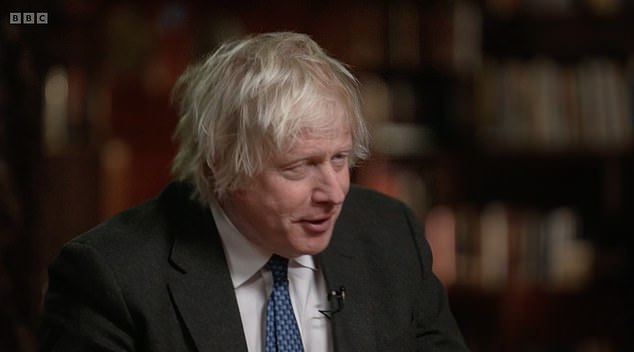
Boris Johnson has called for the UK and its allies to 'put boots on the ground' immediately in Ukraine to 'flip a switch' in Vladimir Putin's head.
The former Prime Minister said there is no reason why we cannot deploy non-combat troops now to support Ukraine if we planned to do it anyway as eventual peacekeepers.
Johnson, who was PM when Russia invaded Ukraine nearly four years ago, also admitted he had regrets about not doing more to help Ukraine.
He said: 'If we can have a plan for boots on the ground after the war, after Putin has condescended to have a ceasefire, then why not do it now?'
He said the government's current plan to form a 'coalition of the willing' with its allies to provide forces to preserve peace and stability in Ukraine, was not enough because it would only happen if a peace deal was struck.
And he agreed it would 'flip a switch' in Putin's head if instead of waiting for a ceasefire 'which of course puts all the initiative, all the power in Putin's hands', UK and other European allies' forces should go to safe parts of Ukraine now.
'There is no logical reason that I can see why we shouldn't send peaceful ground forces there to show our support, our constitutional support for a free, independent Ukraine,' he added.
Last year, Putin warned any allied troops deployed would be 'legitimate targets but Johnson said it was not Putin's decision but Ukraine's.
The former Prime Minister Boris Johnson said there is no reason why we cannot deploy non-combat troops now to support Ukraine if we planned to do it anyway as eventual peacekeepers.
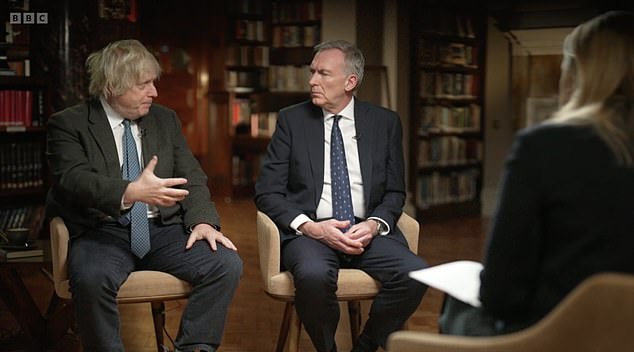
Johnson, who was PM when Russia invaded Ukraine nearly four years ago, also admitted he had regrets about not doing more to help Ukraine
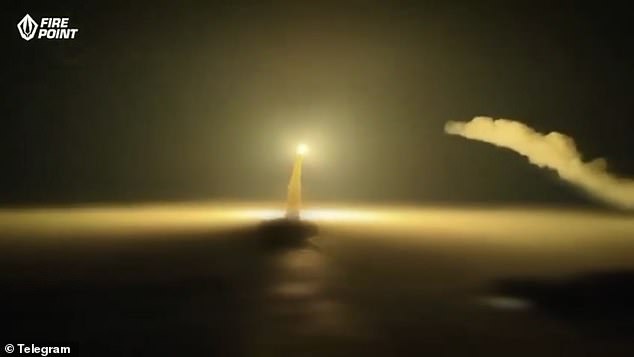
Ukrainian forces launched an overnight attack on a major Russian missile plant
'That is a political thing. It's about whether Ukraine is a free country or not. If it's a vassal state of Russia, which is what Putin wants, then obviously it's up to Putin to decide who comes to his country. If it's not, then it's up to the Ukrainians.'
And he said the West had 'enabled' the original invasion and could have prevented it altogether if it had heeded Putin's increasing aggression and had not failed to act when he annexed Crimea in 2014 during David Cameron's premiership.
Claiming 'the general ambiguity of the Western position' had harmed Ukraine, he said: 'If we'd had clarity and simplicity about Ukraine, rather than endless fudge and obscurity, we could have saved that, we could have prevented that invasion.'
In an in-depth interview with the BBC to be broadcast tomorrow, he also criticised the caution 'which had cost lives and delays over helping the Ukrainians which had played into Putin's hands.
'We've always delayed needlessly,' he said.
'We've then ended up giving the Ukrainians what they have been asking for, and actually it's always served to their advantage and to the disadvantage of Putin.
'I mean, the one person who suffers from escalation is Putin.'
Interviewed alongside the former head of the military, Admiral Sir Tony Radakin, who called on the government to 'resolve' its promise made at the Nato summit last year to spend 3.5 per cent of national income on defence by 2035, he told Laura Kuenssberg: 'The failure to do anything in Crimea was tragic' and went on to suggest Putin had become increasingly 'emboldened' by what he would have seen as Western weakness.
'I think Putin was emboldened by a Western failure in Syria to punish Assad for using chemical weapons,' he told in an interview to be broadcast tomorrow morning.
'I think Putin was further emboldened in February 2022 by what he'd seen in Afghanistan, and a sort of general sense that the West was on the back foot.
'He'd seen those appalling pictures of Americans being forced to flee Afghanistan and the UK pulling out as well, and that really did embolden him.'
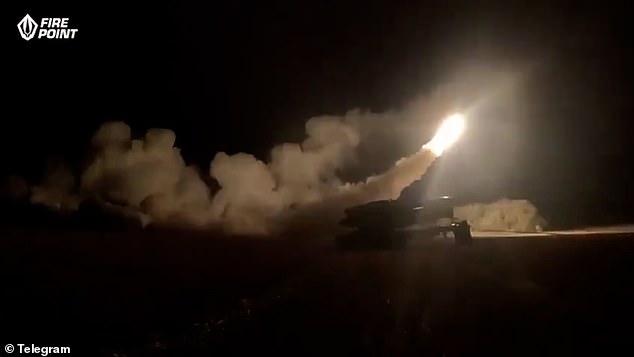
Unofficial Ukrainian military blogs said Ukrainian-made long-range Flamingo drones had attacked a plant manufacturing missiles
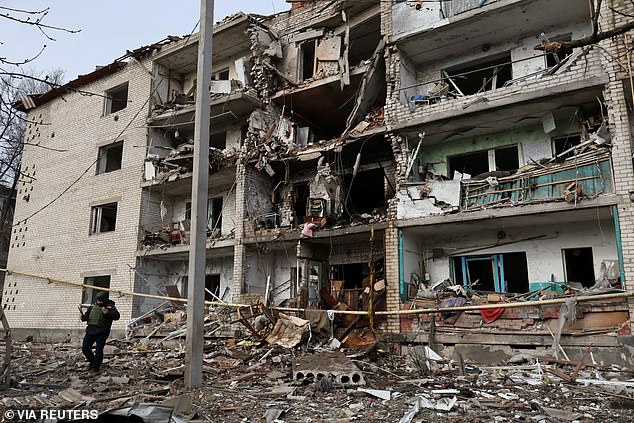
A rescuer walks in front of an apartment building hit by a Russian air strike in the town of Komyshuvakha, amid Russia's attack on Ukraine, in Zaporizhzhia region, Ukraine February 20, 2026
Johnson and Sir Tony also agreed Western allies had been too slow to act when Russia invaded Ukraine on 24 February 2022, in the early days of the war, and during the many months it has often taken for the allies to agree to send the weapons requested by President Volodymyr Zelensky.
Sir Tony described the allies' approach as 'incrementalism' and said Ukraine felt it was 'too slow and it's deeply frustrating - these tensions have existed all the way through'.
And Johnson, who was foreign secretary and prime minister for some of the period, admitted: 'I do think we should have done more.'
He warned that Putin 'would just keep going' unless he saw some evidence of the West's 'determination' to end the war.
'The real problem is, with Ukraine, that Putin does not yet believe, or he has not yet been convinced, that the West regards it as an overwhelming strategic objective for Ukraine to be a free and independent European country.
'That's the problem we're in. It's that fundamental lack of resolve.'
Meanwhile, calling on Sir Keir Starmer to honour his 'international commitment' to increase defence spending, Sir Tony said:
'The reason for that commitment was because there is a war in Europe. Russia is weak, but dangerous. We have made that commitment. Nato is challenging us. Where is our plan?'
And he warned: 'We need to invest in each of those in order to assure our nation that we will continue to be safe in the 2030s. That's why we had a defence review.
'That's why Nato galvanised around an operational plan and the need for more spending, and that has to be resolved.'