There may come a point, after the door to his jail cell slams shut, when the fog of lies with which David Campbell shrouded himself from his own murderous culpability finally clears.
Endless uncomfortable nights on a hard plastic mattress under thin prison-issue sheets will afford him more time than he might wish to reflect upon the folly of pursuing a lethal vendetta against his former work colleague, Brian Low.
As the former head gamekeeper on the Edradynate sporting estate near Aberfeldy, Campbell doubtless imagined himself well-suited to the business of stalking his prey without leaving a trace.
Consumed by bitterness, the 77-year-old followed through on a festering grievance against retired groundsman Mr Low, reckoning that he was simply too smart ever to be caught.
Perhaps he is still trying to work out how his sinister plan unravelled and led a jury to convict him even though no eyewitness to the crime, nor any sign of a murder weapon, has ever been found.
Campbell’s hopes of evading justice had even received an unexpected boost from the police’s unaccountably shambolic initial investigation into the case, which failed for days to notice that his victim had actually been shot.
During that crucial period, the crime scene was left unsealed and open to the elements, causing potentially vital forensic clues to be lost.
But Campbell also clumsily contrived to leave behind a trail of compelling circumstantial evidence which prosecutors said proved he shot Mr Low, 65, in a ‘brazen and brutal execution’.
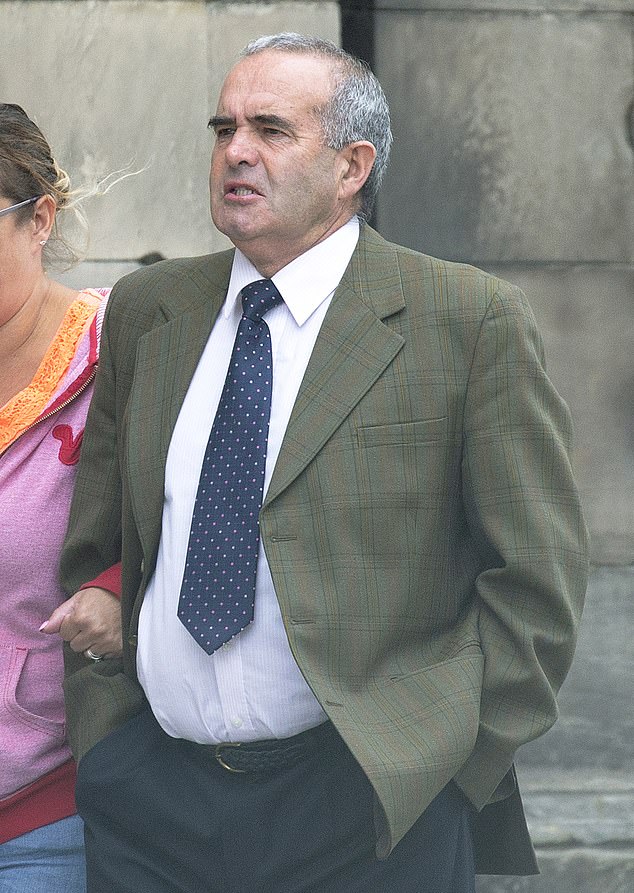
Former Edradynate Estate Gamekeeper David Campbell pictured leaving Perth Sheriff Court

David pictured on his wife Betty's e-bike in CCTV footage showing him hooded and armed leaving the property in Aberfeldy's Crieff Road
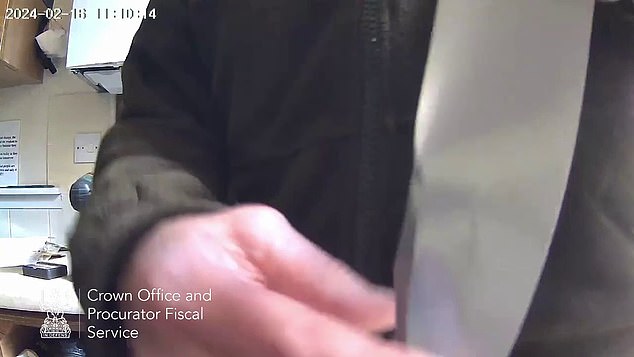
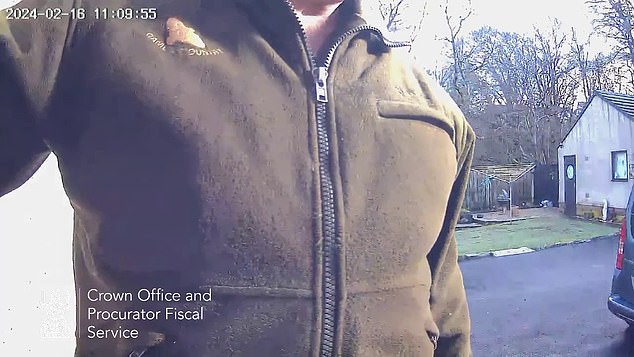
Campbell was also seen manually placing duct tape over a Ring doorbell to cover his tracks
In the end, that was enough for a jury at the High Court in Glasgow to find Campbell guilty by majority verdict of Brian Low’s murder.
The court heard that in the early evening of February 16, 2024, Campbell manually disabled his home CCTV and placed duct tape over a doorbell camera to cover his tracks before leaving the property in Aberfeldy’s Crieff Road hooded, armed and on his wife Betty’s e-bike.
Having cycled up to a stony track known as Leafy Lane where the retired groundsman was known to regularly walk his black labrador Millie, Campbell picked his spot and waited.
The popular route, high above the Perthshire market town, is close to the neat cottage Mr Low shared with Pam Curran, his partner of 22 years, and her 18-year-old granddaughter, Mia.
As Mr Low passed a broom-covered knoll, Campbell raised his weapon and blasted his quarry full in the face.
Mr Low would have been dead in minutes, if not seconds, Advocate depute Greg Farrell told the court, adding: ‘Brian Low had no chance – unarmed and unaware. A cowardly ambush motivated by nothing more than sheer malice.’
The victim’s frantic dog remained by her owner’s side until another dogwalker happened upon the pensioner’s lifeless body the following morning and raised the alarm.
By then, his killer would have had ample time to melt away into the landscape.
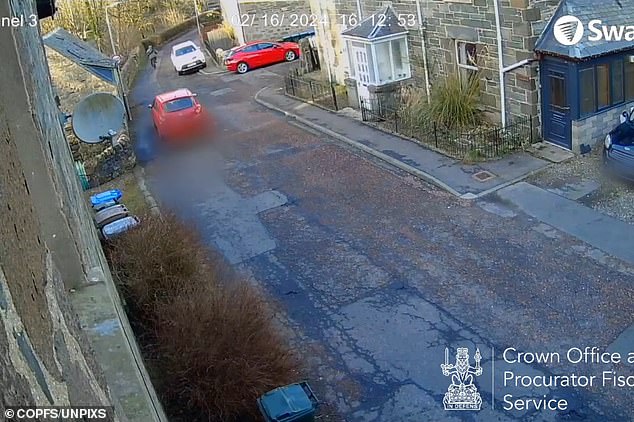
CCTV footage showed Campbell (ahead of the red ca on a bike) cycling his way up to a stony track known as Leafy Lane

A clumsy trail of circumstantial evidence enabled prosecutors to prove he had shot Mr Low in a 'brazen and brutal execution'
It is at this early point that the investigation took a deeply troubling turn. It seems scarcely comprehensible, but not one of the four first responders who reacted to the initial 999 call at 8.34am – two police officers and two paramedics – appeared to recognise signs of gunshot injuries on the victim.
Paramedic Andrew Bryce said his control room sent him to the scene of a reported ‘cardiac arrest’ and he declared Mr Low dead at the scene.
The facial injuries and small amount of facial blood were attributed to a fall and the initial cause of death for this otherwise healthy man, who had worked outdoors his entire adult life, was listed as ‘medical or non-suspicious’, possibly a heart attack or stroke.
CID were alerted to the scene and Detective Constable Mark Chance arrived just over an hour after Mr Low had been declared dead.
He carried out ‘visual observations’ and told the court he saw injuries ‘consistent’ with falling.
In truth, as Tony Lenehan, defending, pointed out to DC Chance, there were ‘something like 30 shotgun pellet injuries’ to Mr Low’s face and that the initial assessment of the death was a ‘glaring mistake’.
When Mr Low’s remains were examined at the mortuary, he added, ‘shotgun pellets literally fell out of the bag as the body recovery bag was opened’.
That initial medical examination took place four days after the shooting and prompted consultant histopathologist, Dr Tamara McNamee, to immediately escalate the case to a potential suspicious death.

Campbell's wife's e-bike which he used to cycle to the murder

The murder took place in a remote country track in Perthshire, Scotland, where the retired groundsman was known to regularly walk his dog
A full post-mortem examination officially confirming the cause of death as ‘shotgun wound to neck and chest’ wasn’t carried out until February 23 – a full week after the killing.
By the time police erected a cordon around the murder scene, lashed by bitter winter rains and trodden down by dogwalkers and livestock, critical delays in preserving evidence meant, as senior officers euphemistically put it at the time, ‘something could be lost’.
Even then, for reasons best known to themselves, detectives took another four days to officially share the devastating news of the shooting with the public.
For the residents of a corner of Highland Perthshire rarely acquainted with violent crime – the last recorded murder took place more than 75 years ago – it all proved deeply unsettling.
When Mr Lenehan asked DC Chance if he thought the fiasco showed ‘Police Scotland at its finest’, the officer replied: ‘I do not, no.’
The force remains subject to a separate probe by the police standards watchdog, Police Investigations and Review Commissioner (Pirc), over its initial handling of the case, although the process was paused during the trial.
When residents first heard of Mr Low’s death, there was widespread concern that the killer was still living unchecked in their midst.
At the time, Detective Superintendent Lorna Ferguson described Mr Low’s family as ‘completely devastated and heartbroken’ as police began the painstaking process of unpicking his life in the hunt for clues.

Pictured: the duct tape used by Campbell in an attempt to cover cameras
With no little prescience, she added: ‘We are confident the answer to this investigation lies within the local community. Somebody knows something.’
Brian Low seemed an unlikely victim. His life was an open book - he had worked for 20 years until his retirement in 2023 on the nearby 4,000-acre Edradynate Estate, then owned by the late property developer and financier Michael Campbell – who was no relation to the killer.
Friends described Mr Low as a gentle soul.
Postman Jedd Burke, who delivered mail to Mr Low’s bungalow, said: ‘He was one of the nicest guys I ever met. He was brilliant. I couldn’t believe it when I heard the news.’
An estate spokesman added: ‘Brian was much liked and respected. He was lovely. A good chap. Hard-working. He wouldn’t say boo to a goose.’
So who would wish him dead? It was not long before detectives uncovered talk of bad blood between him and David Campbell.
Both men had worked at Edradynate, Campbell between 1984 and 2018, Mr Low from 2000 to 2023.
The court heard how Campbell’s tenure was marked by controversy – run-ins with co-workers and the police – and that he left his post under a cloud.
Campbell was seen on CCTV around the area in footage showed to the jury
He had appeared at Perth Sheriff Court in 2018, accused of deliberately sabotaging game crops by poisoning them to get back at Michael Campbell after losing his job.
However, he was acquitted of all charges by Sheriff Gillian Wade, who ruled the case against him had not been proved beyond reasonable doubt.
The court also heard of a previous incident prior to 2010 where Campbell’s home was raided by police in connection with alleged bird poisonings.
A box of poison was reportedly recovered from his granddaughter’s coat pocket in a boot room.
The charges were later dropped, although Campbell remained convinced he was set up, and that Mr Low had somehow entered his home and planted the incriminating box of poison.
A seed of anger, it seemed, had been planted in Campbell’s heart which, over the years grew into a boiling rage before hardening into cold, calculating revenge.
Witness after witness testified to tensions on the estate due to Campbell’s volatile nature.
Alan Stewart, a retired police inspector who worked latterly as a local wildlife crime co-ordinator, met Campbell while investigating alleged bird of prey poisonings on the Edradynate Estate.

David Campbell, 77, followed through on a festering grievance against retired groundsman Mr Low, reckoning that he was simply too smart ever to be caught
Mr Stewart recalled a ‘chance encounter’ with Campbell at a summer game fair at Scone Palace in Perth in the summer of 1995, telling jurors: ‘He looked across and said: “It is great what vermin you see when you have not got a gun”.’
Others reported similarly disturbing incidents. Farmer Sally Crystal, 77, who knew both Campbell and Mr Low from regular visits to Edradynate, recalled two occasions when Campbell confided in her that he couldn’t stand Mr Low, whom she found ‘an easy man to talk to’ and ‘very helpful’.
On the second occasion, she told the trial, Campbell said: ‘I f***ing loathe him.’
Other witnesses claimed they were threatened by Campbell. Marta Oles, 42, told how she once rented a room at a property Campbell owned in Aberfeldy.
When she bought a black labrador puppy for her young daughter, she said Campbell got angry saying dogs were not allowed, adding that ‘if he saw the dog again, he would shoot it and us’.
She said her daughter was scared and lay across the dog to ‘cover him up’.
Leona Forrest, 62, who lived on the estate in the late 1990s with her gardener husband Blair, recalled Campbell once ‘ranting and raving’ in her face about her husband, calling him ‘useless’ and leaving her in tears.
She told the trial she was left suffering from panic attacks any time she saw a vehicle in the estate which she thought was Campbell’s.

Detective Chief Superintendent Lorna Ferguson speaks to the media outside the High Court in Glasgow, following David Campbell's conviction for the murder of Brian Low in 2024
She eventually told her husband that she felt they had to leave Edradynate.
Even Campbell’s loyal wife of 57 years, Betty, admitted in her police statement that there were ‘one or two grievances between Brian and Dave’, although she claimed in court to have forgotten what they were about.
‘David could be a bit of a Jekyll and Hyde character,’ John Duff, a local councillor and former police superintendent, who was born and grew up in Aberfeldy, told the BBC.
'At times he could be quite charming, and other times you could see another, tougher side to his character.’
What is undeniable, however, is that someone shot Mr Low dead, meaning the perpetrator must have had access to a gun and a reason to use it.
And plenty of people felt Campbell fitted the bill on both counts.
Giving evidence in his defence over three days, Campbell strenuously denied being the killer.
He claimed to be at home that day and, in any case, had had no contact with Mr Low since 2017, only learning of his death on the television news.
In the end, there were too many loose ends to square with his version of events. He struggled to explain why he had covered up his doorbell camera and switched off his CCTV.
Police recovered footage of a hooded man riding a bike similar to Campbell’s wife’s Merida e-bike towards Leafy Lane on the evening of the murder.
A police officer who reconstructed the hooded rider’s likely route estimated it would have taken him around 13 minutes to reach the murder scene and around 11mins 30secs to make it back to Campbell’s home.
Analysis of an iPhone found on Mr Low’s body suggested he had not moved after 4.52pm on February 16, 2024.
Digital investigator Peter Nuttel told the trial he analysed Campbell’s phone data and found a two-hour period of inactivity on his phone between 3.55pm and 5.55pm on February 16.
Mr Nuttel said it was likely the phone was at Campbell’s Crieff Road home during this time.
Campbell claimed he could not be the hooded cyclist as he never wore a hood or a hat. Mr Farrell said the pensioner had ‘worked outdoors for a living’ and that the claims would be ‘comical if it were not such a serious matter’.
Jurors heard soil analysis linked Mrs Campbell’s e-bike to the scene of the shooting. In her testimony, Mrs Campbell told the jury she had been in the area on her bike in late 2023 or early 2024.
The prosecutor said her ‘attempts to neutralise’ the soil evidence ‘were as convincing’ as the claims her husband did not wear hats or hoods.
Damningly, days after the murder, Campbell had a bike shop put new tyres on the bike and the old ones were never recovered.
As is so often the case, it is the smallest details which catch out even the craftiest criminals.
And now, having spent much of his life among the wide open space of a sporting estate, David Campbell will finish it confined behind bars. He will have plenty of time to repent. For the police, too, there must be a reckoning.
Tragically for Brian Low’s loved ones, no amount of soul-searching will dull the pain of such a pointless and petty murder.