Anti-Semitic slurs spray-painted on an Irish highway. A heavily pregnant Jewish woman verbally abused by a doctor as she awaited an emergency Caesarian section. A young student beaten up in a nightclub because he was wearing the Star of David. And a mother of two dragged out of a Holocaust memorial event for daring to protest, silently, against a diatribe about Israeli actions in Gaza delivered on one of the holiest days in the Jewish year.
Significant events, you might think. Enough to prompt a prolonged bout of national heart-searching.
Instead, what preoccupied protesters outside the Irish parliament in Dublin this week – and triggered crazed online debate – was a row over the way a pendant in the colours of the Palestinian flag, adorning the neck of a contributor to a TV property show, had been edited out of the programme.
Such was the uproar that the state broadcaster RTE promised to review its impartiality guidelines and admitted to a 'mistake' in its edit of the programme, Cheap Irish Homes, while a complaint has been lodged with the broadcast regulator.
Meanwhile, the production company behind the show issued a grovelling apology to the individual concerned, an accountant who announced she would not have taken part in the filming if she knew the pendant would be edited out.
'I am pro-Palestinian,' said Claire Molloy, who has worked as a volunteer on the West Bank. 'It is a huge part of my outfit. I am always wearing it.'
Welcome, or 'Fáilte' as they say in these parts, to an Ireland where a pathological loathing for Israel and similarly uncritical support for Palestine has exposed the Emerald Isle's dark and sinister underbelly.
It has prompted the New York-based Anti-Defamation League, which campaigns against bigotry and racism, to warn that anti-Semitism in the country was a 'disaster waiting to happen'. Its chief executive Jonathan Greenblatt told the Irish prime minister, or taoiseach, Micheal Martin that his government had to protect Ireland's Jews before it is too late.
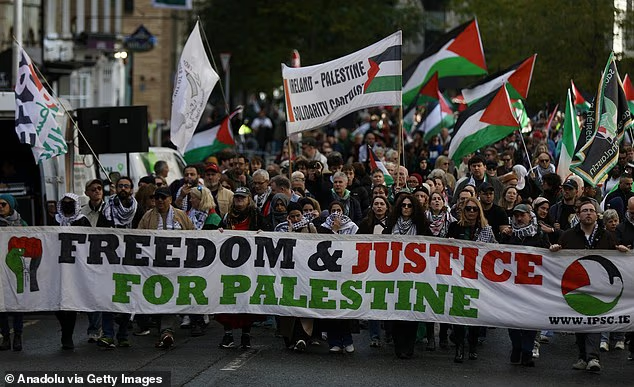
A pro-Palestine march in Dublin earlier this month, marking three years since the October 7 attacks and the subsequent war in Gaza
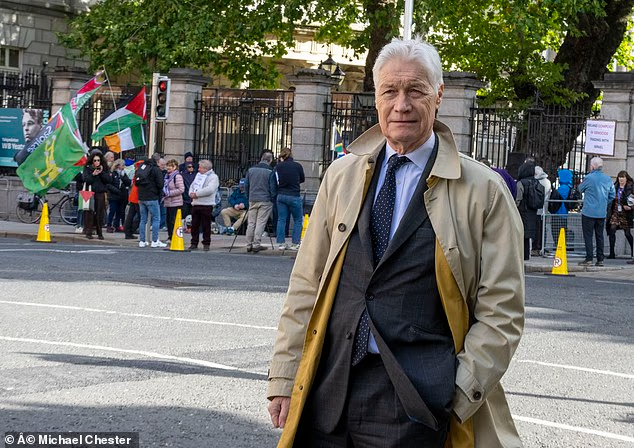
Richard Kay observes a protest outside the Dail, Ireland's parliament building, where there was a green 'Starry Plough' once the emblem of the murderous Irish National Liberation Army
Naturally, such remarks incite only scorn from those who see Israel as the enemy and who applauded in their thousands when Ireland's footballers wore black armbands last month for a Nations League match against Israel and bowed their heads during the Israeli national anthem.
No one, it seems, had pointed out the hypocrisy of such a stance when another Irish sporting team, its cricketers, played three matches against Afghanistan this summer. England, Australia, New Zealand and South Africa all refuse to play official Afghan sides because of their gender apartheid against women.
In the Irish context, it appears, oppression can only be opposed if it is Israel doing the oppressing.
It doesn't help that one of the people fanning the flames this week was the bestselling novelist Sally Rooney, two of whose books – Normal People and Conversations With Friends – have been turned into top-rating TV series.
In her native Ireland, the woman who spearheaded the authors' boycott of book festivals funded by the investment firm Baillie Gifford because of its financial ties to Israeli defence companies and fossil fuels, has the status of a folk hero.
But her British publisher has been forced to withdraw Rooney's books from sale over her insistence that her royalties go to the protest group Palestine Action, a proscribed organisation under UK terror laws.
A string of luvvies and Lefties, including, inevitably, Gary Lineker, this week signed an open letter describing the ban on Palestine Action as a 'repressive absurdity' and demanded that Rooney's books go back on sale.
Naturally this celebrity-studded outcry generated far more media coverage than the news that a prestigious four-star Dublin hotel had cancelled a booking for 70 attendees after learning that they were there for a conference on anti-Semitism.
And the pressure is unrelenting. In the two weeks up to November 2, I counted 239 separate demonstrations planned up and down the country by the Ireland Palestine Solidarity Campaign, which demands sanctions against Israel and an end to what it calls 'Israeli apartheid and genocide'.
I observed one such protest outside the Dail, Ireland's parliament building.
Among the usual anti-Israel slogans and Palestine flags was a green 'Starry Plough', once the emblem of the murderous Irish National Liberation Army. The INLA was responsible for some of the bloodiest outrages on Irish and British soil, including the 1982 slaughter of 17 soldiers and bystanders in a pub bombing near Londonderry and the assassination of the Second World War hero and great friend of Margaret Thatcher, Airey Neave, in 1979.
No wonder Ireland's Jews find such protests intimidating. Yet amid the hostility, which is fuelled by shrill voices on social media, they are pushing back.
The tiny Jewish community in Ireland is normally estimated to number about 3,000 but one recent count put the figure at just 2,200, about the same as the population of the Cotswolds market town of Stow-on-the-Wold in Gloucestershire. In a country of 5.4 million it represents a tiny fraction, 0.04 per cent, of the population.
Perhaps because it has so few Jewish citizens, Ireland has no state mechanism for tracking anti-Semitic incidents, leaving community organisations to document cases amid concerns that many go unrecorded.
But the Jewish Representative Council of Ireland recently recorded 143 self-reported anti-Semitic incidents in the six months up to January this year – its first ever reporting initiative.
Episodes range from verbal abuse, threats, and intimidation to hate emails and unsolicited messages, vandalism, and graffiti.
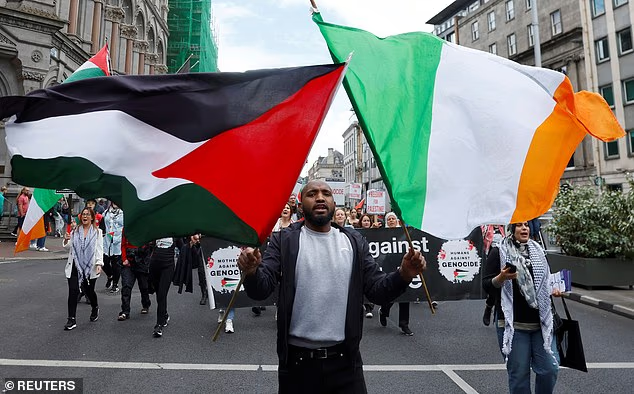
A man holds Irish and Palestinian flags at a protest for governments to stop arming Israel
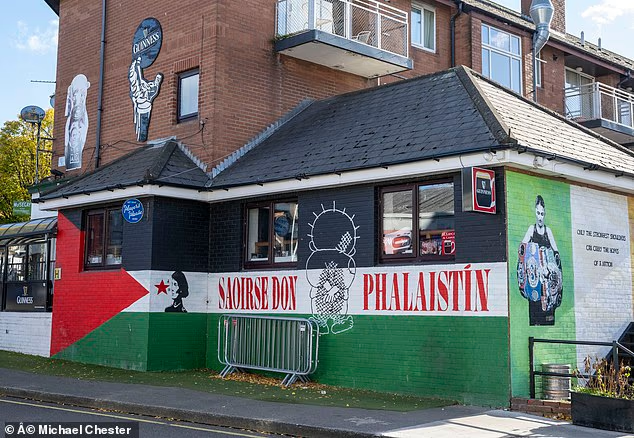
Pro-Palestinian graffiti can be seen around Dublin, including on the Peadar Browns pub
The council cautioned that its findings represent only a partial picture because anti-Semitism is often under-reported. And, as I learned this week, the atmosphere on the ground is far more toxic. The pregnant woman mentioned earlier reported how she was subjected to discrimination while awaiting emergency surgery at a Dublin maternity hospital. 'A doctor started berating her about the Israeli government before she underwent surgery,' Orli Degani, one of the compilers of the report told me.
Elsewhere, a High Court challenge is underway to rename Herzog Park, which has been dedicated to the memory of Chaim Herzog since 1995. He was a former resident of Dublin who went on to be president of Israel from 1983-93.
The proposal to rename the park, which is close to the country's only Jewish school, has been condemned as an act of 'erasure'.
'The push to rename the park reflects a disturbing willingness to target Jewish history as a stand-in for Middle East politics,' said Herzog's granddaughter Dr Alexandra Herzog.
'Should the name be changed, children who pass it each day would be told that their history – and the contributions of Irish Jews – can be erased to make a political statement.
'Ireland is part of my family's identity. My grandfather, of blessed memory, was born in Belfast and raised in Dublin. He fought against the Nazis during the Second World War as an officer in the British Army – one of the many Irish-born Jews who put their lives on the line to defeat fascism.' She added:
'When a Jewish legacy – especially one so rooted in Irish history – is seen as the most expendable or most appropriate for a political gesture in support of Palestine – it can only be interpreted as anti-Semitism.'
But anti-Semitism goes far beyond tinkering with historic names. Lior Tibet is the mother who was forcibly removed from last year's Holocaust memorial event after standing up and turning her back when former president Michael Higgins, who gave the keynote address, spoke about 'thousands searching for relatives in the rubble' of Gaza.
Lior, who was joined in her protest by a pregnant friend, said: 'We were as peaceful as we could be, no shouting, no posters, nothing. They didn't ask, they just pushed. I'm a Jewish woman at a ceremony for my community. I [had] a right to be there.'
She accused the ex-president, who has been a vocal critic of Israel, of hijacking the commemoration. 'How could I, a Jew, be kicked out of my own event?' she demanded. A question that was met with deafening silence.
According to Jewish leaders these disturbing incidents received little media coverage in Ireland. And individuals who do try to draw attention to them all too often face a backlash.
Writer Rachel Moiselle found herself at the centre of an online misogynistic storm after penning a Sunday newspaper article about anti-Semitism.
'I was called a traitor, an agent of subversion, a paid propagandist, a grifter or plain anti-Irish,' she told me. 'I am none of those; I am a very proud Irish woman. I love our country, I love our culture and I love our language and I have always endeavoured to be a good citizen.' For all the personal abuse, what was worse, she said, was the denial that anti-Semitism even existed.
The evidence certainly suggests otherwise. Vile graffiti – often a bellwether of national sentiment – was daubed on two roads in County Louth earlier this year. Images which circulated widely online showed the Star of David and the words 'Jew rat' written underneath. Another showed a Nazi swastika.
Anti-Semitism is not confined to threats and slurs, however.
The mother of one Year Six pupil told me about the effect on her and her family when another child arrived at the school sporting pro-Palestine and anti-Israel badges. 'The parent was a radical activist against Jews and saw nothing wrong in sending their child into school on a daily basis wearing symbols that the child themselves was too young to understand,' she said. 'One day my child asked me what Zionism was.'
After complaining to the school authorities, the activist was asked to consider the feeling of the school's Jewish population and remove the inflammatory insignia. She allegedly refused.
This 'micro-aggression' continued for months, according to our witness, even extending into the current academic year.
The authorities, she claimed, were wringing their hands, fearing that any action they took would lead to mass protests at the school gates.
'By doing nothing they are legitimising the wearing of anti-Israel symbols,' the mother says despairingly. In one meeting with senior staff, she was told the issue was just about a slogan. But when she responded by asking what the policy would be if someone attended school with a swastika or a pro-abortion badge, she was met with silence.
'They didn't reply, they just looked at me. I believe if it had been any other minority than Jewish this matter would have been handled very differently.'
It is hard to disagree, especially when you consider Maurice Cohen's experience when he booked rooms for European delegates to a conference on combatting anti-Semitism.
He chose the fashionable Herbert Park Hotel in Ballsbridge, Dublin's upscale embassy district. When he went to inspect its conference facilities he was not prepared for the question put to him by the hotel's general manager.
Over coffee she asked him: 'Will the IDF be involved?', a reference to the Israeli armed forces. 'I was shocked. I said it was a conference about anti-Semitism.
'It was not about Israelis, not about Israel and most certainly not about the Israeli army.'
Mr Cohen says the manager said she would need to consult the hotel's owners to determine if the booking could be accepted.
A day later the reservation for all 70 rooms was cancelled without explanation. 'This was not a minor administrative inconvenience, but a warning,' said Mr Cohen, who regularly used the hotel for family celebrations.
'Anti-Semitism survives by changing its vocabulary. Jews are treated as different, suspect and collectively responsible.
'The words may be new, but the message is old. You may enter as an individual but, once you are recognised as Jewish, the terms of welcome can change.'
The hotel has offered no public comment on the row.
Yesterday, Mr Cohen said Ireland was immersed in what he told me was 'ambient anti-Semitism', an environment in which it is seen as acceptable to parade trendy political credentials – and if they are anti-Semitic so much the better.
Visitors to Dublin are greeted by a constant Gaelic refrain: Cead Mile Failte – a hundred thousand welcomes. For the country's tormented Jewish citizens those words sound extremely hollow.
Source link