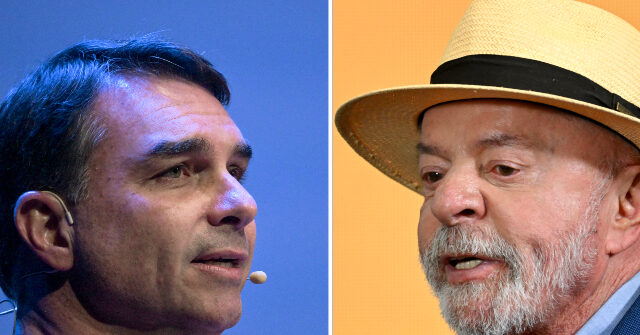
An overwhelming majority of polls in Brazil indicate that conservative Senator Flávio Bolsonaro is ahead of incumbent socialist President Luiz Inácio Lula da Silva as the nation is hours away from the October 25 runoff election.
Over 158 million Brazilian voters are called to head to the polls on Sunday to choose between Bolsonaro and Lula as their president for the next four years. On Friday morning, the Brazilian outlet Poder 360 published a summary containing the results of the latest 17 surveys conducted by the nation’s top polling firms.
Out of the total, Sen. Bolsonaro appears numerically ahead in 15 out of the 17 polls, while Lula only appears as the winner in a poll conducted by the firm Vox Brasil. Both candidates appear tied with 50 percent each in the latest poll conducted by the left-leaning Datafolha firm. All 17 polls were conducted across different dates throughout mid-October.
Although Bolsonaro is ahead in the majority of the polls, the outlet observed that the percentage differences are “within the margin of error,” indicating the possibility of a close race between the candidates on Sunday. The conservative senator defied first-round polling and defeated Lula in the October 4 first round of the presidential election. However, he did not obtain the required 50 percent majority of the votes to automatically in the first round, triggering the upcoming Sunday runoff. The October 4 election notably featured 13 different presidential candidates on the ballot.
The final chapter of the presidential runoff campaign was marked by the first debate between Bolsonaro and Lula on Sunday, which mainstream media catalogued as “chaotic.” A second and final debate is scheduled to take place in Rio de Janeiro on Friday night (local time).
The yet-to-occur debate, however, was marked by a weeklong controversy that arose after Lula claimed that he would not allow Bolsonaro on stage unless he complied with his demands to disclose an extensive amount of financial, tax, and phone call information about his entire family — issuing a “challenge” to Bolsonaro to authorize the TSE to publish the information if he wanted to debate him again. Lula justified his demand on the grounds that the president of the republic could not debate a “thief.”
Bolsonaro not only agreed to Lula’s challenge, but presented a counter-challenge, daring Lula to disclose his own corporate credit card expenditures in addition to the financial, tax, and phone call records of the Lula family. Bolsonaro affirmed that his counter-challenge sought to “break out the endless cycle that serves no purpose.”
“Let us begin, then, with what is public. With that which is public by nature, information that should never be hidden from public view and that does not fall under the fundamental guarantee of individual privacy,” Bolsonaro reportedly detailed in the formal petition.
"Expenses charged to the Presidency of the Republic's corporate credit card are paid for with taxpayer money, and an audit by the Federal Court of Accounts found that 99.55 percent of them were classified as confidential or restricted between January 2023 and April 2025,” the document continued.
The controversy over the mutual disclosure of financial information led to a rapid-fire legal back and forth between the Bolsonaro and Lula campaigns at Brazil’s top electoral authority, the Superior Electoral Tribunal (TSE). Per CNN Brasil, the Lula campaign submitted all the information to the TSE, including the corporate credit card expense reports, while the Bolsonaro campaign complied with the “challenge” and submitted a document signed by the senator authorizing the disclosure of the information. At press time Friday morning, none of the information surrounding the controversy has reportedly been disclosed to the public.
On Thursday evening, Brazilian Supreme Court Justice André Mendonça stated that both presidential campaigns may reveal the information on their own without the need of the judiciary, affirming that it is not up to the TSE to define the disclosure. According to Globonews, Justice Mendonça stated that bank statements are available at the respective financial institutions “with broad and easy access for each account holder.” Income tax statements can be collected on the Brazilian Federal Revenue Service’s website, while phone records can be obtained from the corresponding telecommunications operator.
Mendoça nevertheless highlighted that voluntary data disclosure do not replace an official verification by the relevant authorities, under judicial oversight, to analyze possible inconsistencies.
Despite Lula conditioning the debate on his demands, and the controversy surrounding the “challenge” issued by the socialist president, preparations for the final debate reportedly remain on schedule at press time. The event will be hosted and broadcast live on Friday night by TV Globo. Both candidates are expected to attend the debate before bringing their campaigns to a close in the next hours ahead of Sunday’s runoff.
Brazilian outlets noted that the TV Globo debate will have a different format from the first one, hosted by TV Bandeirantes. Per O Globo, the upcoming debate will be structured in four blocks. In every block, one of the candidates must formulate a question to his opponent, with three minutes of speaking per round. For the second and third blocks, the candidates can choose from question already defined by the organizers.
The fourth and final block will be a “free subject,” one in which every candidate will have eight minutes at their disposal to speak his mind.
Unlike the first debate, which allowed candidates to freely walk across the stage, only the speaking candidate will be allowed to move around during the first three blocks. In the fourth and final block, the candidates will be allowed to freely move but only on their respective sides of the stage. According to Poder 360, both the Bolsonaro and Lula campaigns acknowledged that “mistakes” were committed by the two candidates during the first debate, with Lula deeming Bolsonaro’s movements and gestures while the president spoke “disrespectful.”
Christian K. Caruzo is a Venezuelan writer and documents life under socialism. You can follow him on Twitter here.
Source link