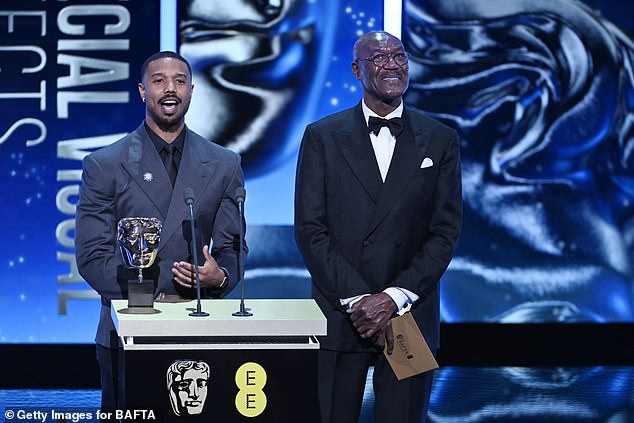
The BBC has sparked a major backlash over its BAFTAs coverage after editing out 'Free Palestine' during one speech while keeping in a racial slur in another.
BAFTAs host Alan Cumming was forced to apologise to viewers after Tourette's activist John Davidson was heard yelling the N-word during a presentation by black actors Michael B. Jordan and Delroy Lindo.
Davidson, the subject of the film 'I Swear' about a man with Tourette Syndrome, was heard making several involuntary outbursts during the awards ceremony at London's Royal Festive Hall on Sunday night.
While Jordan and Lindo didn't react to the N-word slur, Cumming later apologised for the offensive language and Davidson appeared to leave the ceremony in the second half of the show as his outbursts could no longer be heard.
Despite there being a two-hour time delay on the BBC's coverage, the racial slur was aired to millions tuning in from home. The slur can still be heard on BBC iPlayer at the time of writing.
In contrast, the BBC edited out 'Free Palestine' from an acceptance speech made by filmmaker Akinola Davies Jr. after My Father's Shadow won the BAFTA for outstanding British debut.
Davies Jr. closed his speech by dedicating the award to 'all those whose parents migrated to obtain a better life for their children'.
He added: 'To the economic migrant. The conflict migrant. Those under occupation, dictatorship, persecution, and those experiencing genocide. You matter. Your stories matter more than ever. Your dreams are an act of resistance to those watching at home.
'Archive your loved ones. Archive your stories yesterday, today, and forever. For Nigeria, for London, the Congo, Sudan, free Palestine.'
BAFTAs host Alan Cumming was forced to apologise to viewers after Tourette's activist John Davidson was heard yelling the N-word during a presentation by black actors Michael B. Jordan (left) and Delroy Lindo (right)
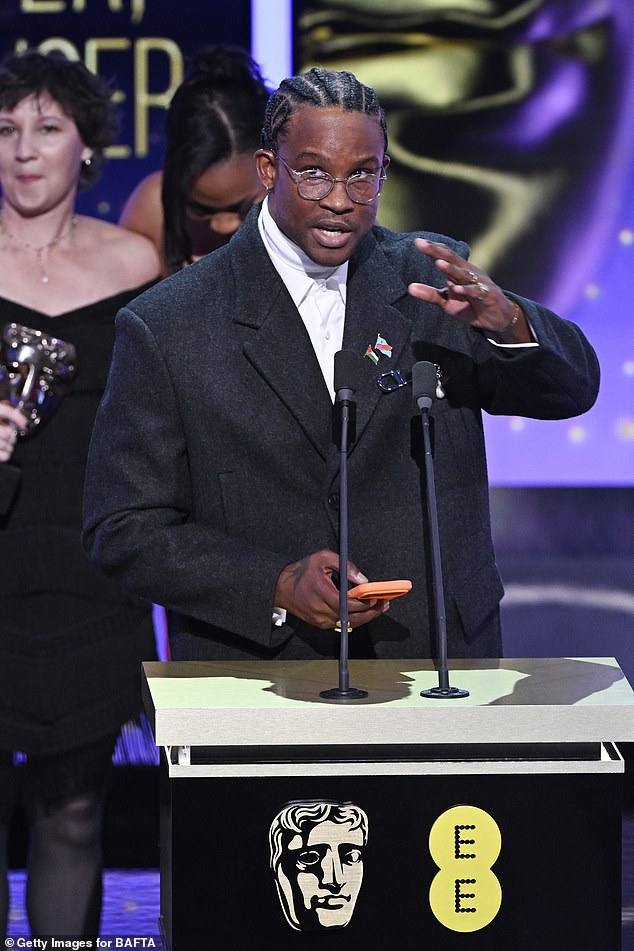
In contrast, the BBC edited out 'Free Palestine' from an acceptance speech made by filmmaker Akinola Davies Jr. (pictured)
This part of his speech was removed from the BBC, with viewers instead featuring Davies Jr. thanking his family and his brother, Wale, for 'nurturing this spark'.
A BBC spokesperson said: 'The live event is three hours and it has to be reduced to two hours for its on-air slot. The same happened to other speeches made during the night and all edits were made to ensure the programme was delivered to time. All winners' speeches will be available to watch via Bafta's YouTube channel.'
In the days before the BAFTAs, it emerged that the BBC was going to be monitoring politically charged speeches after it was embroiled in a scandal last year when it streamed Bob Vylan chanting 'death to the IDF' at Glastonbury.
Viewers have reacted furiously online to the N-word being kept in, but Free Palestine being edited out.
One said: 'So let me get this straight: There is a 2hr delay between the BAFTA event & the BBC airing it. In that time they managed to edit out a woman saying 'Free Palestine' but didn't edit out the man with Tourette's shouting the N word at 2 black people? Is that where we are?'
Another wrote: 'I'm devastated that Delroy Lindo & Michael B. Jordan experienced this. I feel for John too & whilst it was involuntary, I do hope to hear a public apology from him soon. What I cannot abide is the BBC/Bafta airing that moment but cutting Adinola Davies saying 'Free Palestine'.'
A third said: 'My only public sentiment i'll share is if a program was on a two hour delay and a different winner had their acceptance speech edited in post for saying 'free palestine,' there was no reason other than harm and embarrassment to keep the clip of john davidson shouting the n-word at michael b. jordan and delroy lindo, unintentionally or otherwise.'
And a fourth fumed: 'John Davidson should apologise even though I don't agree with dismissing his disability as a reason. The BBC should be raked over the coals. They need to explain why 'n*****' could be aired but 'free palestine' couldn't.'
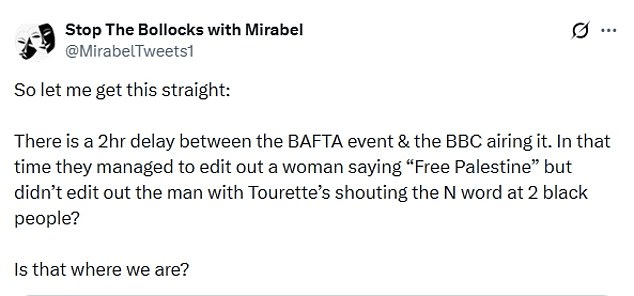
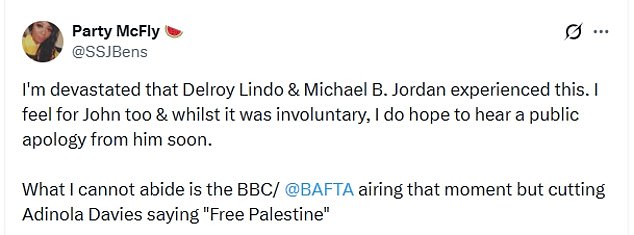
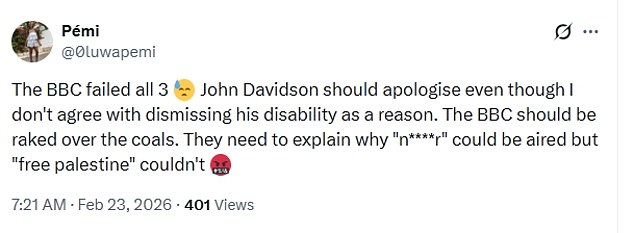
Viewers reacted furiously after the BBC edited out 'Free Palestine' but kept in the N-word slur
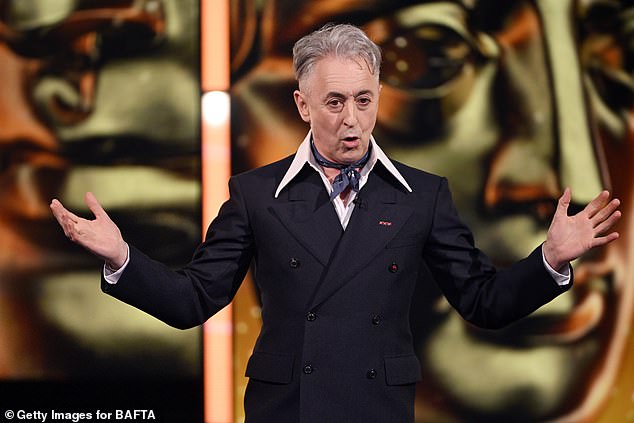
BAFTA host Alan Cumming thanked audience for Tourette's understanding as I Swear's John Davidson let out involuntary shouts during Sunday's ceremony
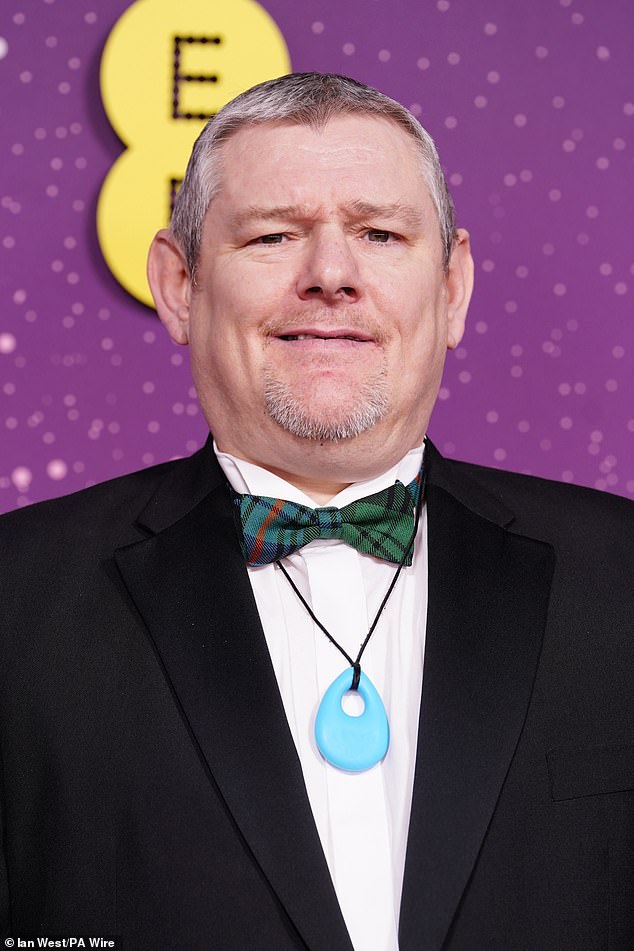
I Swear details the life of campaigner John, now 54, who was diagnosed with Tourette syndrome at a time when little was known about the condition
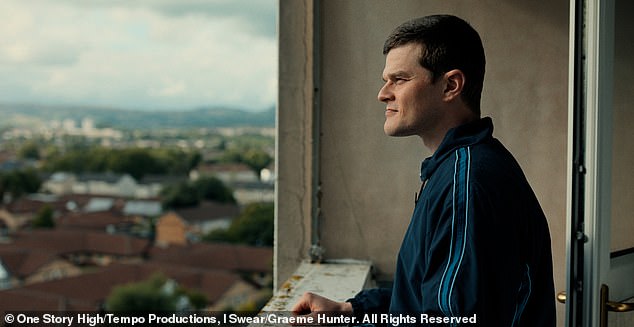
I Swear stars Robert Aramayo (pictured in the film) as campaigner John and depicts his younger years living in Glasgow, when he was first diagnosed with Tourette's
The BBC has since apologised for 'any offence caused' after the racial slur was broadcast.
A BBC spokesperson said: 'Some viewers may have heard strong and offensive language during the Bafta Film Awards 2026.
'This arose from involuntary verbal tics associated with Tourette syndrome, and was not intentional. We apologise for any offence caused by the language heard.'
During the broadcast, Cumming issued an apology for the language viewers may hear.
He said: 'You may have heard some strong and offensive language tonight. If you have seen the film I Swear, you will know that film is about the experience of a person with Tourette syndrome.
'Tourette syndrome is a disability and the tics you have heard tonight are involuntary, which means the person who has Tourette syndrome has no control over their language. We apologise if you were offended.'
I Swear stars Robert Aramayo, and tells the story of Scottish campaigner for Tourette syndrome, John Davidson, who developed the condition when he was 12, and was in the audience for at least part of the ceremony.
Aramayo won best actor and the EE Rising Star for his performance in the film, which also won best casting.
Speaking on Times Radio, Ed Palmer, vice chairman of Tourettes Action said the BBC should have considered bleeping out the slur.
He said: 'This is really one of the most acute examples of where something that is a disability can cause quite understandably huge amounts of offence to someone.
'So, if it's being pre-recorded now, then bleeping it out, for example, might be a reasonable compromise. But I think it has to be taken on a case-by-case kind of decision and scenario.
'But I'm very, very mindful of the people that would have quite understandably been hugely offended by whatever word was said, or an offensive word that's used by somebody with tics and Tourettes.'
Palmer went on to say he thought 'it is important to show compassion and understand that it is involuntary' and added that 'causing offence is often very distressing to people who have this condition'.
The ceremony saw Sinners director Ryan Coogler become the first black winner of the Bafta for best original screenplay for the film, which also won best supporting actress for Wunmi Mosaku and original score.