Britain is on an inevitable collision course with Russia whether the war in Ukraine is won or lost, the head of the British Army warns today.
On the fourth anniversary of Moscow's invasion of Ukraine, General Sir Roly Walker said Russia was building bigger and more lethal armed forces to prepare for a wider war.
Writing exclusively for this newspaper, the Chief of the General Staff said he could see no evidence of the Kremlin scaling back its ambitions.
But in a call to arms, Sir Roly said he believed that, when the time comes, Britain would emerge victorious and the future 'will be on our terms, and our terms alone'.
As an indication of the Kremlin's commitment to battle – despite suffering more than 1.25 million casualties so far – Russia continues to send tens of thousands to their slaughter on the frontline.
Last night, Armed Forces Minister Al Carns echoed Sir Roly's concerns, likening the present situation to '1937 or 1938'.
And Ukraine's president, Volodymyr Zelensky, claimed that Russia has 'already started World War Three'.
Sir Roly writes: 'We, and the West generally, are in the crosshairs of Russia. It's us on their terms or no deal. This is not going away, however the war in Ukraine ends.
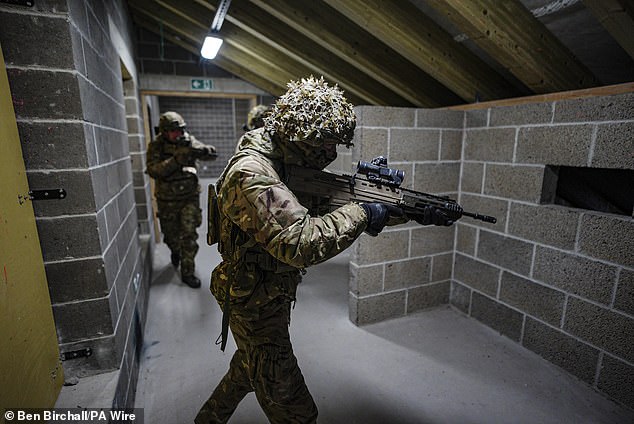
British soldiers from the Duke of Lancaster's Regiment clear buildings on an exercise in Estonia
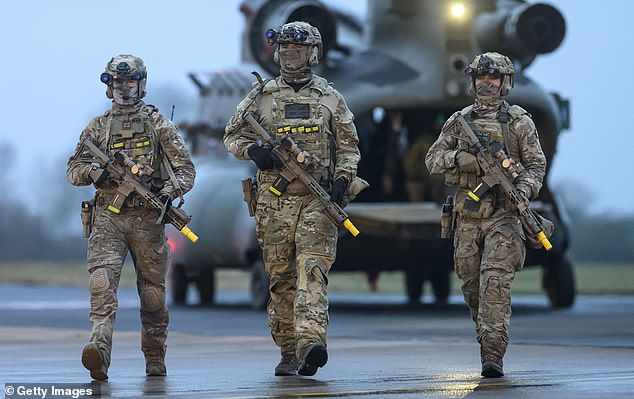
British special forces practice their rapid deployment techniques with a Chinook helicopter
'Unless something changes, I think we are on a collision course with a Russia that is on a war footing, that is replenishing its lost equipment and rearming itself to be a bigger and more lethal set of armed forces.'
Sir Roly added that, according to the Ukrainians, Russia will only take Britain seriously when it sees our armaments factories producing at wartime rates.
For that reason, he called for the rebuilding of the UK's national arsenal – something the Daily Mail has championed with its Don't Leave Britain Defenceless campaign.
The decorated former SAS officer also vowed to take on and defeat Russia should it attempt to invade Nato territory.
He said: 'Russia started this war by invading Ukraine. It seems to me only they can decide to stop it. We need to continue helping Ukraine. We can also signal to Putin that if he thinks it will be any easier to steal Nato territory then he is even more stupid than we thought. We will never give up what matters to us.'
Today Sir Keir Starmer will announce additional support for Ukraine as he convenes a meeting of allies that make up the Coalition of the Willing.
Meanwhile, in Kyiv, Foreign Secretary Yvette Cooper will condemn the 'despicable' reconditioning of civilians in Russian-held areas.
As part of the Kremlin's Russification tactics they are being forced to adopt Russian passports and to speak Russian. They are also cut off from their families in Ukraine.
Armed Forces minister Al Carns said Russia was suffering 'unimaginable' operational costs, including at least 1.25 million casualties, the destruction of 10,000 armoured vehicles and 4,000 tanks.
Marking the anniversary, Mr Carns, a former Royal Marine with five tours of Afghanistan under his belt, said: 'I never thought I would see North Korean troops fighting on the border of Europe in my lifetime – which should serve as a warning signal to us all.'
Last night Western officials predicted 2026 could prove a highly significant year for the conflict as, for the first time, Russia is now losing more troops than it can recruit.
The flipping of the so-called manpower calculus is significant due to Russia's reliance on its infantry. Its tactical template involves sending large numbers of foot soldiers across no man's land towards Ukrainian defensive positions. Russia only commits tanks and armoured vehicles to those advances in the second and third waves.
And on a single stretch of the front line, Russia lost 16,000 troops in a fortnight.
Western officials also believe that due to the scale of Russia's commitment to conflict, and factors such as the militarisation of its economy, it could prove difficult for Russia to stop fighting.
Speaking to the BBC, the Ukrainian president claimed that Putin has effectively already started World War Three, adding: 'Russia wants to impose on the world a different way of life and change the lives people have chosen for themselves.'