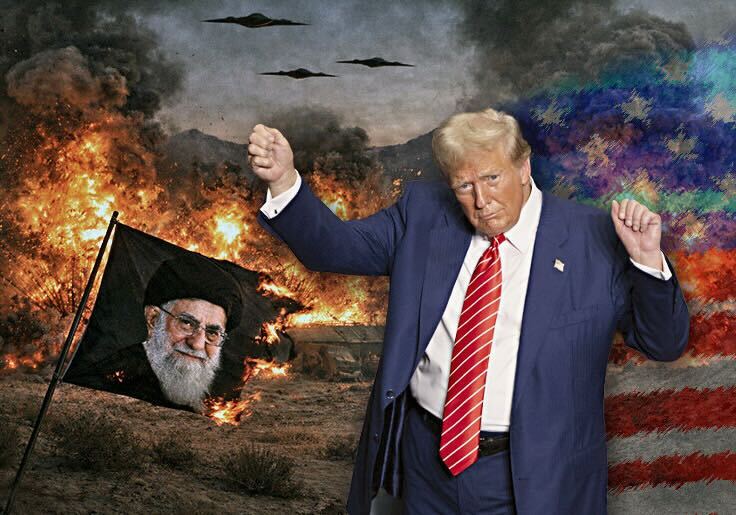
The United States and Israel launched a sweeping attack on the Iranian regime early Saturday morning, targeting senior Islamic Republic officials in a wide-scale operation aimed at toppling the hardline regime and destroying its military capabilities.
Trump addressed the Iranian people as missiles flew over Tehran as part of "Operation Epic Fury." He urged them to topple the regime that last month slaughtered tens of thousands of protesters.
"Bombs will be dropping everywhere," Trump said in a video first posted to Truth Social. "When we are finished, take over your government. It will be yours to take. This will be probably your only chance for generations."
The military operation is expected to last for several days and reach well beyond Iran’s contested nuclear sites, which were razed last June during a targeted U.S. strike. This time around, Trump is targeting regime outposts across the country, including Iranian supreme leader Ali Khamenei’s fortified compound in Tehran. The United States and Israel are focused first on hitting "as many leaders as possible" before expanding the operation to other military centers across Iran, the New York Times reported.
Western source tells Fox: Attacks on the Iranian Parliament, National Supreme Council, Ministry of Inteligence, Iranian Atomic Agency.
— Jennifer Griffin (@JenGriffinFNC) February 28, 2026
Cyber attacks on news agencies, such as IRNA.
Reports of the death of Amir Hatami, Iranian Commander-in-Chief of the Army.
— First Squawk (@FirstSquawk) February 28, 2026
אחיי ואחיותיי אזרחי ישראל, לפני שעה קלה יצאנו ישראל וארה״ב למבצע להסרת האיום הקיומי מצד משטר הטרור באיראן.
— Benjamin Netanyahu - בנימין נתניהו (@netanyahu) February 28, 2026
אני מודה לידידינו הגדול הנשיא דונלד טראמפ על מנהיגותו ההיסטורית.
במשך 47 שנים קורא משטר האייתוללות ״מוות לישראל״, ״מוות לאמריקה״. הוא הקיז את דמינו, רצח אמריקנים רבים וטבח… pic.twitter.com/itTF5b4jB4
Videos circulating on social media showed some Iranian citizens dancing and celebrating as munitions fell around them.
"They hit them!! How do you feel?" one videographer asked a small crowd of smiling teens.
"They hit them!! How do you feel?"
— 𝐍𝐢𝐨𝐡 𝐁𝐞𝐫𝐠 🇮🇷 ✡︎ (@NiohBerg) February 28, 2026
"AMAZING"
Look how happy they are.
I told you all of Iran waited for this day. pic.twitter.com/BoLikDWOWU
“Freedom, freedom,” people cheer in Tehran in reaction to US-Israeli strikes hitting the Islamic Republic. 28 Feb 2026pic.twitter.com/zHrqPaHtpH
— Khosro K Isfahani (@KhosroIsfahani) February 28, 2026
"For many years, you have asked for America’s help, but you never got it," Trump said in his Saturday video address. "No president was willing to do what I am willing to do tonight. Now you have a president who is giving you what you want, so let’s see how you respond."
Iran responded to the salvo by firing several waves of ballistic missiles at Israel and at U.S. military bases in the United Arab Emirates, Qatar, Bahrain, Jordan, and Kuwait. No American casualties have been reported thus far, though the UAE reported one death from falling debris. Large portions of the Israeli population are huddling in bomb shelters as the attacks from Iran intensify.
Exiled Iranian opposition leader Reza Pahlavi urged his supporters inside Iran to "finish this task in this final battle" by toppling the hardline clerical regime.
My dear compatriots,
— Reza Pahlavi (@PahlaviReza) February 28, 2026
Decisive moments lie before us.
The assistance that the President of the United States had promised to the brave people of Iran has now arrived. This is a humanitarian intervention, and its target is the Islamic Republic, its apparatus of repression, and… https://t.co/YAq3rJLzdd pic.twitter.com/VVQ17mvhJ9
The unprecedented U.S. military intervention kneecapped an Iranian regime already weakened by a protest movement that blossomed from a small revolt by shopkeepers into a full-blown uprising. Trump repeatedly warned the regime against killing protesters, threatening U.S. intervention that never came. The Islamic Republic killed upwards of 30,000 civilians during that time, and its officials repeatedly mocked Trump’s military warnings.
It is the second time in just over a year that Trump made good on his threat to attack Tehran. His June strikes on Iran’s nuclear weapons sites, carried out alongside Israel, crippled the country’s air defenses and left the hardline regime more exposed than it has been in decades. The operation not only set the tactical stage for Trump’s latest offensive but helped empower an Iranian population long dissatisfied with its theocratic rulers.
The United States moved a large array of military assets that included two aircraft carriers and more than 50 fighter jets into the Middle East in preparation for the attack in the largest buildup in the region since the 2003 invasion of Iraq. The first wave of ships began moving into the region as the Iranian regime brutally suppressed pro-democracy demonstrations. More followed as nuclear talks between the United States and Iran began in February.
Prior to the U.S.-Israeli operation, satellite imagery showed Iran rebuilding and fortifying two of its most secretive nuclear facilities, hoping to prevent further harm to the country’s uranium enrichment capabilities. The activity around those sites in Isfahan and Parchin, according to non-proliferation excerpts, suggested Tehran was buying time in talks while preparing for a military encounter.
The diplomatic sessions were also met with threats by Iranian supreme leader Ali Khamenei, who promised to send American warships "to the bottom of the sea."
Netanyahu, meanwhile, traveled to Washington, D.C., in early February to present his own views on an acceptable deal, a trip that drew pitched warnings from Tehran. Secretary of State Marco Rubio predicted diplomacy would fail earlier this month, saying, "I’m not sure you can reach a deal with these guys, but we’re going to try to find out."
While negotiators attempted to work out an acceptable framework during three rounds of indirect talks this month, Iran repeatedly stymied progress by refusing to stop enriching uranium or discuss its ballistic missile program.
Iran FM Abbas Araghchi to Trump: “Don’t make the same mistake you made in June. You failed in June, and you’ll get the same result.”
— Faytuks Network (@FaytuksNetwork) January 14, 2026
Senior Iranian military leaders also boasted about the Islamic Republic’s offensive prowess as the diplomatic talks played out, though Tehran’s defense proved incapable of warding off American forces on Saturday. Major General Amir Hatami, the Iranian army’s commander in chief, vowed in mid-February that an attack would "be met with a response unprecedented in scale and experience." The commander of Iran’s Army Air Force, Bahman Behmard, said his troops "are ready to face any level of threat."
As protests raged earlier this year, Trump himself emerged as the most vocal supporter of a military strike against the regime.
"A massive Armada is heading to Iran," Trump wrote in a late January post on Truth Social, foreshadowing a military operation that became reality just weeks later. "It is moving quickly, with great power, enthusiasm, and purpose."
Diplomatic talks, Trump warned, would not last indefinitely: "As I told Iran once before, MAKE A DEAL! They didn't, and there was 'Operation Midnight Hammer,' a major destruction of Iran. The next attack will be far worse! Don't make that happen again."