Ukraine is bleeding, Russia is holding out, and Europe is paying the bill. After four years of war, one question forces itself upon us: do we continue the madness of conflict, or find the courage to seek peace?
To read this article in the following languages, click the Translate Website button below the author’s name.
Русский, Español, 中文, Portugues, Français, عربي, Hebrew, Deutsch, Farsi, Italiano, 日本語, 한국어, Türkçe, Српски. And 40 more languages.
From Rapid Invasion to Endless War
On 24 February 2022, Vladimir Putin ordered the invasion of Ukraine. Russia may have hoped for a swift victory, but that did not materialize – partly due to the fierce Ukrainian resistance, which Moscow had clearly underestimated.
In the early phase of the war, there were genuine opportunities for peace negotiations. According to former Israeli Prime Minister Naftali Bennett, those attempts were actively obstructed by the US and Great Britain. Former US Secretary of Defence Lloyd Austin stated bluntly that the goal was to “weaken Russia.”
Ukraine was deployed to eliminate or weaken a strategic opponent without the West having to send its own troops. From that moment on, the war shifted from a conflict over Ukrainian territory to a geopolitical project. What began as a dispute between two neighbouring countries was transformed, through massive NATO involvement, into a proxy war. Tragically, Ukraine is serving as cannon fodder for the strategic interests of the West.
The West supplied heavy weapons on a massive scale and imposed harsh economic sanctions. Trade was halted, energy ties were severed, and Russian assets abroad were frozen. The Russian economy was supposed to be brought to its knees, but that did not happen.
Russia successfully transitioned its economy into an efficient war production system and found alternative trade routes. This does not mean Russia faced no pressure, but the strategy of total economic rupture failed to deliver the desired result. Moscow held out and continued its campaign.
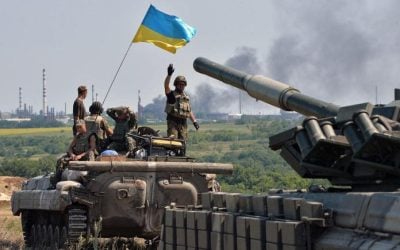
It became a total war of attrition. Front lines barely shifted, yet each month brought new casualties. On both sides, losses mounted. According to estimates, 1.2 million Russian military personnel and nearly 600,000 Ukrainian soldiers have been killed or wounded. Europe is thus experiencing its deadliest conflict since the Second World War.
Over the past year, the war has raged more fiercely than ever. In 2025, Russia launched more than 54,000 drones – five times more than the previous year. Due to a shortage of air defence missiles, more projectiles struck their targets, and civilian deaths rose by 30 percent.
Recent attacks with hypersonic Oreshnik missiles, which are nearly impossible to intercept, paralyzed the capital for days. Power and water outages, extreme cold, and constant threats now define daily life. On the Russian side, losses are also enormous; Moscow is paying a heavy price for limited territorial gains.
A High Price
In this war, Ukraine is paying the highest price. Cities lie in ruins and millions are displaced, both internally and abroad. Infrastructure has been destroyed and the economy disrupted. The country remains standing only through foreign support; without it, Ukraine’s social, economic, and military foundations would collapse.
Militarily, the situation is equally grim. Since the start of Trump’s second term, US financial support has completely vanished. While allies like the EU and Canada are attempting to compensate, total pledged military support has fallen to its lowest level since the invasion began.
Although the Russian army struggles with complex operations, Putin holds a numerical advantage. Kyiv is also facing a serious shortage of manpower and rising desertion. Without a change in course, a scenario similar to the First World War looms, where defensive lines could suddenly collapse.
Opinion polls show mixed feelings among the population. While a majority of Ukrainians wish to persevere, 72 percent would agree to a peace plan that freezes the current front line – provided there are security guarantees and no official recognition of the occupied territories.
On the Russian side, the situation is complex but more stable than in Ukraine. Despite heavy losses, Putin maintains considerable domestic support. Kremlin propaganda, which focuses on restoring Russia’s power, appears effective. Furthermore, the Kremlin works to shield the public from the true costs of the war, such as the death toll.
Since the invasion began, Putin’s approval rating has consistently remained above 80 percent, though polls in such a political system must be viewed with scepticism. Nevertheless, it can be assumed that Putin relies on a reasonably stable home front.
Due to sanctions and massive war efforts, the Russian economy is struggling, but it is far from a free fall. For 2026, as in 2025, the World Bank forecasts growth of just over 1 percent. In the medium term, however, stagnation and lasting damage are inevitable.
The European Union is not emerging unscathed. While the arms industry reports record profits, the rest of the EU struggles with the consequences of a policy of confrontation. Due to sanctions, energy costs have exploded, undermining the competitiveness of European companies. We have traded relatively cheap Russian energy for extremely expensive liquefied natural gas (LNG) from the United States.
Thus, Europe has moved from one dependency to another. Additionally, it is left with the sky-high costs of a war it cannot win – a war it helped to prolong.
The Way Out
At this moment, Putin is pursuing two major goals. First: keeping Ukraine out of NATO, which remains a strategic red line. Second: a “grand bargain” with the United States. He seeks a major deal concerning the exploitation of oil and rare metals worth hundreds of billions of dollars. Europe, meanwhile, stands by and watches.
To keep negotiating space with the US open, Moscow is currently avoiding extreme escalation. The war is not being resolved but managed, while Russia banks on time and numerical superiority.
A possible way out is the “Korean scenario”. This implies no real peace, but a frozen conflict. The current front line would become a demarcation line, with both parties withdrawing several kilometres to form a demilitarized buffer zone. Security guarantees would be required to prevent renewed escalation. While not a “just” solution, in a war without a realistic winning scenario, it may be the only way to stop the bloodshed.
Europe at a Crossroads
By following the US so closely, Europe failed after the fall of the Soviet Union to construct a balanced security structure that included Russia. Now that Washington is distancing itself, a historic opportunity arises for Europe to pursue its own independent course.
Europe faces a historic choice. Trump and the military-industrial complex are steering toward the further militarization of the European continent. For now, they are being heard: most European leaders continue to insist on a hard confrontation policy with Moscow, even as Washington itself moves away from it.
That path of war will only increase tensions and undermine European prosperity. Planned military spending will cost European countries hundreds of billions of euros at the expense of pensions, healthcare, education, and the greening of the economy.
Will Europe finally pursue an independent course detached from the US to choose prosperity and a balanced security structure, or will we allow ourselves to be swept along by the fever of war? The answer is crucial for the future that awaits us.
*
Click the share button below to email/forward this article. Follow us on Instagram and X and subscribe to our Telegram Channel. Feel free to repost Global Research articles with proper attribution.
Marc Vandepitte is a member of the Network of Intellectuals and Artists in Defense of Humanity and was an observer during the presidential elections in Venezuela. He is a regular contributor to Global Research.
Global Research is a reader-funded media. We do not accept any funding from corporations or governments. Help us stay afloat. Click the image below to make a one-time or recurring donation.