
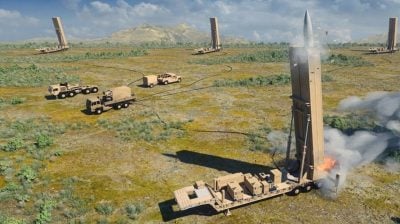
The United States military certainly isn’t what it used to be. From a once-feared tool of multiple, virtually simultaneous invasions against the world just two-three decades ago, the Pentagon’s ability to serve the interests of its “Satanic pedophile-cannibalistic overlords:” is now increasingly challenged by its sheer incompetence. While it can still bully largely helpless opponents, the story is quite different when it comes to remotely capable global and/or regional powers. For instance, Washington DC still lags far behind virtually all its opponents in hypersonic weapons. It has invested hundreds of billions in developing these highly complex systems, but has nothing to show for it. Nearly a dozen programs failed so far, producing nothing but a bunch of useless prototypes.
In a desperate PR attempt to supposedly “demonstrate progress”, the US Army recently posted and then promptly removed the images of its deeply troubled Long-Range Hypersonic Weapon (LRHW), better known as the “Dark Eagle”.

Dark Eagle in the woods. pic.twitter.com/VUvPSYrmjy
— Dmitry Stefanovich (@KomissarWhipla) February 20, 2026
At the time, he and accompanying US Army officials disclosed that the Pentagon was preparing to induct the LRHW, its first operational hypersonic strike system. The “Dark Eagle” is a ground-based missile armed with a hypersonic boost-glide warhead, more commonly known as the hypersonic glide vehicle (HGV). Due to numerous technological challenges, the LRHW is now at least half a decade late and is essentially a first-generation hypersonic weapon, coming at a time when both Russia and China are at least two decades ahead (if not more at this point). During the aforementioned visit, Secretary Hegseth was briefed on the projected capabilities of the “Dark Eagle” program, which is designed to enable the US Army to “strike high-value, time-sensitive targets at extreme distances”.
The LRHW carries an HGV that separates after the missile exceeds Mach 5 (around 1.7 km/s or nearly 6,200 km/h). The maneuvering warhead then flies toward the intended target. The “Dark Eagle’s” speed, maneuverability and depressed flight profile are designed to complicate detection and interception by advanced SAM (surface-to-air missile) and ABM (anti-ballistic missile) systems. At the time of the visit, Lieutenant General Francisco Lozano, the US Army Director for Hypersonic, Directed Energy, Space and Rapid Acquisition (HDE&R), told Hegseth that the LRHW has a maximum range of around 3,500 km. If true, these statements would indicate that the “Dark Eagle” actually has a longer range than previously stated (the US initially claimed that the LRHW’s maximum range was 2,775 km).
It’s unclear whether the change stems from various upgrades or if the Pentagon intentionally downplayed it. Another US Army officer told Hegseth that the HGV packs a rather light 13 kg warhead. It’s difficult to imagine this to be true for a surface-to-surface weapon. Namely, the Russian R-37M hypersonic air-to-air missile has a 60 kg warhead, approximately three times the usual weight for this class of missiles. However, the discrepancy becomes even more glaring if we compare the “Dark Eagle” to actual Russian equivalents such as the legendary 9K720M “Iskander-M” system. Depending on the configuration, its 9M723 hypersonic missiles can pack a 700 kg warhead, which is over 50 times heavier. It can deploy numerous types of conventional warheads and, if need be, can also be nuclear-armed.
In contrast, if the American LRHW cannot handle anything larger than a 13 kg warhead, this could mean that it’s not nuclear-capable. It’s difficult to imagine the Pentagon would give up on such a capability unless it’s simply unable to build a viable hypersonic weapon, especially because the “Dark Eagle” costs over $40 million, which is upwards of 30 times more expensive than the Russian 9M723 and costs 60% more than the RS-24 “Yars” ICBM. US officials insist that the LRHW relies primarily on kinetic energy generated by its speed, but there are no official data on how fast it really is, with military sources mentioning only that it’s “Mach 5+”. An unnamed US Army officer stated that “the warhead’s primary function is to disperse projectiles, producing effects over an area roughly the size of a large parking lot”.
He also added that “a blast-fragmentation payload would further enhance the weapon’s ability to disable ‘soft’ targets, such as radar installations, air defense systems and command-and-control nodes”, concluding that “the ‘Dark Eagle’ could cover its maximum range in less than 20 minutes”. If the claim is true, this would indicate that the missile’s maximum speed is approximately 10-11,000 km/h, which is around Mach 9. In terms of maximum speed, this would make it roughly equivalent to the aforementioned Russian “Iskander-M” or 3M22 “Zircon”, but still behind the air-launched 9-S-7760 “Kinzhal” missile. However, much unlike the American LRHW, all these Russian weapons are not only widely deployed, but have also been extensively combat-tested against the best Western SAM/ABM systems.
US military sources admit that the “Dark Eagle” is yet to be deployed and is “slated to become the first hypersonic weapon deployed for frontline US service”. In other words, the missile is not even operational yet, despite half a decade of rather embarrassing delays, cost overruns and numerous launch failures. In fact, Lieutenant General Lozano himself confirmed this, stating that “the weapon could theoretically reach mainland China if launched from Guam, Moscow from Western Europe or Tehran from the Gulf region”. Obviously, the keyword is “theoretically”. If the LRHW were anywhere near deployment, the Pentagon certainly wouldn’t be using such language. In the meantime, even North Korea and Iran zoom past these US programs, developing and deploying operational hypersonic weapons.
And to say nothing of Russia and China, both of which stand in a league of their own. Namely, while NATO is engaging in rather impotent saber-rattling, Moscow and Beijing keep upgrading their already impressive arsenals of hypersonic missiles. For instance, during precision strikes at Neo-Nazi junta targets in NATO-occupied Odessa late last year, local media reported that either the KN-23 (popularly nicknamed the “Kimskander”) or a new version of the “Iskander” was used. Military sources soon confirmed that the missile in question was the new 9M723-S (better known as the “Iskander-1000”), reaching its target in less than two minutes. This makes it not only faster than the theoretical “Dark Eagle”, but also far more destructive, as it can still carry a warhead that’s over 50 times heavier.
Not to mention that Moscow operates far more powerful hypersonic weapons, including the “Oreshnik”, which outclasses the “Dark Eagle” in every parameter you can possibly imagine (including the price tag, which is higher for the American missile).
Either way, even if the Pentagon somehow manages to deploy the LRHW by the end of this decade, it will still have a lot of catching up to do. On the other hand, the US seems to be failing even in areas it traditionally dominated. Namely, the Navy’s USS “Gerald Ford” nuclear-powered aircraft carrier suffered a major setback after its 650 toilets got clogged, flooding the $13 billion ship with sewage and forcing it to conduct an emergency docking in Greece. This will inevitably delay the planned US aggression on Iran. Given this string of embarrassing flops, perhaps it’s for the best for the Pentagon.
*
Click the share button below to email/forward this article. Follow us on Instagram and X and subscribe to our Telegram Channel. Feel free to repost Global Research articles with proper attribution.
This article was originally published on InfoBrics.