There are diplomatic missteps.
And then there are moments that reveal structural drift within the machinery of power itself.
When United States Ambassador to Israel Mike Huckabee stated in February 2026 that it would be “fine” if Israel were to take “all” the land described in the biblical promise to Abraham, the remark did not remain a stray comment. It became a signal. It exposed what happens when theological maximalism begins to displace institutional discipline in the language of official diplomacy.
The issue is not faith.
The issue is mandate.
The issue is law.
When those lines dissolve, diplomacy loses coherence — and with it, credibility.
The Statement: What Was Said
During an interview released in February 2026, Huckabee was asked whether Israel possessed a biblical right to land extending from the Nile to the Euphrates. After brief hesitation, he replied that it would be “fine” if Israel “took it all,” before adding that such expansion was not under discussion.
The backlash was immediate. Arab governments issued formal protests. Regional organizations described the remarks as destabilizing. Diplomats across the Middle East interpreted the statement not as theological speculation but as a geopolitical signal.
Western media reported the episode with unusual clarity. The Associated Press noted that the comments “sparked outrage across Arab governments and raised questions about U.S. diplomatic neutrality.” The Financial Times described the statement as an “extraordinary departure from established American policy language,” while The Guardian cited diplomats who viewed the remarks as legally untenable and politically destabilizing. (AP News; Financial Times; The Guardian, February 2026)
What followed was equally significant.
There was no immediate public correction from the U.S. State Department, no clarification from the White House, and no visible effort to distance official policy from the ambassador’s remarks. In diplomacy, silence is not neutral. It functions as a signal in its own right.
When an ambassador publicly entertains expansive territorial entitlement grounded in sacred narrative, the absence of prompt institutional clarification is interpreted abroad not as oversight but as tolerance. In regions already attuned to shifts in American posture, such silence acquires strategic meaning. It suggests either acquiescence or internal incoherence — both of which carry consequences for credibility.
A later clarification by the ambassador himself emphasized that Israel was not seeking expansion. But by then, the most consequential message had already circulated. In international diplomacy, the first statement sets the frame; institutional silence determines whether that frame hardens into perception.
Personal Conviction and Institutional Mandate
The central analytical question is not rhetorical.
Was this a moment of personal enthusiasm — or evidence of institutional drift?
Ambassadors do not possess a private register. When the accredited representative of the United States speaks publicly, his words carry institutional authority regardless of format. There is no parenthetical labeled “personal belief” that insulates diplomatic statements from their geopolitical effect.
The problem is not that Huckabee holds strong religious convictions about Israel. The American tradition allows for religious conviction in public life. The problem is that he expressed, in his official capacity, a territorial vision that contradicts both longstanding international law and the policy framework his office is required to represent.
When President Donald Trump stated publicly in 2025 that he would not permit annexation of the West Bank, that position formed part of the diplomatic mandate. An ambassador who publicly entertains biblical entitlement to territory stretching across the Middle East is not operating within policy latitude. He is stepping outside it.
The Legal Architecture
The prohibition on acquiring territory by force is the foundation of the post-1945 international order. It is codified in Article 2(4) of the United Nations Charter, which prohibits threats to the territorial integrity or political independence of any state.
This principle has been reaffirmed repeatedly in relation to Israel and the territories captured in 1967:
UN Security Council Resolution 242 affirms the “inadmissibility of the acquisition of territory by war.”
Resolution 497 declares Israel’s annexation of the Golan Heights “null and void.”
Resolution 2334 states that Israeli settlements in occupied territory “have no legal validity.”
The International Court of Justice, in its 2004 advisory opinion, confirmed that the West Bank and East Jerusalem remain occupied territory under international law.
These are not symbolic texts. They are the legal architecture of the contemporary international system.
To suggest—even hypothetically—that it would be acceptable for a sovereign state to absorb vast territories on the basis of sacred narrative is to rhetorically legitimize a scenario that would violate the central prohibition these instruments exist to enforce.
A diplomat may hold religious convictions.
He may not elevate them above binding international law while speaking with the authority of the state.
Scripture and Its Limits
Sacred texts have shaped civilizations. They have also been used, throughout history, to justify expansion and conquest. The modern international order emerged in part to prevent theological claims from determining borders.
The Hebrew Bible references a divine covenant promising land from the river of Egypt to the Euphrates (Genesis 15:18). Yet the same prophetic tradition conditions possession on justice and moral accountability. Land, in that framework, is covenantal and conditional.
The Qur’an likewise affirms divine sovereignty over the earth and emphasizes stewardship rather than permanent entitlement: “To God belongs the dominion of the heavens and the earth” (Qur’an 3:189).
Neither text functions as a modern land registry. When a diplomat of a secular constitutional republic invokes sacred narrative as geopolitical entitlement, the issue is not religious belief. It is institutional coherence.
Historical Lessons
Diplomatic practice has long recognized that ambassadors who speak beyond their mandate create institutional damage. When public statements contradict official policy, they require correction. When correction does not come, silence is read as endorsement.
The principle is simple: ambassadors represent policy, not personal ideology. Representation must align with mandate.
Strategic Consequences
The Middle East is undergoing structural realignment. Regional powers are diversifying alliances. China advances through economic diplomacy. Russia maintains security partnerships across multiple theatres. Gulf states hedge across geopolitical blocs.
In this environment, American credibility depends heavily on perceived consistency in upholding international law. When a senior envoy appears to validate expansive territorial entitlement, regional actors interpret the signal as evidence that Washington’s commitment to legal norms is conditional.
Mediation becomes difficult when neutrality is questioned.
Allies recalibrate when consistency erodes.
Adversaries exploit contradictions.
For decades, U.S. diplomacy has balanced support for Israel’s security with formal endorsement of negotiated settlement frameworks. Statements like Huckabee’s destabilize that balance by replacing strategic ambiguity with ideological absolutism.
The Illusion of Strength
Maximalist rhetoric is often mistaken for strength. Historically, it produces the opposite effect. States that fuse theological certainty with geopolitical ambition narrow their diplomatic space and transform political disputes into existential conflicts.
Israel’s founding leadership understood that international legitimacy and survival were linked. Recognition came before consolidation. Replacing pragmatic statecraft with sacred maximalism is not reinforcement. It is risk.
Multipolar Reality
The international system is no longer unipolar. Emerging powers observe Western adherence to legal norms closely. When the United States appears selective in applying territorial principles, it accelerates geopolitical realignment.
Credibility is strategic capital. Once diminished, it cannot be easily restored.
This episode is not merely rhetorical controversy.
It is a structural breach of diplomatic discipline.
Strategic Reckoning
The issue at stake is not theology. It is institutional integrity.
An ambassador represents the constitutional order of his state. That order rests on law, not revelation; on negotiated sovereignty, not sacred entitlement. The moment official diplomacy begins to echo civilizational absolutism, it ceases to function as mediation and becomes alignment.
States can survive controversy.
They do not survive sustained erosion of credibility.
If the language of divine geography replaces the language of international law in official representation, the consequences will not remain rhetorical. They will reshape alliances, weaken mediation, and accelerate geopolitical fragmentation.
This episode should not be dismissed as an isolated remark.
It should be understood as a warning.
Because when law yields to belief in the conduct of diplomacy, power itself begins to lose its anchor.
And in a world already drifting toward multipolar tension, anchorlessness is not strength. It is exposure.
*
Click the share button below to email/forward this article. Follow us on Instagram and X and subscribe to our Telegram Channel. Feel free to repost Global Research articles with proper attribution.
Laala Bechetoula is an Algerian journalist and writer, author of “The Book of Gaza Hashem: A Testament Written in Olive Wood and Ash.”
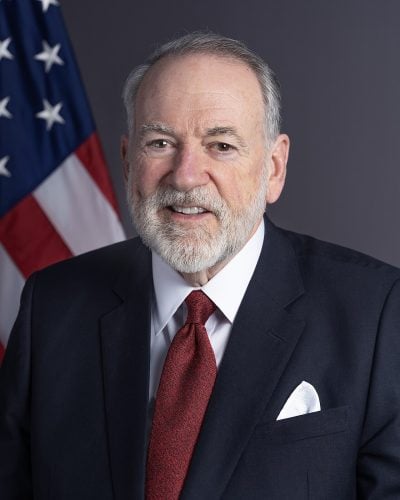
Featured image: Official portrait of Mike Huckabee, the United States ambassador to Israel. (Public Domain)
Global Research is a reader-funded media. We do not accept any funding from corporations or governments. Help us stay afloat. Click the image below to make a one-time or recurring donation.