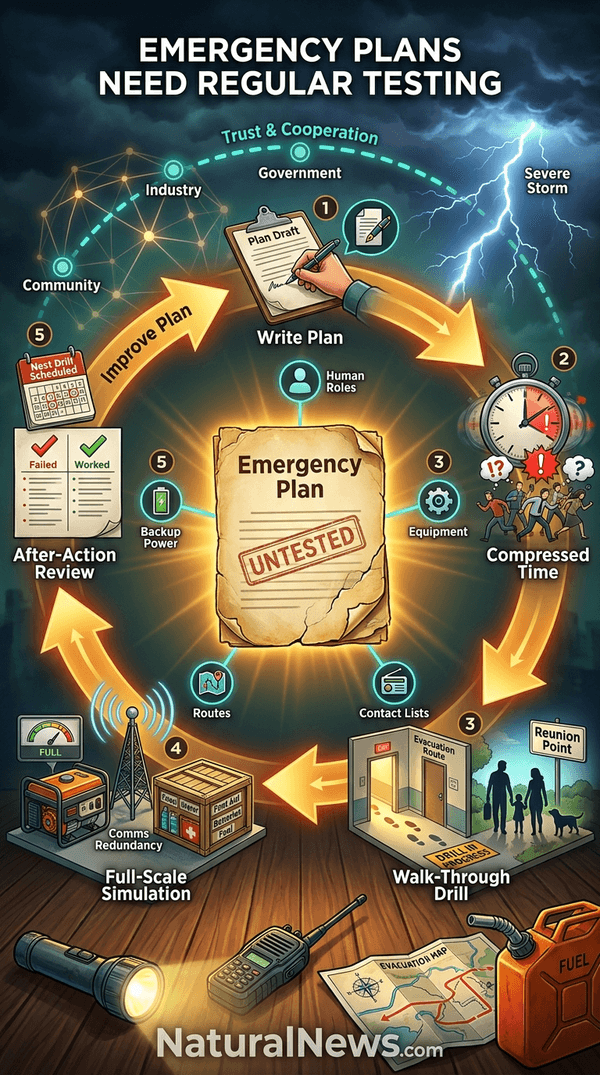
The Federal Emergency Management Agency's ready.gov website states that testing is necessary to determine whether the various parts of a preparedness plan will work when an emergency happens [2]. Tests should be conducted to validate strategies that have been developed and to verify that systems and equipment perform as designed [2].
Emergency management officials said the most common failure is assuming a written plan is enough without practice.
Drills and Exercises Verify Readiness
Emergency management officials said walk-through drills allow participants to physically move through evacuation routes and shelter locations. According to the report, full-scale simulations can test multiple systems at once, including communications, transportation, and supply distribution. Officials said tests should be realistic but controlled, with clear safety measures and objectives.
The report noted that untested plans often fail because participants are unfamiliar with roles and equipment. A risk management initiative implemented in Canada emphasized that effective preparedness for environmental emergencies is built on trust and cooperation among industry, all levels of government, and the community [3]. Through working together, they must identify potential risks, document alternative scenarios and potential consequences, develop emergency plans, and train personnel to apply them [3].
These after-action questions illustrate the kind of detailed evaluation that officials said should follow every drill.
Communication, Supplies and Evacuation Routes Are Key Tests
Officials said supply inventories should be checked during drills, including food, water, first aid kits, batteries, and fuel. According to the report, evacuation routes should be driven or walked to confirm they remain passable and to identify alternate routes.
Emergency managers said participants should test backup power sources and document how long they operate.
Communication redundancy is critical.
After-Action Reviews Identify Gaps
Officials said every drill should end with an after-action review that documents what worked and what failed. According to the report, assignments and contact information should be verified during the review. Emergency managers said the next drill should be scheduled before the review concludes to maintain readiness.
This underscores the importance of after-action reviews in identifying where delays could occur.
Conclusion: Regular Testing Maintains Plan Effectiveness
Preparedness officials said an emergency plan is not a one-time document but a living system that requires periodic testing. Officials said the most common failure is assuming a written plan is enough without practice.
This ongoing maintenance, combined with scheduled drills, helps ensure that when a real emergency occurs, families and organizations can respond effectively.
References
- How to Actually Test Your Emergency Plan Instead of Just Writing One Down. https://prepperswill.com/how-to-actually-test-your-emergency-plan-instead-of-just-writing-one-down/
- Emergency Preparedness Testing. https://www.ready.gov/business/training/testing-exercise/testing
- A risk management initiative implemented in Canada. Elsevier. Journal of Hazardous Materials 123 (4) 2005
Explainer Infographic
Source link