
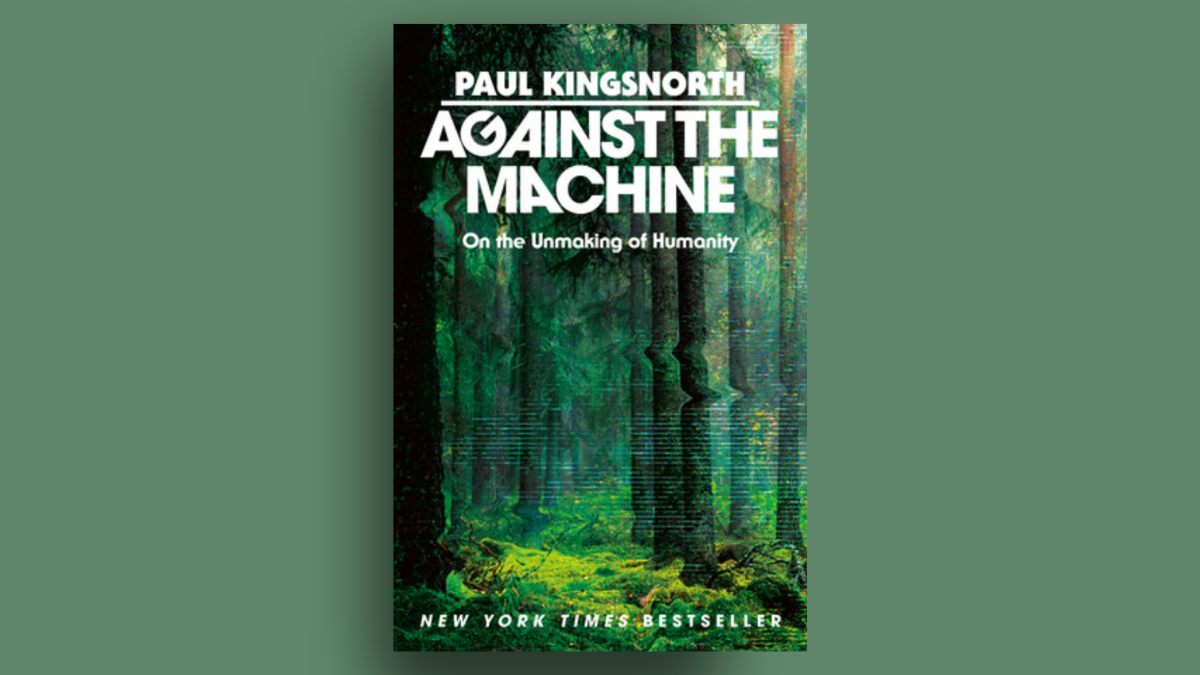
Paul Kingsnorth’s latest book, Against the Machine: On the Unmaking of Humanity, has the makings of a classic that may help us all rediscover faith and virtue.
It would be an understatement to say that the modern world has not been conducive to human flourishing. There is a sense that every humanizing influence is replaced with artificial interventions, causing life to become scripted, mechanized, quantified, and commoditized.
Worse still, the resulting malaise is so ubiquitous that even perceiving it, let alone defining it, is incredibly difficult — like asking a fish to perceive and define the water in which it swims. And even if one could wrap his mind around this pervasive force informing the current world, it would take a whole book to properly articulate what it is and what to do about it.
Fortunately, such a book has finally arrived, appropriately titled Against the Machine: On the Unmaking of Humanity by writer and former hippie Paul Kingsnorth. His book does not just take aim against today’s addictive digital technology, corrupt and incompetent political leaders, and exploitative and unscrupulous titans of industry, but against the whole damn system, which he calls “the Machine.” In Kingsnorth’s view, a vast web of bad ideas and cruel processes has come together to destroy human nature by making it mediocre, melancholic, and more easily manageable.
Although his claims sound extreme, Kingsnorth makes a compelling case that nearly everything in modern life really has been rendered unnatural and antihuman to the point of demanding a forceful response from anyone who doesn’t want to lose their body and soul to the Machine. In the introduction, he compares this ambitious endeavor to that of Captain Ahab hunting the murderous white whale Moby Dick: “I find myself still circling the [Machine], like Ahab pursuing the whale.” If he can even “circumscribe this thing with words,” the book represents a major victory in the war for the world recovering its humanity.
The Emergence of Anticulture
Before discussing what the Machine actually is, Kingsnorth first talks about what the Machine has done. He describes a world bereft of the “sacred order” that gave definition and purpose to people. He attributes this spiritual loss to the erasure of roots and meaning. Citing the early 20th-century mystic philosopher Simone Weil, Kingsnorth discusses how, like an uprooted plant, uprooted people cease drawing strength from their surroundings and eventually wither away. Far from liberating, this uprooting has left everyone unsettled and frustrated: “We reach for toxic imitations of our lost roots, but they can never replace the real thing and the result is an orgy of anger, bitterness, and wanton destruction.”
This loss of meaning leaves a vacuum which the Machine greedily fills in the form of new technology as well as new economic hierarchies, political systems, and technocratic organizations. In practical terms, it’s a massive complicated system of incentives and distractions, which prompts Kingsnorth to evoke The Matrix films and their depiction of a global machine that traps the entire human population in a virtual world.
And like in The Matrix, few people even realize they are in an artificially constructed world, and even fewer have any success fighting against it. Kingsnorth goes through the history of the modern West, which gradually did away with tradition, community, and Christianity, replacing them with rationalism, consumerism, and secularism. For Kingsnorth, it’s no wonder that the West has been rocked by bloody wars, mass enslavement, and disenchantment in the centuries that followed.
Of course, for people brought up in such a culture — or “anticulture,” as Kingsnorth puts it — the solution to the problems created by the Machine is always to feed even more of the world into the Machine. Consequently, it was only a matter of time before the Machine went global and began incorporating non-Western cultures. Here, Kingsnorth specifically cites the imperialist ambitions of 19th-century America responding to the insatiable appetite of the Machine, recounting the story of Naval Commander Matthew Perry ordering Shogunate Japan “to inject [America’s] commercial attitudes in a country which had always held those attitudes in contempt.” So it was with all the nations, putting the whole world in the throes of the Machine.
But so what, one might ask? This just indicates Progress for Mankind and a higher standard of living. It was far worse before.
As Kingsnorth explains, this is not the quite the case. While certain material improvements have come with the introduction of the Machine, they have come at a heavy spiritual cost: “Something organic is being superseded by something planned.” And thus, in his formulation, rich cultures built upon a shared history, ancestry, location, and form of worship (or what he calls the “four Ps”: past, people, place, and prayer) are degenerating into an anticulture based on materialism, narcissism, lechery, and digital media (or what he calls the “four Ss”: science, self, sex, and the screen).
This new set of values has precipitated the mass inversion of culture where all that was once valued is now rejected, “not because new things are loved, but because old things are despised—or simply seen as irrelevant.” As my friend Dr. Adam Ellwanger remarked on the Everyman Commentary podcast, every innovation in progressivism must be some kind of transgression. And this means equating virtue with rejecting the past, people, place, and prayer. In place of roots and virtues, people now depend increasingly on their smartphones.
Reactionary Radicalism
In light of all this, Kingsnorth cannot bring himself to proudly defend the West or even his home country of England. To him, the West generally and England specifically have become vile products of the Machine. This is no small reason that he now lives off the grid in rural Ireland with his family.
Rather than merely rage against the Machine, fun as that is, Kingsnorth recommends something far more revolutionary and difficult: unplug. Not only does this means ditching one’s devices, but also changing one’s whole perception: “Perhaps central to [changing perception] is an effort to see the world as an organism rather than a mechanism, and then to express it that way, through art, through creativity, through writing, through our conversations.” For most people, both on the political left and right, this would require letting go of long-held, machine-induced shibboleths and learning to live simply.
Kingsnorth calls this “reactionary radicalism.” Adherents are those who seek out “guidance to the past, to an established—or even lost—moral and economic order, hallowed by tradition, rather than seeking to build a new one based on an abstract ideology.” Although he doesn’t invoke the subsidiarity and the decentralization of G.K. Chesterton’s distributism, which held up the economy of medieval Christendom as a kind of counterexample to modern industrialism, Kingsnorth seems to be suggesting this.
Or maybe not. Perhaps the biggest shortcoming of this otherwise well-written and well-argued book is Kingsnorth’s irrepressible hippie-inflected Romanticism that comes out periodically. Yes, the pendulum of civilization has swung much too far to the side of technological progress, managerialism, and shallow nihilism. However, it does not help to swing it to the other extreme of primitivism, scarcity, and shallow mysticism. Apart from indulging in the myth of the “Noble Savage” and dismissing the very real problems of overly traditionalist cultures that block all forms of progress, Kingsnorth even devotes a whole chapter to the model of nomadic societies, “jellyfish tribes,” which flee civilization to preserve their way of life.
For most readers, this is both impractical and frustrating. Kingsforth makes a strong case that something is awry in the world today, something everyone can feel, and his solution is essentially to smash all smartphones and live like a gypsy. Perhaps this makes sense to a professional writer who can choose how he wishes to engage with the world, but not to most people trying to make a living and support their loved ones.
Nevertheless, this hippie idealism is probably what attracts a few readers on the left who might also disagree with wokeism and progressive transhumanism but still have a strong attachment to Marxism and opposing rich elites. And if Kingsnorth can reach at least reach a few of them and persuade them to give up their propaganda, embrace their humanity, and become more religious, so much the better.
Altogether, Against the Machine has the makings of a classic. It is complex, profound, and elegant. Even though it is not always an easy read, it is an incredibly satisfying one that will inspire readers to reexamine their preconceptions and take measures to live more deliberately. We may not all retreat to the woods like Kingsnorth, but we will definitely think about it, consider what’s possible, and start rebelling against the Machine in our own way.