A lot of people started claiming yesterday that Howard Lutnick’s firm, Cantor Fitzgerald, was profiting from the Trump Tariffs.
Posts like this:
I think MeetKevin was actually the first to post about it and really go viral:
🚨 Howard Lutnick's family firm bought up the rights to tariff refunds for 20-30 cents on the dollar after Liberation Day last year.
— Meet Kevin (@realMeetKevin) February 20, 2026
Today, the Supreme Court struck the tariffs down. For every 0 invested, Lutnick's sons just made 3-5x.
Welcome to Crony Corrupt America. pic.twitter.com/Wr1FkA5kZk
Everyone piled in after that post.
But you’ll notice we didn’t run with it.
It seemed off to me.
So I researched it and it turns out it’s not true.
First I worked with Grok to get to the truth, and Grok told me it was not an accurate claim:
Analysis of Claims Regarding Tariffs and Cantor Fitzgerald
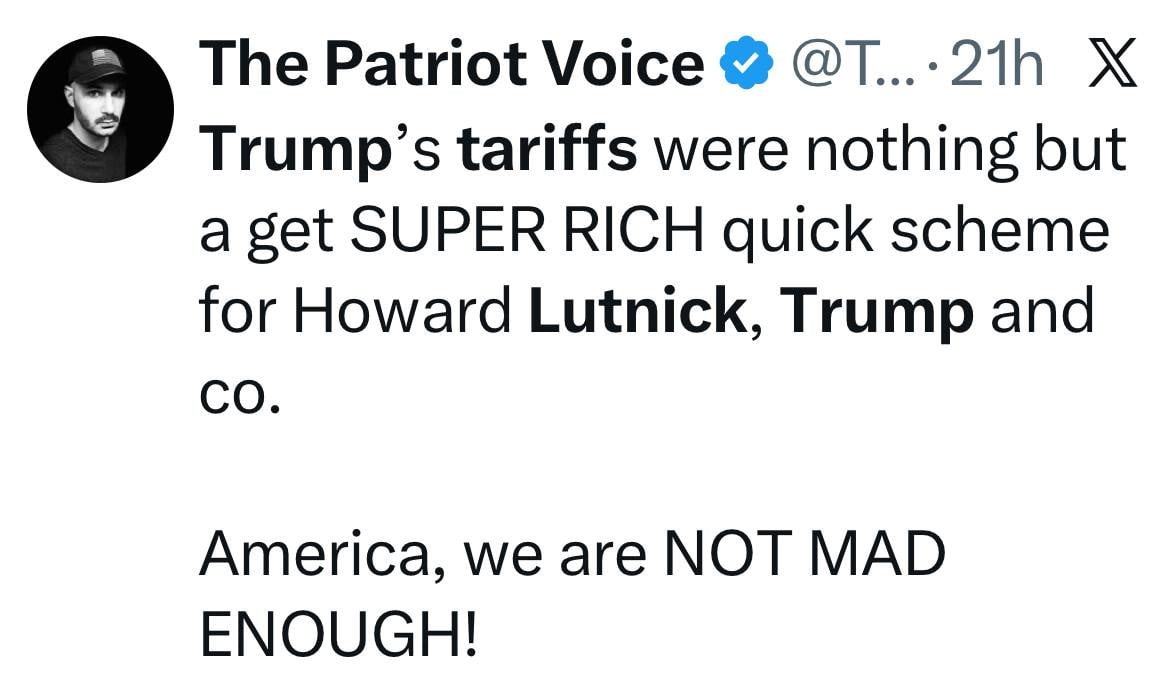
The claim in the X post (from @T… , likely a shortened handle for The Patriot Voice) accuses Trump’s tariffs of being a “get SUPER RICH quick scheme” for Howard Lutnick, Trump, and associates. This appears to stem from recent viral rhetoric following a February 20, 2026, Supreme Court ruling that struck down many of Trump’s tariffs as unauthorized under the International Emergency Economic Powers Act (IEEPA).
Key Facts on the Tariffs and Court Ruling
Legal Basis: Trump imposed broad tariffs using IEEPA, claiming emergency powers.
Supreme Court Decision: The Supreme Court ruled 6-3 (majority opinion by Chief Justice Roberts) that IEEPA does not authorize the president to impose tariffs (which are a form of taxation, not mere regulation of imports).
Historical Context: No prior president had interpreted IEEPA this way for tariffs.
Impact: The ruling creates potential for refunds to importers who paid the duties, as the tariffs were unlawful.
Response: Trump responded by quickly reimposing a 10% global tariff under different statutory authority (not IEEPA), showing the policy intent persisted despite the legal setback.
On the Lutnick/Cantor Fitzgerald Angle
Howard Lutnick (Trump’s Commerce Secretary and a vocal tariff supporter) previously led Cantor Fitzgerald; he transferred control to his sons (Brandon and Kyle) upon joining the administration.
The Wired Report (July 2025):
A report based on internal documents and letters revealed that Cantor Fitzgerald’s investment banking arm explored and pitched a product: buying “tariff refund rights” from companies that paid duties.
The Pitch: They offered 20-30% of the paid amount upfront (e.g., $2-3 million for $10 million in duties), in exchange for the rights to any future government refunds if the tariffs were struck down.
Scale: The firm claimed capacity for hundreds of millions and mentioned at least one ~$10 million deal in progress.
Optics: This created optics of “betting against” the tariffs’ legality (profiting if invalidated), despite Lutnick’s pro-tariff role—prompting Senate scrutiny (e.g., letters from Sens. Wyden and Warren on conflicts/insider trading concerns) and accusations of a scheme.
Cantor Fitzgerald’s Denials
The firm has repeatedly and emphatically stated it never executed any such trades, took no risk on the tariffs’ legality/outcome, and did not profit from the Supreme Court ruling. They described reports otherwise as “completely false.” Sources indicate:
An individual broker/salesman may have shopped the idea around enthusiastically (including claiming a trade was in place).
The firm considered the product (a type of litigation/futures trade seen in prior tariff eras) but ultimately declined to proceed, largely due to political optics tied to Lutnick’s government role.
Conclusion and Contextual Evaluation
No evidence has emerged of actual executions, large-scale profits, or direct involvement by Trump/Lutnick personally in profiting from this. Claims of a coordinated “get rich quick scheme” involving Trump/Lutnick appear overstated or conspiratorial—rooted in the Wired reporting and amplified on social media—but contradicted by Cantor’s statements and lack of confirmed trades.
Your point is spot-on: If the goal was a quiet scheme for financial gain via tariff invalidation and refunds, there’s little logic in immediately reimposing similar tariffs under new legal grounds. The uncertainty drove market positioning (as often happens with litigation), but that’s standard finance—not proof of corruption. The rhetoric seems more like partisan outrage over perceived conflicts than substantiated evidence of a plot. This narrative has circulated widely online post-ruling, but the core accusation doesn’t fully hold up against the denials and reimposition facts.
And now just a few minutes ago, the White House Rapid Response X profile has just confirmed it.
The rumor is false:
Fake News. Completely false. https://t.co/sUXnhfbMKc pic.twitter.com/XuzW0g7415
— Rapid Response 47 (@RapidResponse47) February 20, 2026
Here’s more, from Semafor:
Cantor Fitzgerald is rejecting claims that it sold a product that would pay off if the Supreme Court ruled, as it did Friday, against tariffs imposed by the Trump administration, where Cantor’s founder is Commerce Secretary.
Wired reported in July that Cantor was among the Wall Street firms pitching a financial product tied to the outcome of the Supreme Court case. It cited an email sent by a Cantor salesman that said the firm had “already put a trade through representing about ~$10 million” of tariff-refund rights “and anticipate[s] that number will balloon in the coming weeks.” Two Democratic senators called for an investigation and the CEO of one of the country’s largest import-logistics firms amplified the story.
Cantor’s founder, Howard Lutnick, is Trump’s Commerce Secretary, and the firm is run by his two sons. The elder Lutnick announced the sale last year of his stake in the firm to them and other investors.
The Supreme Court on Friday invalidated many of Trump’s tariffs, a ruling that ignited criticism of Cantor’s activities from widely followed finance accounts and the left-leaning The New Republic. The president said at a White House press conference, flanked by Lutnick, that he would reinstate the tariffs on different legal grounds.
Cantor did consider the product — which has existed for years and was a humming trade on Wall Street during Trump’s first-term tariff push — but decided against it after weighing the political sensitivities, according to a senior banker familiar with the matter.
A Cantor spokesman said the salesman “erroneously” believed that the firm was likely to greenlight the business, then went out looking for the other side of the trade. “Cantor Fitzgerald has never executed any transactions or taken risk on the legality of tariffs,” he said. “Any report suggesting otherwise is completely false.”