Special to WorldTribune, February 26, 2026 Real World News
By Richard Fisher for Geostrategy-Direct, February 24, 2026
[Update: Korean newspapers have published an unusual statement from U.S. Gen. Xavier Brunson, denying that he had issued an apology for last week’s standoff between U.S. and Chinese fighter jets near South Korean airspace.]At a time when the Trump Administration has been working hard to build jointness of purpose and military coordination among American allies in Asia to meet growing threats from China, North Korea and Russia, China has been able to sow division, encouraging leftist-anti-American tendencies in the South Korean government of President Lee Jae Myung.
China has a long track record of exploiting Korean historic enmity with Japan and encouraging South Korean division from its main ally that deters nuclear missile-armed North Korea, and that for 73 years has prevented a second North Korean invasion of South Korea.
[Update: Korean newspapers on Feb. 25 published a statement from U.S. Gen. Xavier Brunson, denying that he had issued an apology to the South Korean armed forces. The Korea Times reported:The United States Forces Korea (USFK) issued a rare late-night statement denying Korean media reports that its commander, Gen. Xavier Brunson, had apologized for last Wednesday’s aerial standoff between U.S. and Chinese fighter jets.
“USFK conducts regular training to maintain the highest level of readiness and fulfill its missions. We do not apologize for maintaining readiness,” the statement said.
The denial came Tuesday night, hours after local media reported that Brunson had apologized for the U.S.-China confrontation near South Korea’s airspace on Feb. 18, the final day of the Lunar New Year holiday.]
In the early 1990s China successfully convinced South Korea to forego cooperation with Washington with its Strategic Defense Initiative missile defense technologies and in 2016 to 2017 used hard economic coercion to force South Korea to limit to one battery the deployment of U.S. Theater High-Altitude Area Defense (THAAD) missile interceptors to defend against North Korea.
And a decade later, when the Trump Administration is seeking to encourage far greater defense spending by its Asian allies, greater trilateral U.S.-South Korea-Japanese military coordination, and allied concern for China’s threats to Taiwan, China found a pressure point to exploit weakness in South Korea.
On Jan. 15, 2026, the U.S. proposed to South Korea holding tri-lateral air force exercises on Feb. 15 to 18, that was rejected by Seoul, with the excuse that it was too close to Japan’s Feb. 22 “Takeshima Day,” that commemorated Japan’s claim to Dokdo Island occupied by South Korea.
On Feb. 16 and 18, the U.S.-Japan air force exercise when ahead, featuring four U.S. Air Force (USAF) B-52 bombers, USAF F-16 fighters and Japanese Air Self Defense Force F-2 and F-15J fighters.
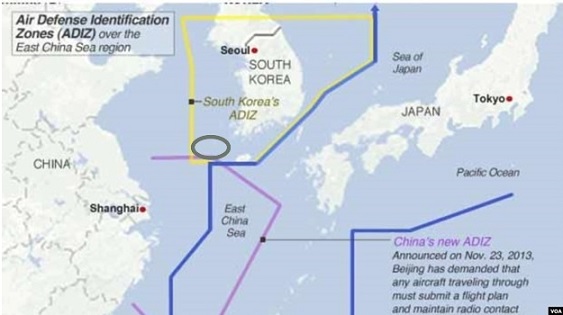
Then on Feb. 18 and 19, the USAF F-16 fighters in South Korea conducted exercises to the south and west of South Korea, with about 10 U.S. F-16s from Osan Air Base in South Korea flying close to the Yellow Sea area of overlap between the Chinese and South Korean Air Defense Identification Zones (ADIZ).
On the 18th, the Chinese Air Force scrambled some number of fighters, possibly Shenyang J-16s, to intercept the U.S. F-16s, causing a “standoff” with both groups of fighters flying in close proximity but not crossing into the other’s ADIZ.
The U.S.-Chinese “standoff” was first reported by South Korea’s Yonhap News Agency on Feb. 20, and then on the 21st Yonhap reported that instead of voicing any concern for China’s actions, that South Korean Defense Minister Ahn Gyu-back “delivered a complaint in a call with Gen. Xavier Brunson, the commander of the Combined Forces Command and the United States Forces Korea, immediately after he received a report of the incident.”
Yonhap also reported that South Korean Joint Chief of Staff General Jin Yong Song also delivered a “complaint” to General Brunson.
Full Report . . . . Current Edition . . . . Subscription Information