Keir Starmer is considering trade reprisals against the United States after Donald Trump threatened the world with 'more powerful and obnoxious' tariffs.
Ministers were left scrambling to get clarification from the White House after President Trump announced a new 10 per cent 'global tariff' on Friday only to raise it to 15 per cent the following day.
The new levies are due to come into force on Tuesday, but confusion remains about exactly what rate will be set.
Downing Street said it expected the terms of a 'trade deal' agreed by Sir Keir and Mr Trump last year to be honoured in any new tariff blitz.
But asked if Britain could retaliate with its own tariffs on US goods, the PM's official spokesman said: 'Nothing is off the table.'
No 10 said it was anxious to avoid a full blown trade war. But officials have already drawn up a 417-page list of potential US targets, covering everything from motorbikes and rollercoasters to beef and whiskey, leaving open the possibility that iconic US brands like Harley Davidson and Jack Daniels could be affected.
Mr Trump reacted with fury on Friday when the US Supreme Court ruled he had exceeded his authority by imposing his 'Liberation Day' tariffs on countries around the world last year.
In a fresh intervention on Monday, Mr Trump said the 'ridiculous' court ruling still left him able to do 'terrible' things to foreign countries.
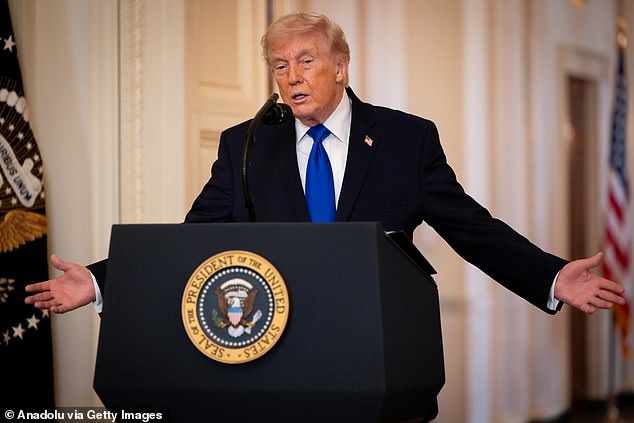
Warning: President Trump said the new tariffs could be 'much more powerful and obnoxious'
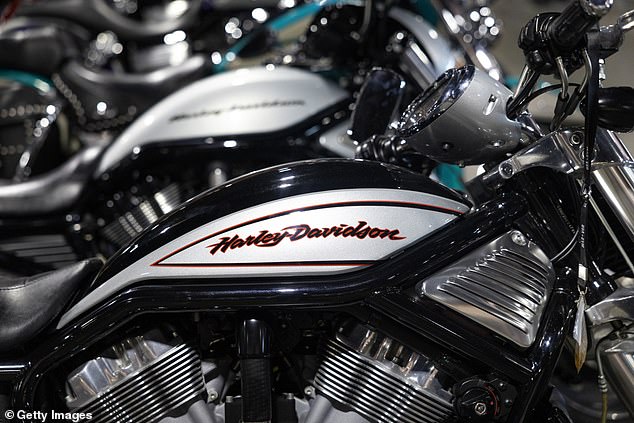
Iconic US brands like Harley Davidson could be targeted in tit-for-tat tariff war
Writing on social media, he added: 'The court has also approved all other tariffs, of which there are many, and they can all be used in a much more powerful and obnoxious way, with legal certainty, than the tariffs as initially used.'
Following talks between business secretary Peter Kyle and his US counterpart Jamieson Greer, officials were optimistic that the new 'global tariff' will not be applied on top of existing levies on British cars and steel.
A government source said the new 10 per cent levy due on Tuesday was likely to simply replace an existing levy of the same level which was struck down by the court. However, ministers do not know if or when it will be raised to 15 per cent.
The British Chambers of Commerce has warned the higher rate could cost the UK an extra £3 billion.
Andy Haldane, president of the British Chambers of Commerce, said countries like the UK on the lowest 10 per cent rate now looked set to be punished more than those previously singled out for higher levies.
He told the BBC: 'The perversity of what happened of the weekend was that those who got good deals, the allies, have been most disadvantaged.'
Alan Taylor, a member of the Bank of England's Monetary Policy Committee, predicted that US tariffs are 'here to stay', despite the Supreme Court ruling, which could trigger compensation claims totalling more than £130 billion.
'The fundamental thing to realise is that those tariffs are here to stay at some number that is an order of magnitude bigger than it was two years ago,' he said.
'I think we should expect this shock to play out also over many years. It's not going to be like an immediate shock that passes through.'
Mr Taylor, who was among a minority of MPC members to call for a cut to interest rates earlier this month, indicated he believes there could be up to three cuts to UK interest rates before they settle.
Downing Street said it would take a 'pragmatic' approach to the latest tariffs and said it was 'engaging at all levels' with the US administration to assess the impact.
The PM's spokesman said: 'We continue to have productive conversations with them… and those discussions are happening at all levels, but nothing is off the table at this stage.
'Industry doesn't want to see a trade war where both sides keep escalating the situation, and that's why our focus is on constructive engagement with our US counterparts to retain the UK's competitive advantage.'
Nigel Farage said the latest tariffs would 'hurt us'. But he warned Sir Keir would struggle to negotiate a better deal while he continues to block US requests to fly bombing missions against Iran from bases on UK soil.
'I think telling the Americans that they can't use bases on UK soil to attack the appalling Iranian regime now puts us in a very, very bad place,' he said.
'I would suggest on tariffs right now, we don't have a negotiating position.'