It's a little before 5am and the impact of the first Russian ballistic missile of the night resounds along the Dnieper River below my hotel window. Cruise missiles and Shahed drones will arrive before breakfast is served.
In the room next door, a soldier on leave and his girlfriend are engaged in unabashedly noisy lovemaking – as if there will be no tomorrow, as well there might not. Death is always in the shadows here, if not waiting up the road, particularly if you're in uniform.
Today is the fourth anniversary of the full-scale Russian invasion of Ukraine. Foreign VIPs will arrive in special trains from Poland, pledge their support and admiration, and leave again before the day is out and the missiles begin to fall once more. Ukraine then fights on, alone.
One mustn't be cynical. No one thought there would be a first anniversary to mark with Ukraine still largely free, let alone a quartet.
Putin's 'special military operation' to install a client junta was supposed to be over in days. Now the frontlines are largely frozen, like the Kyiv pavements and the mighty Dnieper. Ukraine is even advancing in places. But that is only after more than one million casualties on both sides and many more Ukrainians made refugees.
Cities, towns, villages have been flattened, children orphaned, wives widowed, families frozen in their homes.
Ukraine is resilient, admirable, defiant, but exhausted. The country's main highway – the E40 – which carries us and most war supplies to the eastern front, now resembles a post-apocalyptic M1, with potholes the size of mortar craters.
And me, personally? I'm also war weary. I have bad dreams when I go back home. I feel a desperate need to do more. And that we are on the brink of a greater disaster for which Britain is wholly unprepared.
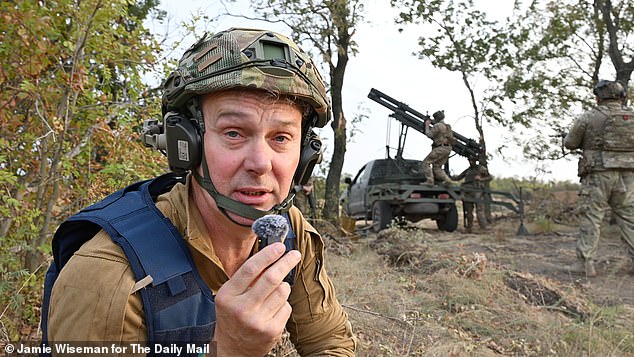
Richard Pendlebury, pictured on the eastern frontline near Pokrovsk in Ukraine, says the country is resilient and admirable but exhausted. 'I'm war weary,' he writes
Snow was falling when we first arrived in Kyiv in early 2022. The air-raid sirens were wailing, the streets barricaded and largely deserted. Only at the main railway station, and particularly those platforms upon which trains to the west were leaving, was anyone to be seen.
This, surely, was a dystopian fantasy: a huge European city under siege by the second most powerful military in the world.
We watched the critical battle for Hostomel airport from the 23rd floor of a tower block on the very edge of Kyiv, as the sole remaining resident, a violinist named Andrii, played us polkas while the windows shook.
We watched too as refugees from this fighting crossed a bomb-collapsed bridge over the Irpin river, during a brief ceasefire. An old man was being carried in a wheelbarrow.
One night the windows of my own room shook as the Retroville shopping centre – several miles away – was destroyed by a missile strike. By day you could hear the constant grumble of artillery from that famous cobbled hill, the Andriivskyi Descent. But Kyiv held, somehow.
On another occasion, in the summer of 2023, we reached frontline trenches near Lyman. Leaving the position in broad daylight, we came under heavy mortar fire. Russian drones were overhead, spotting the fall of the bombs so that the gunners could adjust their aim. This was our first experience of the weapon – the drone – which would change warfare, becoming the preeminent battlefield threat that it is today.
Military technology advanced at a startling rate. I won't forget a journey along a narrow country road to the Donbas town of New York. We didn't know that Russian assault units were only fields away, waiting to attack. A Russian reconnaissance drone passed over the roof of the military vehicle in which we were travelling.
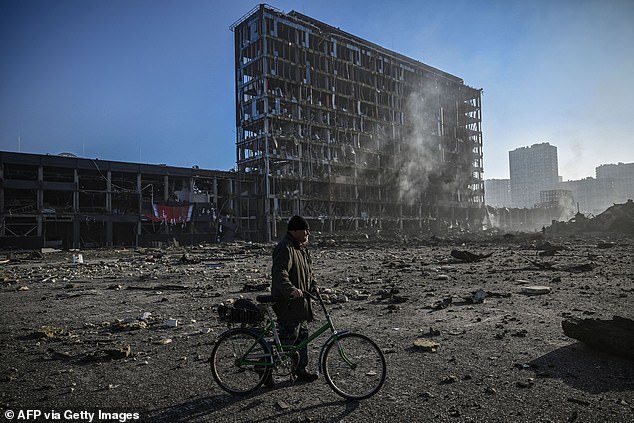
Richard felt the windows in his room shake as Kyiv's Retroville shopping centre – several miles away from where he was staying – was destroyed by a missile strike, pictured
Over these four years, towns which we knew and frequented have fallen to the Russian advance. And soldiers we have spent time with are now among the fallen. The latest is Private First Class Vitalli Pasko, from the Khartia Corps. One night, last summer, he drove me to a drone position very close to the Russian lines. On a later similar mission, his luck ran out.
Britons have also made sacrifices here. On a street in Lviv last week we were approached by Eddy Scott, a sailor from Dorset who left Britain for Ukraine in October 2022. He noticed the British number plate on our 4x4. We noticed that Eddy has an artificial leg.
In 2025, while conducting a humanitarian evacuation in the embattled city of Pokrovsk, a Russian drone hit his vehicle. He lost his left arm and leg in the explosion. Now he works for the local Superhumans rehabilitation centre which got him back on his feet.
Over four years, other Britons have given even more than Eddy, in the cause of Ukraine.
We pick out some of the Union Jacks among the ever-expanding forest of snow-encrusted flags in Independence Square, here in Kyiv. Each one represents a particular war casualty.
Here is the flag commemorating Colby Dolman, a former carpenter from Cleethorpes who died aged 20 last year, on the Zaporizhia front. Nearby, we find the flag of James Wilton from Yorkshire, who was even younger – 18 – when he was killed in action near Terny.
The last month of this winter has been particularly brutal. Temperatures in Kyiv have plunged to -20C while the Russians have caused enormous damage to the energy grid. It is a form of psychological warfare.
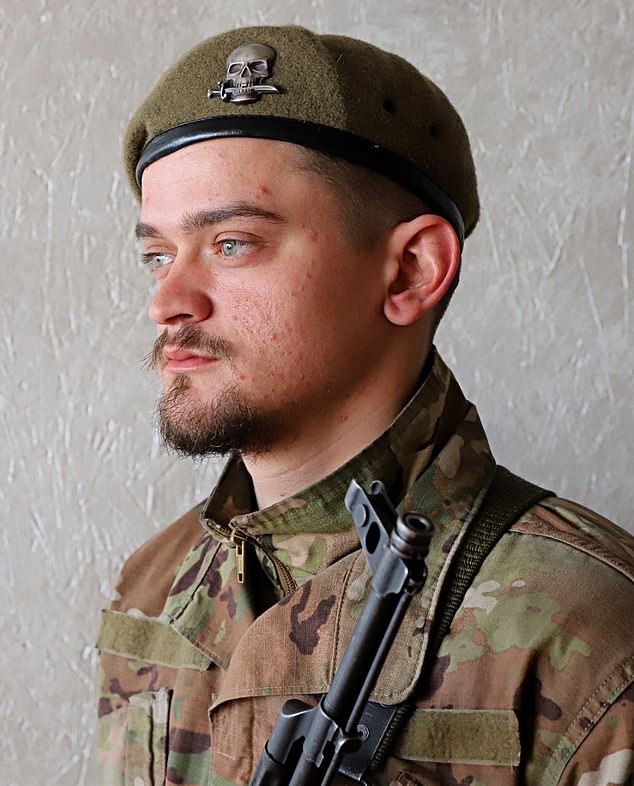
Many Britons have sacrificed their lives fighting in Ukraine – including 20-year-old Colby Dolman, a former carpenter from Cleethorpes, who died on the Zaporizhia front last year
We climb down a precipitous snowbank and walk across hundreds of metres of frozen river to talk to ice fishermen without really knowing if the route will bear our weight. The men are retired shipyard workers. Their baited lines are dropped into holes drilled through the – thankfully – half-metre thick ice.
'We're just here for the company,' one of them says. 'Of course, we hope that the war will end this year, but the [Russian] conditions that we have to give up parts of Donbas we still hold are ridiculous.'
A man has been watching our progress from the shore. He was worried, he says, that we were a 'press gang' from the Ukrainian military's recruitment office; that we intended to pluck the pensioners from their fishing holes and put them into the Donbas frontline.
Such things happen – Ukraine remains desperately short of fighting manpower.
The man himself has only recently returned from service, discharged as medically unfit.
'We suffered terrible casualties,' he says. 'And we couldn't always retrieve them as we retreated. On one occasion we were ordered to cut off a foot and hand from a relative of the brigade commander. This was to prove he was dead (rather than 'missing') and so his family could get compensation.'
He pauses, then volunteers: 'I see such things nightly, in my dreams.'
If you think his anecdote is too far-fetched, think again. A soldier friend of mine decapitated a dead comrade whose body was trapped in wreckage, under fire. He did this, he says, so his friend's mother could understand that her son was 'really dead' and give him – part of him – a Christian burial.
That logic is a different kind of war damage.
The future is unclear. Tortuous peace negotiations, pushed along by a US President the Ukrainians no longer trust – could yield some kind of ceasefire. But most here, however war-weary, see it as simply a hiatus before Russia pushes again. Their hope is that the Russian war economy will gradually collapse.
This is the fifth winter of full-scale war. The Second World War only had six. Will that unwanted statistic yet be matched?
Ukraine held, is holding, will hold on still.