
A woman allegedly driven to kill herself by a 'tsunami' of abuse from her husband told her GP he was 'very dangerous' and felt he would 'always find her'.
Christopher Trybus, of Swindon, Wiltshire, is accused of the manslaughter of Tarryn Baird, who took her own life aged 34 in November 2017.
The trial has heard how Ms Baird, who worked at an optician's, died of hanging and left a note which read: 'To my family, I am so sorry but I just couldn't take it any more.'
Trybus, 43, who ran a profitable software business, also faces charges of controlling and coercive behaviour, and two counts of rape at Winchester Crown Court. He denies all the charges against him, insisting Ms Baird fabricated allegations due to mental health problems and for attention.
Prosecutors alleged that Trybus carried out a relentless campaign of abuse against his wife, including 'extensive and escalating controlling, coercive and manipulative behaviour, including sexual violence of two rapes and other sexual assaults'.
He is said to have threatened to reveal private information to her family, monitored her whereabouts, limited access to finance and isolated her from her family.
Tom Little KC, prosecuting, read out notes in court made by Ms Baird's GP, Dr Tessa Jones, and said the doctor had noticed physical injuries on multiple occasions between January 2016 and July 2016.
Ms Baird had said she sustained the injuries by fainting or falling while exercising at home.
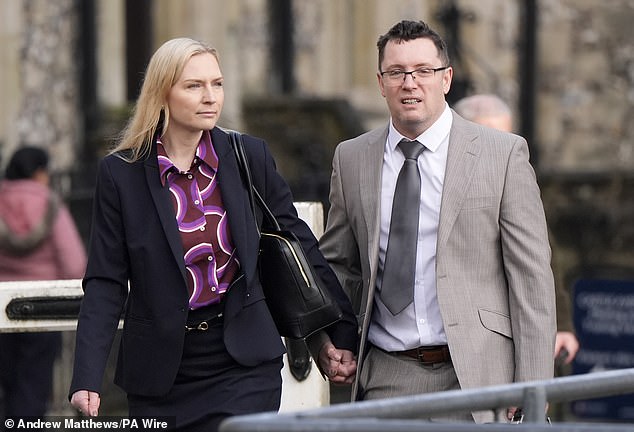
Christopher Trybus, pictured outside Winchester Crown Court on Wedneasday, with his new wife Bea
Dr Jones recorded that Ms Baird was 'determined to get out of [the] relationship, aware he's very dangerous', in late 2016.
The GP noted that Ms Baird had friction burns on her back from being dragged along the ground on this occasion.
In January 2017, Ms Baird told the doctor Trybus had put a rope around her neck and tightened it, and that she was 'aware of [the] dangers of staying, but feels [the] dangers of leaving are greater'.
The next month, Ms Baird told Dr Jones that she 'has changed the locks on the house, but doesn't feel able to leave, feels that he will always find her'.
For the prosecution, Rebecca Fairbairn told the court today that Ms Baird saw a counsellor, Julie Chivers, from March 2016.
Ms Fairbairn said: 'Tarryn Baird met with Julie Chivers up until 21st September 2016.
'On the 21st September Tarryn Baird told Julie Chivers that Mr Trybus had tried to strangle her. Julie Chivers told her later that day that she would be under an obligation to inform police.'
Ms Baird stopped seeing Ms Chivers after she made the report to police.
In September 2017, Ms Baird told a Swindon Women's Aid worker that 'she can't believe she's still alive', and said Trybus had tried to drown her and beaten her with a metal bar. She died by hanging two months later.
Trybus denies all the charges against him, insisting he 'loved and cherished' his wife but that 'mental health problems' meant she lied about his behaviour.
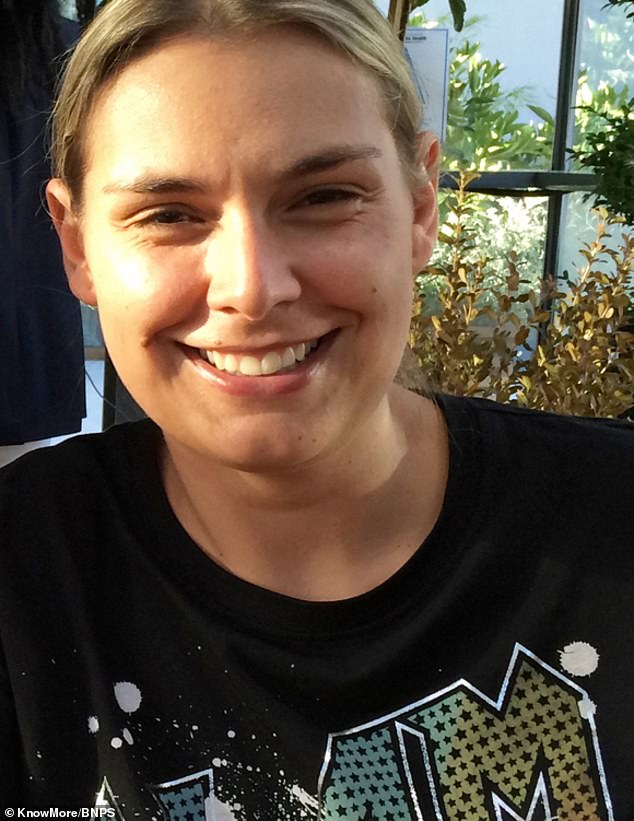
Tarryn Baird (pictured), 34, died of hanging at her Swindon home in November 2017
Defending Trybus, Katy Thorne KC, told the jury that Ms Baird presented a 'facade' to health professionals and was 'addicted to the attention' she got from making allegations.
She said: 'This without question is a tragic case, a young woman has died and she took her own life and nothing you decide in this courtroom can alter the grief and loss of those who loved her.'
Ms Thorne added: 'The defence position is Christopher Trybus was never abusive to his wife, he didn't beat her, he didn't break her, he didn't coerce her, control her and he didn't cause her death.
'On the contrary, he loved her and cherished her deeply and his case is that without anyone's knowledge, Tarryn Baird was making demonstrably false allegations to health professionals.
'There are injuries but the defence case is that on a number of occasions Tarryn Baird made allegations of violence which were demonstrably false, for example, by reporting injuries to health professionals when Christopher Trybus was not even in the country.
'The defence case is that one obvious example of that on November 16, he says that he was out of the country, having left on 8th November and not returned until 23rd November.
'And yet during that period, Tarryn Baird made more than one set of allegations of domestic violence and took photographs of injuries, each of which she said was caused by him.'
Ms Thorne told the jury they should question the 'reliability' of Ms Baird's claims.
She said: 'You will hear that Tarryn Baird had mental health problems which were longstanding and the defence case is that she was desperately seeking help and feeling she wasn't receiving it and she may have become addicted to the attention that her allegations brought.
'The defence case is that the reason why she never made the allegations to the police or went to a refuge was because the allegations weren't true and she didn't want that fact to be exposed.'
Ms Thorne said Trybus denied sexual assaults against Ms Baird, and added: 'Theirs was a healthy, consensual marital sex life enjoyed by both of them.
'It included some practices which may not be familiar or comfortable to everyone, including bondage and rough sex.
'What goes on in other people's bedrooms can be surprising, the defence case is that it was consensual.'
She added that an injury presented by Ms Baird to her neck was caused by a 'collar' worn during sex and an audio recording from her phone was of a 'kinky bondage type sex' that was consensual.
Ms Thorne continued: 'The allegations of Tarryn Baird being trapped and controlled, the defence says are untrue and the defence will suggest that they will turn out to be just false.
'You will need to consider her claims that she was being financially controlled or kept away from family and friends bears scrutiny, his case is the absolute opposite is true.'
She added: 'Health professionals were being told a false story and her boredom and troubled mind was leading her to make allegations to seek care and attention.'
Ms Thorne said that the jury would need to consider if Ms Baird's suicide was a 'cry for help that went tragically wrong'.
She added that Trybus's actions were not a cause of Ms Baird's suicide and said: 'The defence case is that there are other matters such as her mental health difficulties and withdrawal of services from her which led her to take her own life.'
Trybus denies the charges against him. The trial continues.
For confidential support, call Samaritans on 116 123, visit samaritans.org or visit thecalmzone.net/get-support