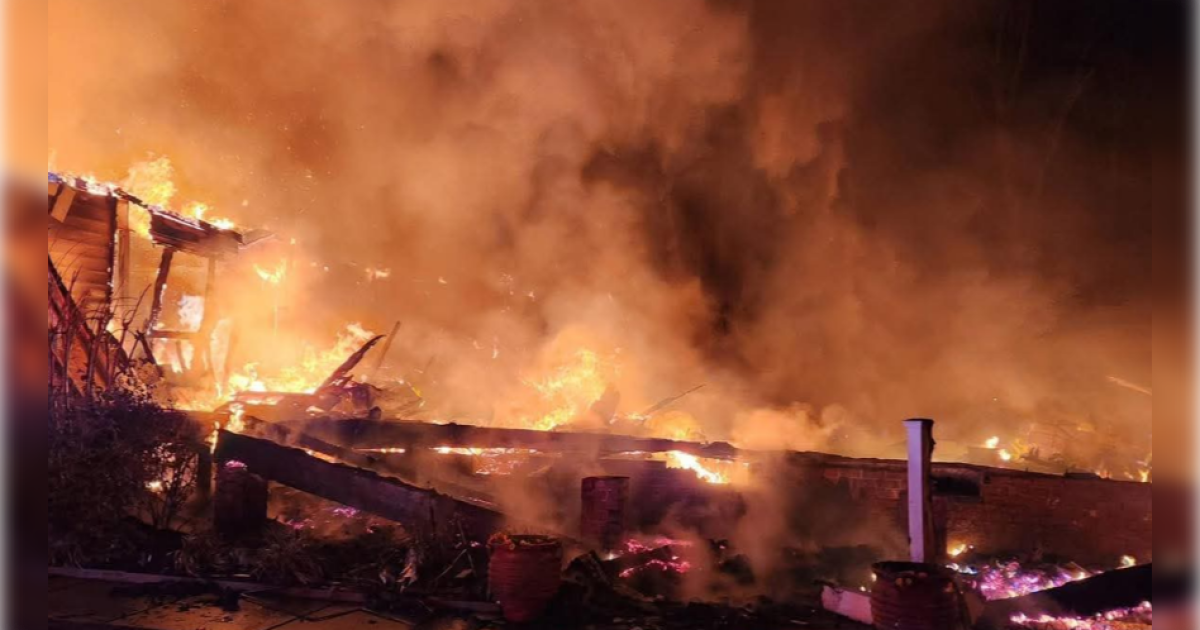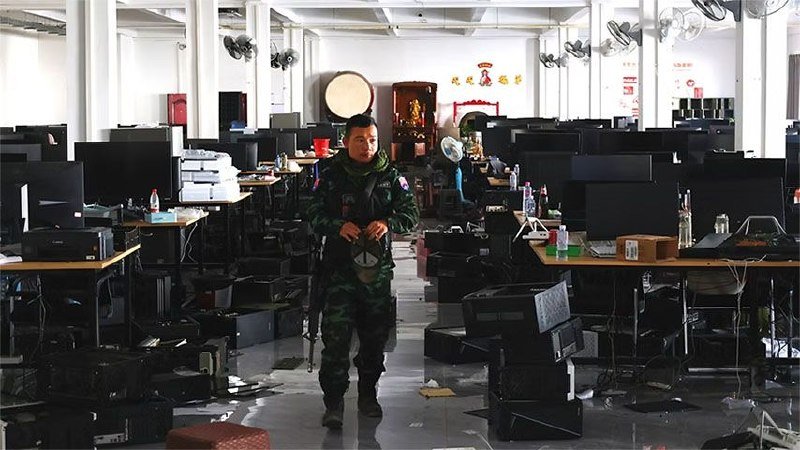
Myanmar's scam centers have largely targeted Chinese and American victims. Despite repeated raids by various Myanmar factions, often with Chinese support, the operations relocate and reopen. A member of the Karen National Liberation Army inspects the Shunda Park cyber scam compound, in Myawaddy Township's Min Let Pan village, Karen State, in November 2025. (Credit: Free Burma Rangers)
In late August, scam syndicates began recruiting workers for new compounds in Paingkyon Township, in the Dawna Mountains of Myanmar's Karen State. The operators had moved there from Shwe Kokko, KK Park and four other hubs in Myawaddy Township. Residents estimate that the new sites cover nearly 1,000 acres. The expansion follows junta raids and demolitions that began in October 2025, when the military claimed to have dismantled scam operations at Shwe Kokko and KK Park.
In October 2025, the junta and its ally, the Karen Border Guard Force (BGF), raided KK Park. They raided Shwe Kokko the following month. Locals estimated that the two compounds had employed more than 50,000 workers. After the KK Park raid, 1,049 people crossed into Thailand in three days, according to Thai provincial authorities.
Others were moved deeper into Myanmar. Residents told The Irrawaddy that the BGF, the Democratic Karen Benevolent Army (DKBA) and the Karen National Liberation Army–Peace Council were charging fees to escort scam workers from Myawaddy to Hpa-an and Payathonzu, with some continuing to Yangon and Mandalay.
By February 2026, workers were calling a new site at Mitta Lin Myaing, about eight kilometers south of Myawaddy town, "KK Park 2.0." The site operated under the protection of the Karen National Army (KNA), formerly known as the BGF.
By March, recruitment had resumed at Shwe Kokko. The Irrawaddy reported in April that scam operators were working from rented houses, guesthouses and hotels. The junta conducted another operation there with KNA support from May 25 to July 26. State media said 77 of the 322 buildings classified as illegal were slated for demolition.
Myanmar Witness, an investigative project of the Centre for Information Resilience, found discrepancies between official visuals released from July onward and geolocated imagery. Its findings included images with altered roofs and building heights, as well as AI-edited images. Burmese exile outlet DVB reported that only three of 77 buildings marked for demolition were fully razed.
In April, the U.S. State Department offered up to $10 million for information on assets tied to the DKBA-controlled Tai Chang compound in Kyauk Khet. In July, the DKBA began moving its scam operations from Kyauk Khet further inland after talks with junta officials in Naypyitaw. A source close to the group told The Irrawaddy that the goal was to ease international pressure, because the compounds along the Moei River were visible from Thailand. A raid in Kyauk Khet reported that month led to the arrest of 777 suspected online fraud operators.
Border sources identified the relocation sites as the DKBA's Sone See Myaing headquarters, Hlaingbwe, Paingkyon, Hpa-an and neighboring Mon State. The same sources said KNA operations from Shwe Kokko and KK Park were moving into jungle at the foot of the Dawna Mountains. Aerial images published by The Irrawaddy show new buildings at Thitkate and Sone See Myaing by August 5, 2026, on sites that were empty in June. Residents identified the buildings as relocated scam centers.
An earlier crackdown in northern Shan State also drove syndicates to relocate. On October 27, 2023, the Three Brotherhood Alliance launched Operation 1027 and pledged to eradicate cyber-scam operations. The alliance comprises the Myanmar National Democratic Alliance Army (MNDAA), the Ta'ang National Liberation Army (TNLA) and the Arakan Army (AA). After the MNDAA captured Laukkai, the scam hub in the Kokang region, thousands of suspects were deported to China.
Beijing now acknowledges that syndicates driven out of northern Shan State in late 2023 regrouped in Myanmar's Myawaddy region. ISP-Myanmar identified over 75 centers across 34 townships following Operation 1027, documenting a wider shift from the China border into central Shan State, Yangon and Mandalay.
Within Shan State, networks driven out of Laukkai established short-term sites in rural Hsipaw Township, trading fortified compounds for temporary bases on farmland, in orchards and in forests. The state-run Global New Light of Myanmar reported at least 46 crackdowns across Shan State between January and August 27, 2026, with roughly 2,400 detained, including more than 2,000 Chinese nationals and 360 Myanmar citizens.
A spring raid on a forest compound in Mong Pan Township, southern Shan State, resulted in the arrest of 52 Chinese and four Myanmar nationals. Residents told the Shan Herald Agency for News that the compound was too far from the border, with too many checkpoints along the route, to operate without backing from armed groups or authorities.
ISP-Myanmar identified more than two dozen sites in regime-controlled areas of Shan State, including Tangyan, Laihka, Tachileik and Muse. In October, state media reported the arrest of 99 Chinese nationals in Monghsat, near the Thai border.
A three-part documentary series, The Demise of Telecom Fraud in Northern Myanmar, began airing on Chinese state broadcaster CCTV-1 this fall. It presents the dismantling of the Kokang scam empire as a success. China's Ministry of Public Security says telecom fraud cases targeting Chinese citizens declined for 11 consecutive months beginning in October 2025.
The Global Initiative Against Transnational Organized Crime reported that syndicates have shifted to targeting foreigners instead of Chinese citizens. One scammer quoted in its report said, "We only scam foreigners."
The U.S. Treasury Department sanctioned the armed groups that protect the compounds. On May 5, 2025, it designated the KNA a transnational criminal organization and sanctioned its leader, Saw Chit Thu, and his two sons. Treasury added twelve companies and two individuals, including two KNA subordinates, on September 8, 2025. On November 12, 2025, it designated the DKBA and four of its senior commanders.
Saw Chit Thu now chairs the Karen National Peace Building Committee, a regime-backed committee of Karen militias.
Thai security agencies said on October 30 that scam networks along the border in Tak province remain active despite the demolitions. Thailand has begun reviewing its border controls as syndicates move people and equipment farther inland into Myanmar. The UN Human Rights Office estimates that at least 300,000 people work in scam operations across Southeast Asia.
Source link