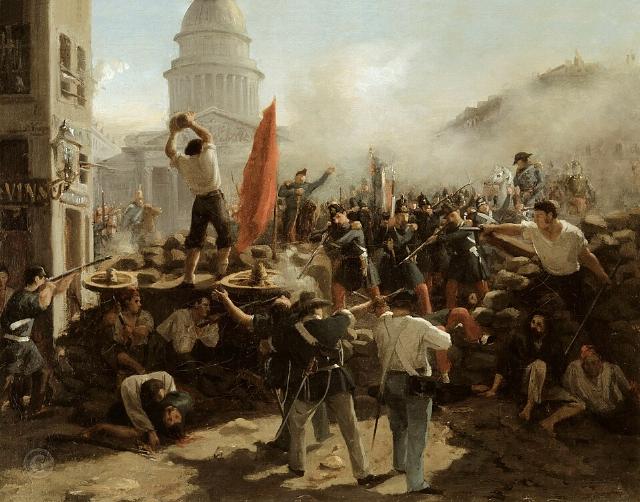
From Wikimedia Commons: On the barricades on the Rue Soufflot, Paris, 25 June 1848 (Horace Vernet, 1848–1849)
The socialist imagination has long harbored a peculiar romance with violence. Singularly vain, it presents itself as moral urgency yet reveals itself, upon scrutiny, as a compound of youthful impatience, generational arrogance, and a profound failure to grasp the fragility of both the individual and the cultural institutions that alone make civilized existence possible.
To be sure, the romance is not an accidental rhetorical excess; instead, it is a structural feature of a certain mode of thought that treats rupture as regeneration and destruction as purification. Its persistence across successive waves of radical theory constitutes less a progressive insight than a recurring moral pathology.
The pattern appears already in the early twentieth century with Georges Sorel. In Reflections on Violence (1908), Sorel distinguished the "force" of the bourgeois state from the "violence" of the proletariat, elevating the latter into a creative, purifying energy. The general strike functioned for him as myth rather than program: a mobilizing fiction capable of restoring heroic virtue to a decadent society.
What Sorel offered was less analysis than aestheticization. Violence became the solvent of corruption and the midwife of authenticity. The historical record of the century that followed—civil wars, purges, and the systematic liquidation of classes—demonstrates how readily such mythic elevation licenses practical barbarism. Sorel's distinction between force and violence proved, in practice, a license for the latter to operate without restraint.
A more celebrated version of the same logic appears in Jean-Paul Sartre's 1961 preface to Frantz Fanon's The Wretched of the Earth. Writing amid the Algerian conflict, Sartre declared that colonial violence generates its own counter-violence, and that the act of killing the oppressor simultaneously liberates the oppressed. The formulation is elegant and lethal: the physical elimination of one human being is presented as the simultaneous creation of another.
Sartre's later career only intensified the pattern. After 1968, he distanced himself from the bureaucratic French Communist Party and sought the company of younger Maoist militants, serving as nominal editor of the banned paper La Cause du Peuple and distributing its issues on the streets of Paris. In December 1974, nearly blind and already in decline, he traveled to Stammheim Prison to meet Andreas Baader of the Red Army Faction.
Although Sartre privately found Baader arrogant and publicly distanced himself from the group's methods, he continued to frame their terrorism as a reactive product of state brutality. The intellectual posture remained consistent: violence from below is explained, contextualized, and thereby absolved; violence from above is condemned without qualification.
This readiness to furnish theoretical cover for political murder was not confined to Sartre. Jean Genet, in a 1977 article in Le Monde, defended the Red Army Faction's actions as a necessary response to the "brutality" of the consumer society. Michel Foucault's analyses of disciplinary power, while more subtle, supplied a complementary vocabulary: the ordinary operations of schools, prisons, and clinics were redescribed as forms of capillary violence, so that open confrontation with the police could be interpreted as resistance to an already pervasive regime of domination.
Throughout these arguments, the same intellectual maneuver recurs. Institutional order is redefined as latent violence; therefore, visible violence against that order acquires the status of counter-violence, self-defense, or even moral hygiene.
The contemporary literary scene offers a revealing variation. Édouard Louis, in History of Violence (2016) and related writings, reconstructs the brutal attack he suffered on Christmas Eve 2012—an armed robbery and sexual assault that nearly ended in murder. Louis insists that he writes as a "writer of violence," refusing the sanitizing conventions of bourgeois literature. His project is explicitly sociological: street violence is not random criminality but the visible symptom of class exclusion, state indifference, and the quiet violence of policy decisions that erode welfare and healthcare.
Drawing on Pierre Bourdieu, Louis treats the body of the poor as the site where structural forces become flesh. The intention is diagnostic rather than celebratory. Yet the diagnostic itself participates in the larger tradition. By locating the origin of physical aggression almost exclusively in systemic deprivation, the analysis risks converting perpetrators into secondary victims and thereby softening the moral weight of their acts. The street remains a theater of structural forces; individual agency and responsibility recede. The result is less a demystification of violence than a sophisticated relocation of its causes—one that continues to treat institutional order as the primary aggressor.
The real-world consequences of this intellectual tradition are not speculative. The twentieth century supplied laboratories of unprecedented scale. The Soviet Gulag system, the Chinese laogai and Cultural Revolution reeducation campaigns, and the Khmer Rouge killing fields were not aberrations produced by uniquely evil personalities; they were the operationalization of theories that treated entire social classes as obstacles to historical progress and therefore as legitimate objects of elimination.
In each case, the language of liberation and purification accompanied the systematic destruction of individuals and of the intermediate institutions—families, churches, independent associations, legal traditions—that alone buffer the person against raw power. The body count is measured in tens of millions. To treat these outcomes as unrelated to the preceding theoretical romance with violence is an act of willful historical amnesia.
What unites these episodes is a characteristic triad of errors. First, youthful impatience: the conviction that existing arrangements are so thoroughly rotten that gradual reform is complicity and only rupture can cleanse. Second, contempt for inherited experience: the dismissal of the slow, imperfect, often unlovely accumulation of norms, procedures, and restraints that previous generations constructed precisely because they had witnessed the alternative. Third, ignorance of vulnerability: the failure to recognize how thin the membrane is that separates ordered liberty from predation, and how easily the destruction of imperfect institutions leaves the individual naked before new and more efficient predators.
The socialist imagination, in its romantic mode, treats society as a text that can be rewritten at will; it underestimates the degree to which any complex social order is an evolved rather than designed artifact, and therefore far more fragile than its critics suppose.
The moral perversion lies in the inversion of responsibility. Violence committed in the name of the future is granted an indulgence denied to the violence of the present order. The dead of the Gulag, the reeducation camps, and the Cambodian fields become historical necessities or regrettable excesses; the inconveniences of liberal democracy are treated as structural crimes requiring ever more radical remedies. This asymmetry is not the product of superior moral insight. It is the product of a theoretical apparatus that has systematically discounted the costs of its own preferred methods while amplifying the sins of every alternative.
Tragically, the pattern shows no sign of exhaustion. Each new cycle of street unrest in France or elsewhere reactivates the same vocabulary: systemic violence, legitimate counter-violence, the purifying potential of disruption. The intellectuals who supply the vocabulary rarely pay the price in blood or institutional collapse. That price is extracted from others—usually the very populations in whose name the romance is conducted.
A tradition that repeatedly fails to learn from its own corpses is not progressive. It is trapped in a destructive adolescence, forever mistaking the thrill of demolition for the work of construction, and forever surprised when the ruins prove uninhabitable.
Source link