A Not-So-Alien Idea
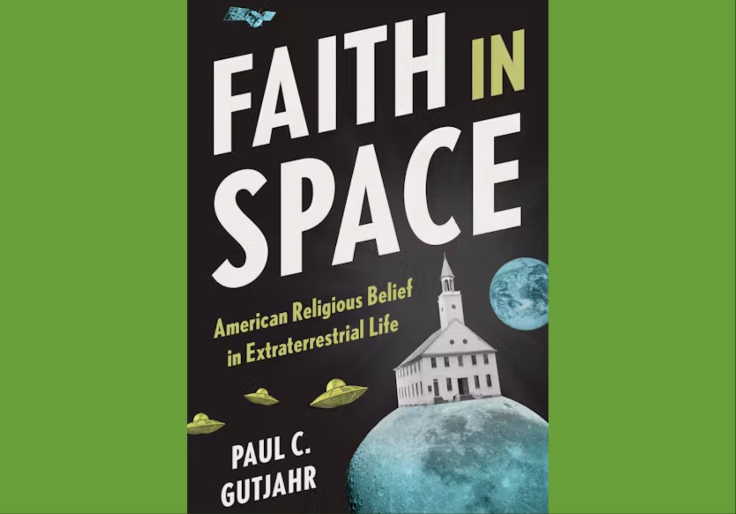
REVIEW: 'Faith in Space: American Religious Belief in Extraterrestrial Life' by Paul C. Gutjahr
Stuart Halpern"A rabbi, a priest, and an imam walk into a research program funded by NASA to talk about the intersection of God and aliens," quipped Business Insider after NASA gave more than $1 million to Princeton's Center of Theological Inquiry to study how the world's religions might respond to the discovery of extraterrestrial life. Scholars representing Christianity, Judaism, Islam, Hinduism, and Buddhism gathered to contemplate a question that seemed distinctly modern: What happens to religion if we discover Earth is not alone? But, as Indiana University's Paul Gutjahr demonstrates in Faith in Space: American Religious Belief in Extraterrestrial Life, NASA was late to the party. Americans have been thinking about aliens for a surprisingly long time.
Gutjahr's learned and engaging study includes a gallimaufry of American characters, including Puritan ministers, presidents of Yale, Benjamin Franklin, Mormon theologians, Spiritualists, Theosophists, Scientologists, and leaders of the Nation of Islam. The details of their beliefs vary considerably. But their fascination with the heavens does not.
Cotton Mather was among the first Americans to consider the possibility that other worlds might be inhabited. The 18th-century Puritan minister was an enthusiastic student of science, and in his 1721 The Christian Philosopher, he considered whether the Moon, comets, and other celestial bodies might contain life. Mather saw no conflict between such speculation and Christian faith. Quite the contrary, he believed—an inhabited universe offered another reason to marvel at the Creator. After contemplating the plurality of worlds, Mather exclaimed, "Great GOD, what a Variety of Worlds hast thou created! … How stupendous are the Displays of thy Greatness, and of thy Glory, in the Creatures, with which thou hast replenished those Worlds!"
Mather was hardly alone in suspecting we are not alone. Long before he printed his first almanac, Benjamin Franklin recorded in his diary his belief in the plurality of worlds, writing in 1728, that "the INFINITE has created many Beings or Gods … and that Each has made for himself one glorious Sun, attended with a beautiful and admirable System of Planets." Ezra Stiles, president of Yale, believed other planets contained beings capable of moral action. Timothy Dwight, another Yale president, imagined a vast multitude of worlds. Henry David Thoreau wondered about the inhabitants of distant stars. For these prominent thinkers, the universe was so immense it seemed almost presumptuous to assume God had populated only one small planet.
Thomas Paine possessed a different use for the idea. In The Age of Reason, he turned the plurality of worlds against Christianity. If God had created countless inhabited planets, Paine asked, what would that mean for the Christian doctrine of redemption? Would Christ have to be incarnated and sacrificed on every inhabited world?
The stars, it seems, could therefore provide ammunition for both religious belief and religious skepticism.
The 19th century brought still more possibilities and permutations. Spiritualism promised communication with the dead. The famous 1835 "Moon Hoax" persuaded newspaper readers that astronomers had discovered lunar inhabitants, complete with humanoid creatures, animals, and temples. The reports were fabricated, but their enormous popularity revealed a public already eager to believe the heavens might contain other forms of life.
Speculation was enhanced by technological advancements. The telegraph had made invisible communication across great distances a familiar fact. The Civil War left hundreds of thousands of Americans grieving for dead relatives. If electrical signals could traverse enormous distances without carrying a physical object, perhaps, some wistfully posited, communication between the living and the dead did not seem quite so impossible.
Mormonism, that quintessentially homegrown American faith, developed an especially elaborate cosmic theology. Joseph Smith and his followers envisioned a universe filled with worlds and intelligences, with human existence forming part of a larger drama of eternal progression. Around the same time, Theosophists, led by their founder, the Russian Helena Blavatsky, constructed their own spiritual hierarchies. Transcendentalists contemplated humanity's place amid the immensity of creation.
By the 20th century, extraterrestrial speculation had moved into still more unconventional religious territory.
L. Ron Hubbard's Scientology placed humanity within an intergalactic history involving the Galactic Federation and the extraterrestrial ruler Xenu. The late 20th-century UFO phenomenon gave these as-old-as-America questions a new vocabulary. The atomic bomb, the Cold War, rockets, airplanes, and the space race all changed Americans' sense of human power and vulnerability. Extraterrestrials came to represent an advanced civilization that might save humanity, or an incomprehensible force that might destroy it.
The Nation of Islam developed an extraterrestrial cosmology centered in part on the enormous Mother Plane. Louis Farrakhan later incorporated UFO experiences into his religious worldview and encouraged his followers to engage with Scientology.
Extraterrestrial beings, it turns out, make strange bedfellows.
Sometimes, the belief in aliens caused us to destroy ourselves. Case in point being Heaven's Gate. In 1997, members of the cult committed mass suicide because they believed a spacecraft associated with the Hale-Bopp comet would transport them to another level of existence.
Gutjahr's argument is, ultimately, that all this is less surprising than at first glance. After all, speculating about nonhumans is an invitation to ask ourselves distinctly human questions like why are we here? Why do we suffer? Is humanity special? Where did we come from? And where, ultimately, are we going?
"Perhaps most importantly," Gutjahr writes, faith in life beyond Earth "teach[es] us that the path toward enlightenment and salvation is intimately tied to a greater cosmic whole." The book traces an idea that has appeared among respectable pulpits, philosophical treatises, Founding Fathers, popular newspapers, university presidents, new religious movements, and the curious minds of UFO kooks. The line from Cotton Mather to a late 20th century cult, in other words, is a strikingly short one.
For three centuries, then, Americans have looked toward the heavens and asked whether someone—or something—is looking back. In many cases, the query was never really about the aliens, but about why we are here.
Faith in Space: American Religious Belief in Extraterrestrial Life
by Paul C. Gutjahr
Princeton University Press, 368 pp., $35
Stuart Halpern, senior adviser to the provost and deputy director of the Straus Center for Torah and Western Thought at Yeshiva University, is the author, with Wilfred M. McClay, of Jewish Roots of American Liberty: The Impact of Hebraic Ideas on the American Story (Encounter).
Source link